Harold Webster Smith is standing on somebody else’s front steps, holding his hat. In the photograph, the house has shutters, a small porch and a narrow metal railing. Smith, on the right, is delivering his bank’s first mortgage check to Joe Baltrush. It is December 1935. The bank is about two months old. Its founder is twenty-four.
A banking history might ordinarily begin with a charter, a boardroom or a formidable pile of money. This one offers a doorstep. It is a useful place to start, because the distance between a financial institution and the person using it is unusually easy to see. There is barely room for two men on the landing. The transaction has an address, and the founder has come to it.
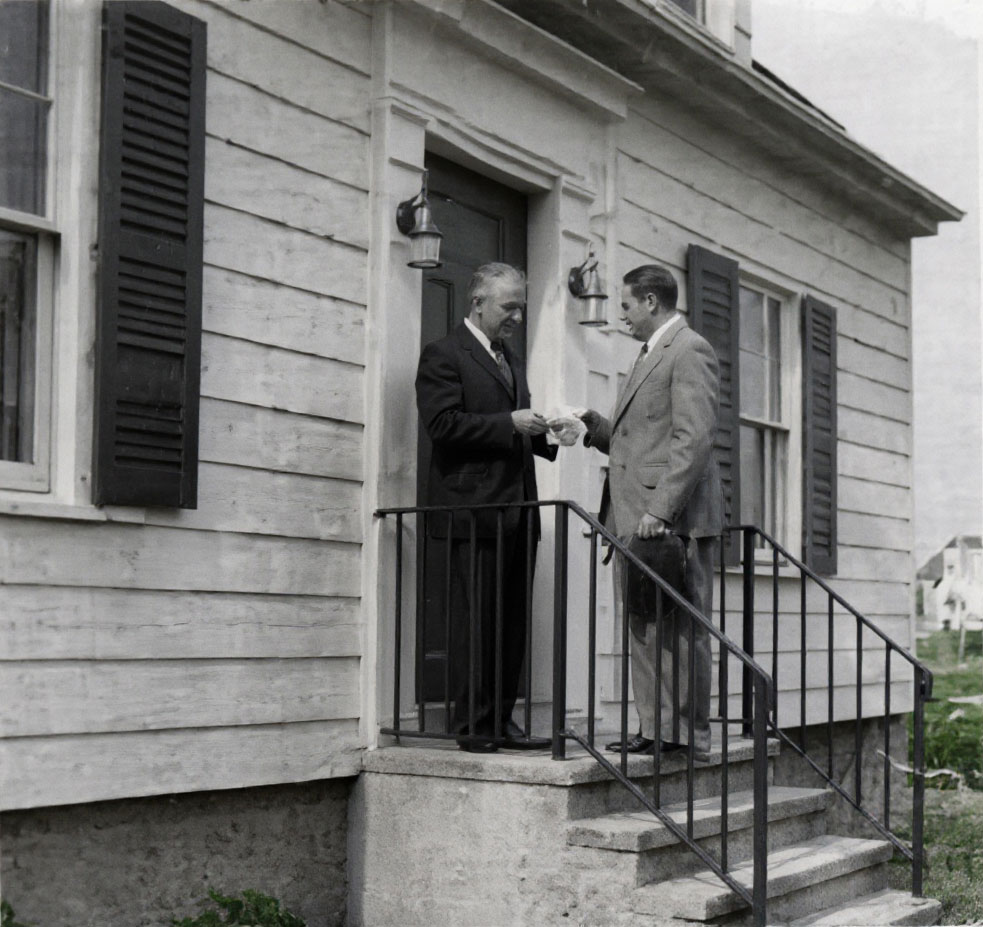
Smith opened First Federal Savings and Loan Association of Waterbury on October 11, 1935, with $25,000 raised from friends and family. He wanted people in his community to be able to buy and build homes during the Great Depression. There is an appealing mismatch between the size of that ambition and the size of the operation. A bank needs customers to believe it will still be there tomorrow. Smith was asking them to begin believing at a particularly difficult moment.
The office had room for an idea
The original office measured eleven feet by thirty-eight feet. That is 418 square feet, by simple multiplication: enough to give the institution a location, without giving its founder much opportunity to get lost. People around the city came to call the operation “Harold’s Bank.” A personal nickname is rather convenient when the official name requires most of a breath.
There was a more literal reason for the association. Smith was the only employee during the first year. The usual distinction between the founder and the organization was, for the moment, largely a matter of stationery. For a customer, meeting the bank meant meeting Harold.
The last $500 needed to complete his initial fundraising came from his mother, Margaret. His son Jim later recalled that the office’s downtown location mattered much more to his father than its lack of grandeur. Those details put some welcome proportions around the founding story. This was a young person assembling support, accepting a modest room and insisting on being in the place he wanted to serve.
Born in Waterbury on July 23, 1911, Smith graduated from Crosby High School in 1928. He was a champion swimmer and tennis player there. Dartmouth followed, with a cum laude graduation in 1933 and postgraduate study at its Tuck School of Business. Before returning to start the thrift, he worked for the U.S. Treasury Department.
That route gave the young founder an education beyond the room in Waterbury. Yet the destination remained his hometown. His career began to take its distinctive shape when he brought his training back to a specific set of neighbors. A house purchase could be an economic abstraction in Washington; on a front step, it acquired shutters and a railing.
Permission to lend, discipline to wait
First Federal was part of a broader experiment in restoring housing finance. The federal government was encouraging savings and loan associations as a way to make home construction and mortgage borrowing more accessible. Smith’s undertaking belonged to that public effort as well as to his own family’s willingness to back him. The local founder and the national framework needed each other.
The business grew to $1 million in assets by 1938. In subsequent years it offered GI and FHA loans, bringing government-backed lending programs into its work with homeowners. There is a practical continuity here: the founding purpose could develop through new kinds of loans, rather than requiring an entirely new reason for the bank to exist.
Still, the chronology refuses to hurry for the reader’s benefit. The first branch opened in Watertown in 1959. A second followed ten years later. Set beside the 1935 opening, those dates make an unusually patient business story. Anyone hoping for a new office in every chapter will have to admire the restraint.
Patience alone, of course, does not explain a bank. Lending requires decisions about what can be repaid, what can be afforded and what happens when circumstances change. The founder who took the conspicuous risk of opening in a depression also built a career around controlling risk. The two impulses had to coexist at the same desk.
“Never take a risk you can’t afford.”
One of Harold’s rules, recalled by his son James C. Smith
That rule leaves room for action. It also puts a limit on the pleasure of acting. A lender can help a customer only while remaining able to keep its own promises. Read alongside the slow arrival of branches, the maxim gives Smith’s career a recognizable rhythm: willingness at the beginning, calculation throughout.
Fifty-two years, then a second chief executive
By the mid-1980s, the institution was preparing for a different scale. In 1986 it converted to stock ownership and formed Webster Financial Corporation. The holding company’s name honored the founder. Outside capital and a new corporate structure opened another chapter for a business that had begun with family and friends.
In 1987 Smith retired as chief executive after fifty-two years. His son James C. Smith succeeded him. Harold remained chairman until 1995. Those two dates matter separately: giving up the daily operating job and leaving the chairmanship were different events, eight years apart. The succession allowed a long overlap between the founder’s experience and his successor’s authority.
Jim had joined the business in 1975. He became president in 1982, before taking the chief executive role. His father’s tenure was long enough to give succession a substantial apprenticeship. When a business has spent decades identified with one person, changing the person at the top is a test of whether the organization has learned to work without that particular pair of hands.
The bank’s 1995 annual report shows how far the work had spread. At year-end, it served 275,000 customers from sixty-four Connecticut banking offices and reported $3.2 billion in assets. It organized its work around consumer, business and mortgage banking. The institution had acquired additional banks, and it needed an identity that could accommodate those combined operations.
Webster became the bank’s name in 1995. The choice gave Harold’s middle name a public life of its own. “Harold’s Bank” had been the neighborhood shorthand; Webster could travel. There is a pleasing economy to that solution. A corporate naming exercise ended up somewhere in the middle of the founder’s birth certificate.
The inheritance had to work
Harold died on October 24, 1997. The next year, Webster announced the foundation bearing his name. Its purpose extended the founder’s connection to community investment, including housing. A memorial can be a fixed object. This one would have budgets, partners and decisions about where money could do useful work.
His influence also faced a less ceremonial test. In a 2012 letter to banking regulators, Webster described modifying mortgages with balances totaling more than $200 million since 2008. The changes had kept more than 1,200 families in their homes and saved participating homeowners an average of more than $300 a month. These were actions taken after Harold’s lifetime, by the organization he had started.
The distinction matters. A founder cannot claim every later decision, and successors deserve their own credit. But the bank’s original purpose gives those later numbers a particular resonance. Helping someone obtain a house and helping someone remain in one are related problems, encountered in different economic weather. The continuity becomes visible in the work.
Jim spoke in 2012 about the principles his father had established, and about adopting them as formal values when the bank was renamed in 1995. In the same interview, he described cutting the dividend during the recession while maintaining charitable contributions. Whatever the difficulty of making that choice, it gave the language of community obligation a place in the accounts.
The steps are still there in the story
In 2016, the first-loan photograph acquired a sequel. Jim returned to the same Waterbury house with Peter Baltrush, Joe’s grandson. He presented a framed copy of the old image. Peter remembered playing in the house as a child; another family owned it by then. Banking history had managed to produce a family photograph for two families.
Smith’s name continues elsewhere in Waterbury, too. The regional chamber’s Harold Webster Smith Awards recognize entrepreneurs, small businesses and manufacturers. The categories suit a founder whose own institution began as a small local enterprise. They turn remembrance toward people still trying to establish something of their own.
In February 2026, Jim, as chairman of the Harold Webster Smith Foundation, supported proposed funding for the Waterbury Land Bank in Connecticut legislative testimony. The foundation had been its inaugural funder. The objective was to return distressed properties to productive use and strengthen neighborhoods. Decades after that first mortgage, housing remained an active concern attached to Harold’s name.
Webster marked its ninetieth anniversary in October 2025. For an institution of that age, the temptation is to tell the story entirely through accumulated size. The doorstep photograph makes a useful correction to the camera angle. There is a customer, a founder, a check and a house. Smith’s wager becomes easiest to understand at that scale: a bank would have a future if it could help its neighbors build theirs.