Consider an envelope addressed to you. The name is correct. The offer looks plausible. The color belongs to a company you recognize. You open it without thinking about the database, the printing press, or the machine that tucked the contents inside. Jetson Specialty Marketing Services works in that unexamined space. Its business begins with a deceptively difficult assignment: make an industrial process behave as though it were paying attention to one person.
- JSM combines customer data, personalized print, mail production, and postal preparation.
- It handles both acquisition campaigns and sensitive account or compliance communications.
- Its practical proposition: one team responsible across the production sequence.
Known as JSM, the privately held company serves brands and agencies with direct marketing and customer communications. Finance, healthcare, insurance, telecommunications, utilities, nonprofits, and retail appear among its target industries. These organizations have different reasons to send a letter. A donation appeal invites a response. A collections notice records an obligation. Both depend on details that are easy to overlook until they go wrong.
A blue worth buying a press for
In September 2016, Komori announced that JSM had purchased a SCREEN Truepress Jet520HD, a high-definition inkjet web press. The revealing part of the announcement was the explanation from Don Remley, then its executive vice president of business development. He talked about reproducing a customer’s exact color, every time. That is a wonderfully specific concern for a company selling marketing services.
“We are stewards for our customers’ brands”
Don Remley · 2016 equipment announcement
The press could produce detail at 1,200 by 1,200 dots per inch while handling variable information and high-resolution images. The attraction was consistency alongside variation: keep the brand recognizable while changing the content for different recipients. A logo stays familiar; the message can move. JSM’s investment makes sense once you see that those two requirements have to coexist on the same sheet.
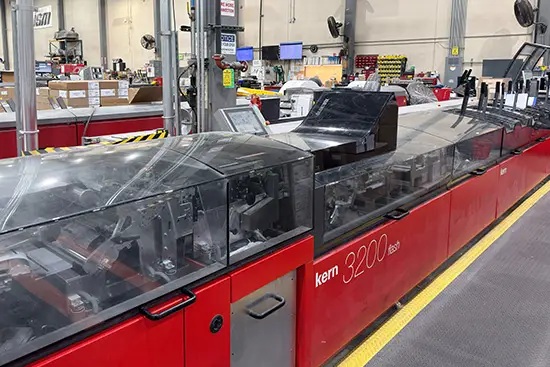
The machinery kept evolving. In its 2025 magazine, inserting-system supplier Kern reported that JSM had installed the first Kern 3200 in the United States. Printing puts information on paper; inserting gets the right components into an envelope. In this business, the machine after the press deserves attention, too.
The envelope has a chain of custody
JSM’s critical communications work makes the stakes clearer. Its service covers regulatory mailings, balance transfers, collections, account management, and recall or breach notices. Here, a successful job requires more than an appealing piece of print. The content must belong to its recipient, and the sender needs an account of what happened.
The company describes digital verification and reconciliation intended to check that required pieces are produced, personalized correctly, and mailed once. Approved templates keep language consistent. Postal tracking, automated data exchange, and role-specific reporting make the job visible to the people responsible for it. These are useful capabilities for an organization whose legal and operations teams need the same mailing to answer different questions.
- 01Prepare
the data - 02Personalize
the print - 03Assemble
& verify - 04Prepare
the mail - 05Track &
reconcile
JSM reports PCI Level 1 status and describes encrypted data handling, round-the-clock facility monitoring, and audit trails. Security is part of the production proposition. A buyer evaluating sensitive mail should examine the actual controls and their scope alongside print samples. A handsome letter tells you something about the press. It tells you much less about how the customer file was handled.
The cost hiding between suppliers
The commercial model is a business buying services for a campaign or an ongoing communication program. Agencies can also use JSM through white-label or co-branded arrangements. The agency keeps its client relationship while adding production or fulfillment capability. JSM occupies the space where marketing plans meet the equipment, data preparation, and postal work needed to execute them.
Its integrated approach gives buyers something concrete to compare with coordinating separate specialists. Every transfer introduces another brief, another schedule, another place to resolve a mismatch. JSM proposes keeping those steps together. That can be valuable when production, security, and timing matter simultaneously, although integration alone cannot establish that a campaign will earn a better return.
Cost also lives inside the mailing itself. JSM offers address hygiene, change-of-address processing, suppression, segmentation, presort, and commingling. The practical logic is straightforward: examine who should receive the message and how it enters the postal system before paying to manufacture and send it. Buyers should evaluate those services with production and postage in the same conversation.
JSM advertises production in as little as 48 hours after final file approval. That is a production claim, not a delivery promise.
A factory with a flag wall
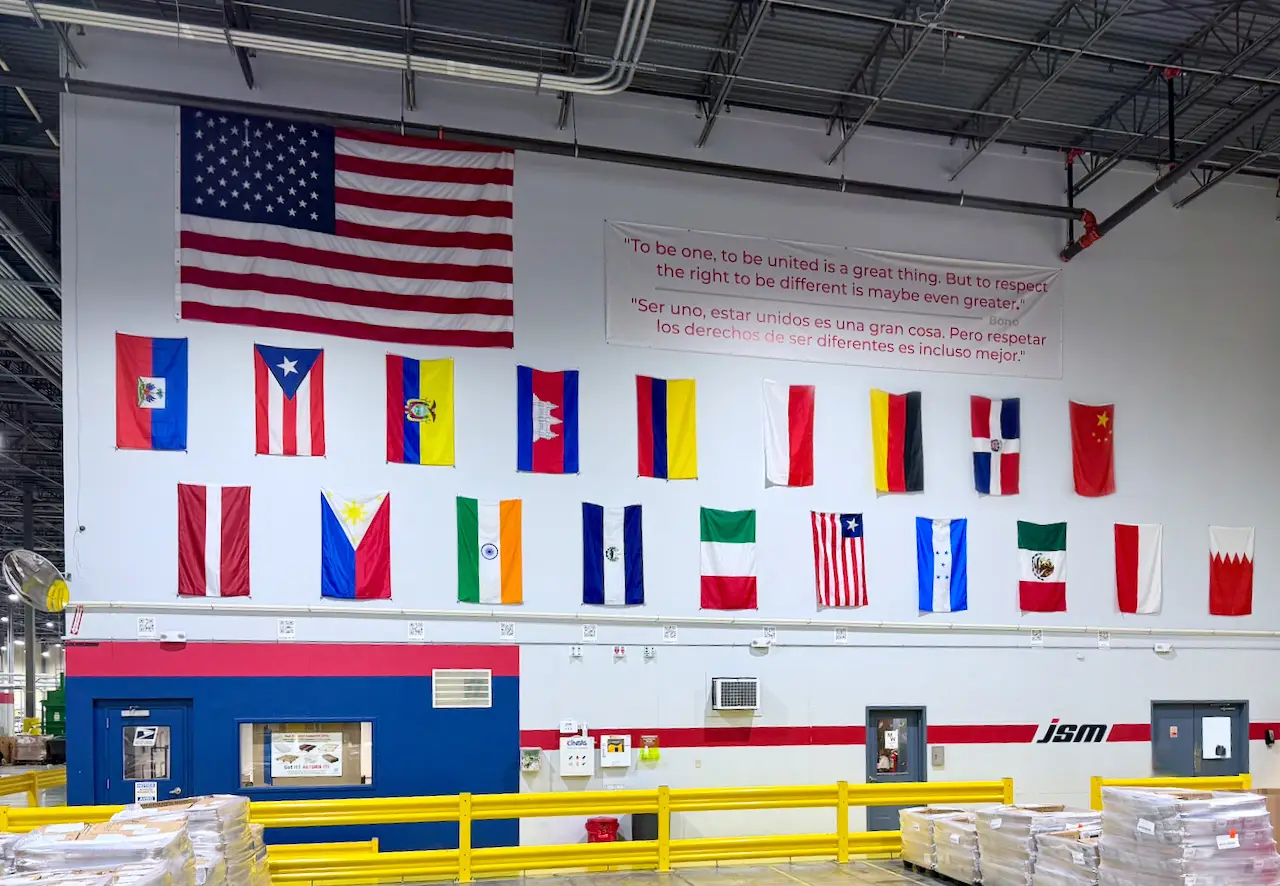
Automation has a human setting. JSM’s culture page shows a factory wall hung with national flags and a bilingual message about respecting differences. The company describes English as a Second Language classes, monthly luncheons, performance bonuses, and a children’s holiday party. These details give its stated commitment to inclusion a more tangible shape than a list of corporate adjectives.
The family-business history needs two clocks. JSM’s company profile lists 2011 as its founding year. Its broader Jetson history spans earlier generations; Kern traces those roots to a garage in the 1950s. The distinction matters. The present company and the accumulated experience behind it are related stories with different starting points.
Follow the handoffs
JSM also coordinates mail with digital advertising, using a shared audience across channels. Its marketing offer includes research, creative testing, modeling, and reporting. The company’s place in the market extends beyond printing whatever file arrives. It offers help deciding who receives the message, making it, delivering it, and examining the response.
The useful lesson travels beyond direct mail: follow the handoffs. Who approved the input? Who checks the output? Who can explain the exception? An exclusively digital campaign has little need for envelope machinery, and a postal campaign needs time for physical transit. For a buyer whose message belongs on paper, however, these questions make a better purchasing brief. The envelope looks simple because someone has done the complicated work before it reaches you.