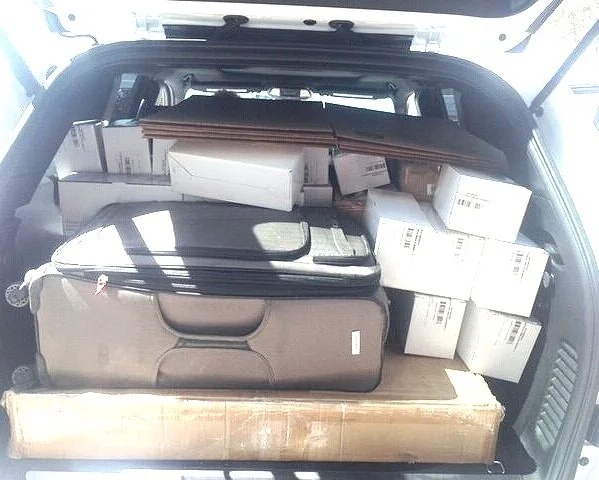
Jessica Sturzenegger had a car full of samples and a request that could fit on a card. She wanted Whole Foods managers to put their support for Amara in writing. If the buyer agreed to stock it, would they back the brand? She drove from store to store in California, collecting signatures. One manager surveyed the proposal and called it cute. She felt embarrassed. He signed.
There are grander ways to describe the beginning of a business. This one has the advantage of showing the work. A buyer was somewhere ahead. A manager was standing in front of her. She needed to give that manager something specific to say yes to, then carry the evidence into the next conversation. The car was doing the job of a distribution center, with considerably less room for a forklift.
Years later, as founder and CEO of Amara Organic Foods, Sturzenegger would be discussing national retail and financing. The cards remain a useful introduction to her. She was prepared to make an awkward request, collect a modest answer and go to the next store. A business could accumulate that way, one small permission at a time.
Before the baby aisle, a wider world
Sturzenegger was born in Switzerland and grew up largely in the United States. Her family spoke French, and her mother cooked meals from scratch. She had wanted to be a chef. Food was something prepared and shared, rather than merely acquired in a wrapper on the way to somewhere else.
College complicated that arrangement. At Bucknell, bagels became a conspicuous part of her diet. The distance between a family kitchen and a student schedule gave her a practical question to carry around: what happens to the food people want when they no longer have time to make it? Busy students were among the first people she imagined developing products for.
Her degree pointed in several directions. She graduated in 2010 with majors in economics and international relations, and minors in Arabic and Spanish. She co-founded Bucknell’s Microfinance Initiative, participated in student government and studied abroad in Egypt and Chile. A senior independent study examined entrepreneurship in emerging markets. Before she was trying to sell food, she was interested in how people built enterprises and what those enterprises could change.
“Ideas are a dime a dozen”
Jessica Sturzenegger
That academic preparation would later have a practical use. Analysis and the confidence to lead mattered to her account of building Amara. An idea could be interesting for a long time without becoming a product. Eventually somebody had to decide what to do with it on Monday.
Chile made the question practical
After graduation came a Princeton in Latin America fellowship with Mujeres Empresarias in Chile. Her 2010-2011 fellowship biography described an interest in business, international affairs and languages. Working with entrepreneurs put those subjects into the same room. The next move took her across the table, from learning about other people’s ventures to helping start one.
By early 2012, Sturzenegger and two friends had received Start-Up Chile seed capital for a baby-food venture with ambitions beyond Patagonia. The accelerator offered equity-free funding, a temporary visa and access to business networks. There was a place to work on the idea, and a framework that expected the work to happen.
It is an earlier chapter than the familiar 2017 retail launch. Between the two sits a distinction that matters in her story: deciding to pursue a food business and getting a finished product onto a shelf are separate achievements. An accelerator can help someone begin. It cannot do all the manufacturing, explaining and persuading that follow.
The useful thing about taking something away
Amara’s founding team included Sturzenegger, Cristian Boada and chef Vicki Johnson. The original proposition required a little explanation: fruits, vegetables and other ingredients could become a dry, shelf-stable meal, with liquid added before serving. Removing water changed how the food could be stored and carried. A parent could choose how much liquid to mix in.
Sturzenegger’s ambition was expressed in a domestic comparison. “We want to be the first choice after homemade for Moms.” Homemade gave people a reference they understood. The machinery behind the product could be complicated; the desired place in a kitchen was easier to picture. Amara was asking to become the packet someone reached for when cooking from scratch would not fit the day.
The products debuted at Whole Foods in 2017 after three years of development. The elapsed time is part of the product’s biography. There were specialists to work with and a process to establish before the packaging could do any selling. The company that shoppers encountered in the baby aisle had already spent years existing as a problem its team was trying to solve.
There was a commercial consequence to removing water, too. Less water meant less weight to ship. It is a pleasantly literal business detail: something absent from a recipe could also be absent from a delivery bill. A small packet could carry an argument about convenience without requiring the customer to take an interest in freight.
A company learns to speak
Developing a product and explaining it ask different things of a founder. Sturzenegger has described herself as quiet and reserved. She had to learn storytelling, and hired a coach to help. Her interest in technical details did not automatically make those details interesting to a person deciding what to buy.
Early Amara had plenty to explain. The dry format needed a demonstration; the business needed language a shopper could use without becoming an expert. A customer should be able to repeat the idea to another customer. Every additional technical term gave that second conversation another chance to stall.
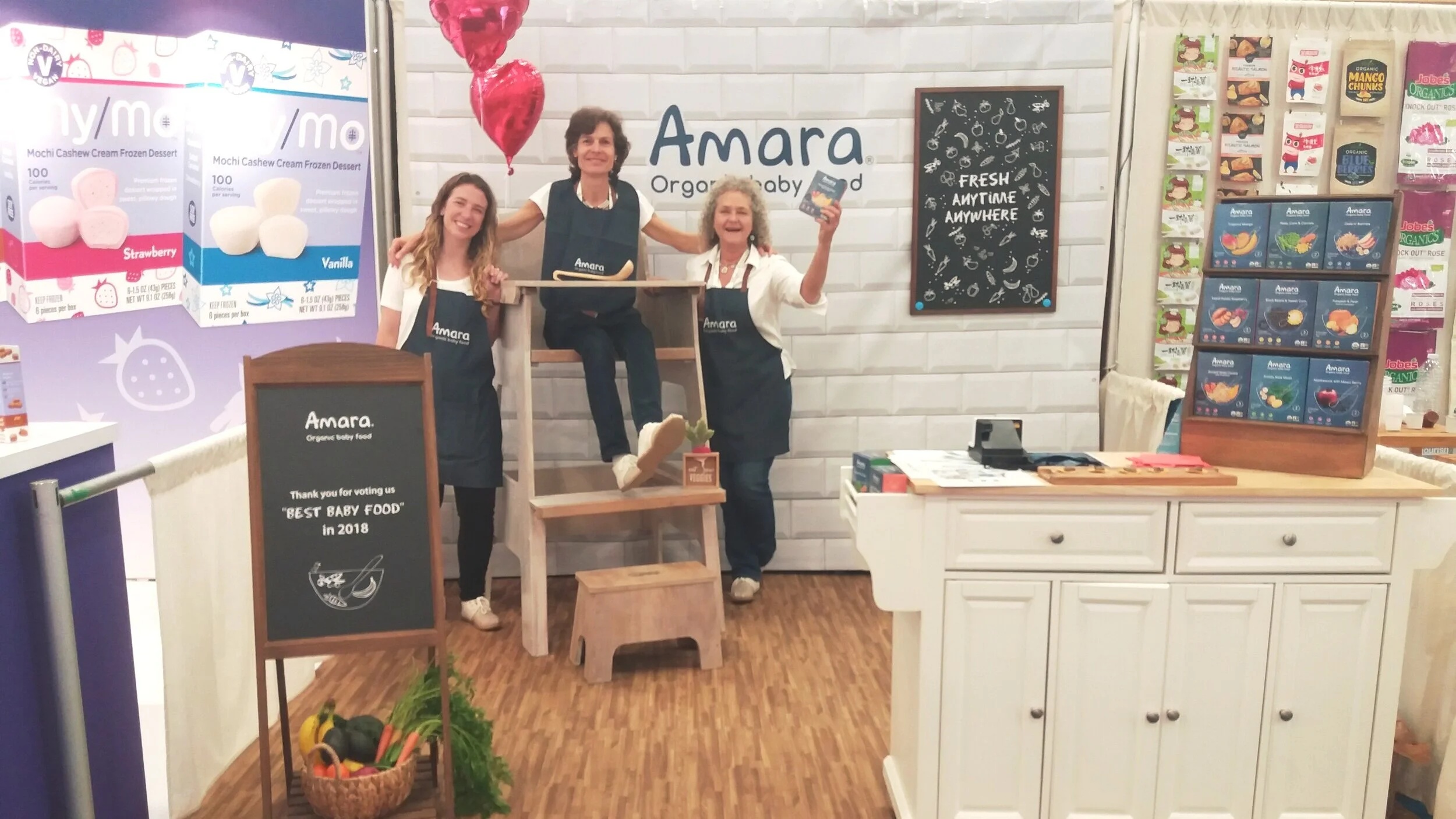
The company also made room for a less verbal introduction. At a 2019 trade show, its team brought an oversized high chair for people to pose in. A booth selling baby food had found a prop that required almost no explanation. The photograph shows Sturzenegger with colleagues beside the chair, surrounded by the signs, packets and furniture of a company asking strangers to stop for a moment.
The chair was a joke with a job. Trade shows contain many earnest people standing beneath earnest signs. Giving visitors something amusing to do created an opening for the more serious conversation. It also left behind a picture with a little life in it, rather than another row of people holding a product at chest height.
The work after the announcement
In 2020, Amara raised approximately $2 million in seed funding. The company had expanded its distribution, and production needed to catch up. For Sturzenegger, investment was tied to a practical constraint: there were more places the food could go than the small business could comfortably supply.
By March 2024, the financing announcement was a $20 million Series B led by HumanCo Investments, with Melitas Venture Capital and Touch Capital among the other investors. Sturzenegger described plans for broader distribution, more production and additional product lines. Each item on that list would create work well beyond the day the announcement appeared.
Series B financing led by HumanCo Investments
She talked about forecasting, communication with suppliers and the contribution of everyone involved in getting the product delivered. Growth depended on coordination. A forecast needed to be compared with actual sales. Suppliers needed to know what was coming. People who might never appear in a company photograph still affected the experience of buying its food.
Public recognition followed. Amara ranked No. 44 on the 2024 Inc. 5000. Sturzenegger appeared on the 2025 Female Founders 500 list, recognized for the business’s revenue growth and two new product lines. In June 2026, she became an EY Entrepreneur Of The Year Greater Philadelphia Award winner. The regional distinction joined a career whose earlier documents had been a fellowship biography and an accelerator update.
The awards give the story dates to circle. They also make it possible to see how long some of the intervals were. A venture reported in 2012, a retail debut in 2017, a larger financing in 2024: there was plenty of ordinary working time between the milestones.
Some distance from the desk
Sturzenegger has an unusually decisive way of getting away from work: freediving. She has described it as a way to switch off when doing so on land is difficult. By 2025, diving was more often something she traveled to do than something easily fitted into a workweek. The business had grown into time she once had available.
Back at Amara, the audience had grown as well. By October 2026, the range included baby food, smoothie melts, fruit bites and breakfast oat melts, with distribution across national retailers. Her conversation that month covered consumer feedback, sourcing, experienced teams and the changing role of a CEO. The company was serving children from zero to seven and thinking about the occasions on which families would use its products.
That is a larger set of questions than the one on the original card. It still requires attention to what another person will actually agree to do: try a packet, stock a shelf, place another order. The early store visits gave Sturzenegger a version of the job small enough to carry in a car. Its scale has changed. The next conversation still has to happen.
Follow the conversation
Explore Amara and hear Sturzenegger discuss the work in her own words.