Jessica Kirk has spent much of her career selling order to people living with complexity. The products have changed: supply-chain systems, analytics that inspect employee spending, software for the argument formerly known as “the office,” and now the digital machinery behind salons and spas. The recurring assignment is less glamorous than a launch party and more useful than a slogan. Find the human problem inside the system. Give it a shape. Make that shape memorable enough to travel.
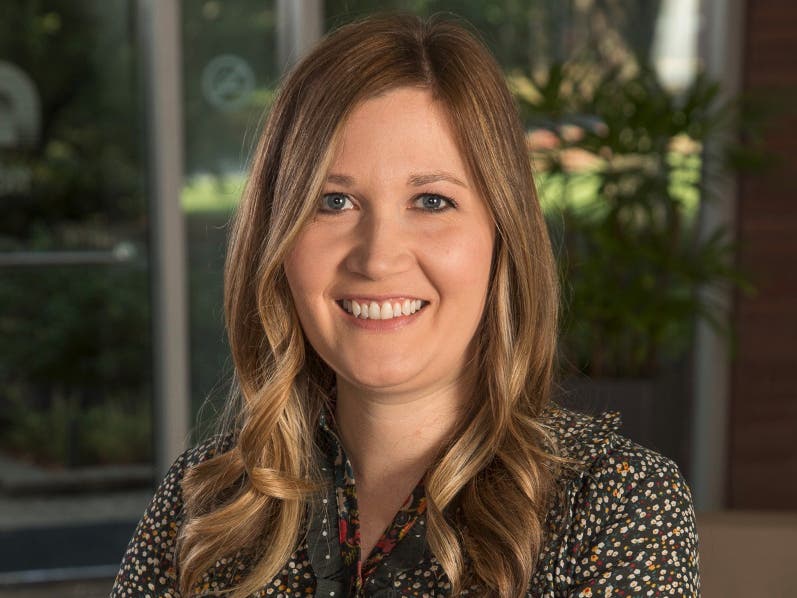
In February 2025, Kirk became chief marketing officer at Millennium Systems International, the company behind Meevo. From Atlanta, she joined a business founded in 1987 and built around the operational details of beauty businesses. Meevo says more than 150,000 users log in each day. Its software manages the sort of things that look like menu items on a product page but feel like Tuesday afternoon to an owner: appointments, payments, inventory, staff, client communication and the delicate art of getting someone to come back.
That is a striking place for a B2B marketer to land. Enterprise software often lives behind a curtain. Beauty businesses do not have much curtain. Their work is performed in conversation, at close range, on a clock. A late appointment ripples through a day. A missed message becomes an empty chair. A clumsy checkout can flatten the grace of everything that preceded it. The software is infrastructure, but the experience is personal.
Translate a broad operating platform into the small, recognizable wins that make a beauty business run better.
First, make the mess nameable
The clearest example of Kirk's method came at OfficeSpace Software, where she was appointed CMO in 2021. The timing was almost comically difficult. Employers, workers, property teams and pundits were all debating the return to offices, often using the same handful of phrases until they had been polished smooth. Every workplace vendor wanted a place in the conversation. The conversation had become a crowded elevator, and everyone was pressing the button for thought leadership.
OfficeSpace and its communications partner chose to organize the uncertainty. They described four ways companies were approaching hybrid work: Traditionalist, Architect, Nomad and Pioneer. The labels gave business leaders a compact way to recognize their own policies. The team then supported that frame with original Harris Poll research about what workers expected and what employers planned.
“Return to the office was the top topic in the press during the pandemic, and it was a challenge to stand out amongst an endless set of competitors.”Jessica Kirk, then CMO of OfficeSpace Software
The important word in that quote is not “competitors.” It is “stand out.” Many marketing teams hear that phrase and reach for volume. Kirk's team reached for structure. Four models turned a sprawling argument into a quiz a decision-maker could take in their head. Original research added weight. The company could participate in the news without merely repeating it.
Then came the less romantic part: the numbers. The program secured more than 1,400 media placements and nearly 185 million in audience reach. It produced 181 leads and 165 demo requests. Fifty-six became opportunities; seven became closed deals carrying $140,000 in annual recurring revenue. The ratio from demos to leads looks almost suspiciously tidy, but the reported figures are precise. Attention entered one end. Revenue came out the other.
Those results do not make a universal formula. They do reveal a habit: connect the idea to the commercial outcome. Kirk described the campaign's “big idea” as a foundation for both marketing and sales strategy. That is the operator's version of creativity. It has to survive contact with another department.
A career built near the machinery
Kirk's route to that campaign began well below the CMO line on an org chart. She attended the University of North Carolina at Charlotte from 2003 to 2007 and earned a bachelor's degree. By 2012 she was managing marketing programs at RedPrairie, a supply-chain software company. A public recommendation from a colleague remembers her joining the RedShift 2012 team only a few months before the event, locating the gaps, solving problems and staying calm in a crisis. The work was strong enough to lead to a promotion.
It is a small story, and therefore a revealing one. Executive biographies tend to sand careers into polished blocks: strategy, growth, leadership. Events are where those nouns have to wear shoes. A badge printer fails. A speaker changes a deck. Someone discovers the room has the wrong capacity. Remaining calm is not a personality garnish; it is production infrastructure.
In 2013, Kirk moved to Oversight Systems as director of marketing and later served as vice president of marketing. Oversight's product used analytics to examine corporate spending for risk, errors and policy violations. It was another complicated system with a practical promise: help finance teams notice what ordinary review misses. In 2019, when Kirk was VP of Marketing, the Technology Association of Georgia named her a finalist for Marketing Executive of the Year and placed Oversight's Finance Tour among the campaign finalists. Her profile also records a Silver Telly award that year for general non-broadcast work.
Marketing programs at RedPrairie, including RedShift 2012.
Joined Oversight Systems, eventually becoming VP of Marketing.
TAG finalist recognition for executive and campaign work; Silver Telly award.
Appointed CMO of OfficeSpace Software, leading global marketing.
Joined Millennium Systems International as CMO.
OfficeSpace followed in 2021. Kirk's remit covered global marketing operations, growth, brand recognition, differentiation, messaging and market presence. That job description is broad enough to swallow a calendar. Yet the campaign that best represents her time there remained admirably specific: four models, a body of research and a measurable path to sales.
The categories across this career seem unrelated until you view them from the customer's chair. A supply-chain manager, a finance leader, a workplace planner and a salon owner all face some version of the same indignity: the day produces more operational detail than any person can gracefully hold. Software promises to carry some of that weight. Marketing has to explain which weight, why it matters and what the day looks like after it is lifted.
The salon is not a spreadsheet
At Meevo, Kirk's abstraction problem is now paired with an unusually sensory industry. Salons and spas are made of texture, timing, memory and trust. Their management software still has to count things. It has to organize clients, schedules, inventory, loyalty programs, messages and money. But the owner does not experience these as database fields. The owner experiences a regular client getting their preferred time, a staff member seeing a clean schedule, or a front desk ending the day without a reconciliation mystery.
This makes customer connection more than a pleasant phrase in Kirk's appointment announcement. Meevo serves businesses from solo practitioners to franchises in more than 36 countries. One message has to meet people operating at radically different scales without making the independent owner feel miniature or the multi-location group feel underserved. Comprehensiveness is useful in a platform and dangerous in a paragraph.
Kirk's public activity offers a glimpse of where the messaging is heading. She has highlighted the nuisance of owners manually pulling data together across exports and spreadsheets. She has thanked the colleague who made partner integrations possible. Both gestures point toward the same promise: software should reduce the chores between a business and its decisions.
The customer does not wake up wanting a platform. They wake up wanting the day to work.
The sentence is an observation, not one of Kirk's published quotes, but her record supports the principle. At OfficeSpace, she used the market's own uncertainty as the raw material for a clearer story. At Oversight, the story was about finding risk buried in transactions. At Meevo, it is about seeing the business through the daily blur of bookings, payments and relationships. Each begins with a system. Each becomes persuasive only when it returns to a person.
Serious metrics, human edges
Meevo's leadership page refuses the usual parade of executive adjectives. Beside Kirk's title, it lists a wine collector with sommelier dreams, a proud soccer and lacrosse mom, and a food-obsessed traveler. It is a compact character sketch, and unusually appropriate for a marketer whose work is translation. Wine asks for vocabulary around sensation. Youth sports teach the choreography of calendars. Food-minded travel begins with the belief that a place can be understood through what people make and share.
None of this proves a marketing philosophy, and it should not be forced to. It does make the operator behind the metrics easier to see. So do the words former colleagues use: bright, professional, hard-working, creative, results-driven and calm. Kirk has also been a member of Atlanta's Technology Executives Roundtable since February 2024, joining peers who discuss the less photogenic subjects of company building, from alliances and financing to intellectual property and growth.
The interesting tension in her career is between scale and closeness. Meevo's systems process billions of dollars in transactions each year. Yet each transaction belongs to a visit, each visit to a client, and each client to a relationship a local business hopes to keep. Numbers are the proof. People are the plot.
Kirk's work suggests that a useful marketer keeps both in view. Give the complexity a name. Bring evidence. Build a frame that sales can carry and customers can recognize. Then measure whether anyone moved. There is wit in the economy of it: the grand business of brand building, reduced to making the next choice clearer.
Her latest chapter is still being written. The appointment at Millennium Systems International is recent compared with the long stretch at Oversight or the years at OfficeSpace. But the brief already fits the pattern. Beauty-business software may manage thousands of details. Kirk's job is to keep those details from becoming the story. The story is the owner who gets an hour back, the team that knows what happens next, and the client whose experience feels effortless because a great deal of machinery behaved itself.