Jeremy Roche spent years making a rather substantial commute. After FinancialForce moved its headquarters to San Francisco in 2012, he travelled there monthly from Harrogate, England. The London-to-San Francisco flight took about eleven hours. For a business built on the convenience of the cloud, its chief executive still spent a remarkable amount of time getting from one place to another.
By January 2017, that journey was changing. Tod Nielsen was taking over as FinancialForce’s president and CEO. Roche was becoming chief product officer at Unit4, whose Utrecht headquarters could be reached on a much shorter flight. The company he had helped create was approaching a $100 million annual revenue run rate. He would remain its founder and special adviser.
There is a neat temptation to tell this story entirely in numbers. Roche’s career becomes more interesting when you follow the less tidy connections: between the salesperson and the accountant, between a British software business and a Californian platform, between building a company and deciding how to let someone else lead it.
A long preface to a cloud company
Roche graduated from Thames Polytechnic with a business studies degree in 1987. His early career included IBM, then Lychgate UK, where he worked in systems engineering and sales. In 1990 he joined Science Systems as commercial director. The route crossed technical and commercial work well before he became associated with online accounting.
Science Systems acquired CODA in March 2000. Roche took responsibility for product strategy and research and development, and later became CODA’s chief executive. He helped lead its international expansion and the demerger that returned CODA to an independent listing on London’s AIM market. In 2005, he also helped establish the European Software Association and served as chairman.
That background matters to the FinancialForce story. Roche had spent years around established business applications before starting a cloud company. He knew the work accounting software had to perform, and the organizational complications surrounding it. The new delivery method arrived with a considerable amount of accumulated experience attached.
In September 2007, CODA announced plans for CODA 2go, an accounting service built on Salesforce’s Force.com platform. Its planned work was concrete: sales orders, invoices, cash posting and cash management. The product appeared at Dreamforce Europe in May 2008. By autumn 2009, Unit4 and Salesforce had created a separate company around it, with Roche as president and CEO: FinancialForce.com.
Sales, finance, and a small plastic gnome
The problem beneath the software had comic possibilities. In December 2010, FinancialForce helped launch The Deal, a satirical novel about the uneasy relationship between sales and finance. Its team supplied anecdotes from working with those departments. The story paired an ambitious salesperson with an accountant and added corporate intrigue, office romance, and a gnome.
Gerald, the fictional gnome, had an administrative position. Whoever held the latest spreadsheet also held the toy. To obtain the current file, a colleague located Gerald’s custodian and asked for an email. An entire information system, dependent on the whereabouts of a small plastic employee.
Roche promoted the novel as a humorous way to address a serious subject. The joke is useful because it gives departmental friction a physical form. A company can have competent people, sensible intentions and important customers, yet still organize its information around a process that would embarrass a village lending library.
“FinancialForce is my third child”
Jeremy Roche, discussing the 2017 leadership handover
FinancialForce’s proposition was to connect those working lives. Sales had information about the opportunity. Finance had information about the money. The customer had reasonable grounds to expect the company to know both. Roche’s product argument grew out of that mismatch between the customer’s experience and the company’s internal divisions.
A shared platform, a business of his own
Building on Salesforce gave FinancialForce an existing foundation. Roche explained that his developers could concentrate on business functions while using the platform’s underlying tools, including workflow and security. Collaboration could live alongside the work itself. The technical choice helped determine which problems his team spent its time solving.
Even early on, the company had to choose where to concentrate. In October 2010, Roche described an operation of roughly 50 staff in the US and UK, serving customers in about 20 countries. North America and Commonwealth markets were a focus. An international address book was useful; people still had to support customers across its time zones.
By July 2012, FinancialForce employed 130 people across the United States, Britain and Spain. It had reported a $9 million annual run rate for the previous December. Roche also made a point that complicated the obvious description of the company: it was increasingly selling to organizations that were not Salesforce customers. The platform relationship did not define every buyer.
The idea could be explained without discussing software architecture at all. At Dreamforce 2013, Roche appeared on a panel with Peter Coffee, Chris Kenny and Bill Band about transforming a customer company’s back office. Kenny’s business, Chambers Gasket, connected Salesforce with FinancialForce. Its experience included quicker invoicing and the ability to handle more work without adding headcount. A customer question could travel a shorter distance inside the business.
- 01Win the workSales & opportunity
- 02Deliver itPeople & projects
- 03Account for itBilling & finance
One customer relationship runs through all three.
The money gets bigger. So does the job.
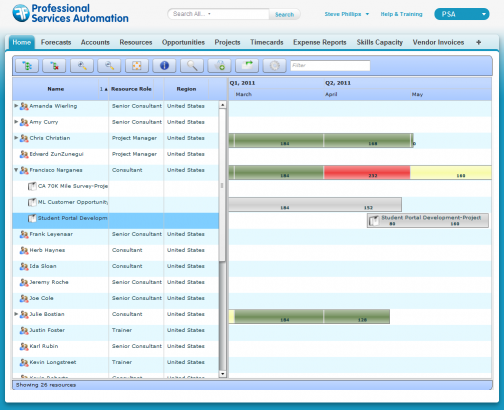
The product range broadened. Acquisitions of Vana Workforce and Less Software added capabilities in human resources and supply chain management. FinancialForce also had professional services automation acquired from Appirio. In February 2014 it presented a cloud ERP suite, bringing those applications together. Roche’s company was taking on a wider set of business responsibilities.
Expansion brought a different management problem: helping the organization itself keep pace. In October 2014, FinancialForce appointed Charles Ashworth vice president of employee success. The brief connected traditional HR with programs intended to help employees do their jobs and develop. Roche publicly tied the fortunes of employees to those of customers. The language was consistent with a business selling coordination to other businesses.
Then came the larger financing. In March 2015, FinancialForce announced $110 million in new investment, led by Technology Crossover Ventures with participation from Salesforce Ventures. It followed a $50 million investment the previous year. FinancialForce had ended 2014 at a reported $50 million annual revenue run rate.
Funding announced, led by TCV.
Capital for the company’s next stage, separate from its revenue.
Roche treated the shared platform as an advantage, while acknowledging the continuing need to build software suitable for larger organizations. Investment enlarged the possibilities. It also enlarged the work: product development, implementation capacity, sales and the ability to support customers who expected the system to matter every working day.
Another commitment had been present from the beginning. Roche initiated FinancialForce4Good when the company started in 2009. By the end of 2016, FinancialForce had formalized a pledge to give at least one percent of employee time to the community. An employee volunteer council helped direct the effort, choosing underserved youth education as its main focus. The company had made room for work beyond its own product.
Giving the calendar a vote
The 2017 change in leadership involved a business and a household. Roche’s family was based in the UK; he had chosen against relocating to the West Coast. He described FinancialForce as his third child. The phrase conveys considerably more attachment than the usual wording of an executive departure announcement.
He also spoke warmly about Nielsen’s suitability. The incoming chief executive brought experience at businesses including Salesforce and VMware. Roche saw shared management instincts and experience with greater scale. He recalled advice from Marc Benioff about thinking through successive business milestones: a million, ten million, a hundred million, a billion. Different stages made different demands.
At Unit4, his new chief product officer role covered product and customer experience. It was a continuation of a relationship he had maintained throughout FinancialForce’s development. His stated ambitions included a thriving FinancialForce under Nielsen and faster cloud innovation at Unit4 in Europe. He was changing his contribution while remaining interested in what the team would do next.
The next team at the table
Subsequent appointments put Roche’s experience alongside other founders. In November 2020, Paid announced £2.2 million in seed funding and his arrival as chairman. Its work concerned the cumbersome relationship between large enterprise buyers and smaller suppliers. Roche singled out the practical problem of making those transactions easier. The invoice was still capable of ruining an otherwise promising relationship.

Dayshape now lists Roche as a non-executive director and adviser. Its public welcome in February 2026 described contributions to strategy, execution and scaling a software business serving professional services firms. The setting has changed, but the subject is familiar: organizing the people and processes needed to deliver the work a company has promised.
FinancialForce itself became Certinia in May 2023, years after Roche’s CEO tenure. Its move beyond the original financial software identity reflected the wider services business it had developed. His founding role belongs to that history; his current advisory work belongs to a continuing career.
Follow that career back through the products and appointments and an ordinary customer remains in view, waiting for an answer about work, an invoice or a payment. Roche built around the difficulty of giving that person a coherent reply. The deal could be signed in a moment. Making the company behave as though it remembered the deal took rather longer.