Jeremy Bluvol’s business concerns a particular species of wasted time: the minutes spent proving something a computer ought to know already. Which benefits apply? What does the customer owe? Has the claim gone through? These questions have the peculiar ability to make an ordinary transaction feel like an entrance examination. Bluvol co-founded Anagram to simplify that administrative work. The company’s subject matter may be paperwork, but its underlying commodity is attention.
There is a pleasing mismatch in that assignment. Bluvol trained in mechanical engineering, then added an MBA. His company now works on insurance eligibility, claims and billing. The machinery is less photogenic than a turbine. It nevertheless has moving parts, failure points and people waiting for it to work. His public career follows an engineer into the commercial systems that surround a purchase, and then stays there long enough for the product to change shape.
Two students, one awkward transaction
Bluvol earned his Bachelor of Applied Science in Mechanical Engineering at the University of Toronto and completed an MBA at its Rotman School of Management. Engineering and business make a useful pairing for someone interested in how a system behaves and whether anyone can afford to run it. One supplies the diagram; the other insists that the diagram eventually meet a customer.
He also co-founded Instant Chemistry, where he served as chief operating officer. Anagram came later. Its founding partnership began with a meeting between Bluvol and Brett Plotzker while both were MBA students in Tel Aviv. Plotzker brought experience in quantitative trading and startups. The two founded their business in 2014, years before the name Anagram appeared above the door.
Plotzker’s financial background supplied a memorable comparison: complex derivatives could settle daily, while a straightforward insurance claim might take 180 days to pay. The comparison belonged to the co-founder, and it helps explain the partnership’s opportunity. A process could be familiar to everyone using it and still contain an extraordinary amount of delay. Familiarity, in business, can be an expensive form of camouflage.
Bluvol and Brett Plotzker establish the business that becomes Anagram.
A name made for rearranging
The company was initially known as Patch. By 2017, its web application was helping independent businesses handle out-of-network reimbursement without having to turn every transaction into a manual administrative project. Plotzker described an opportunity created by changing customer habits: online reviews and digital discovery were altering how people chose a business. The billing arrangements still needed to accommodate that choice.
In February 2020, Patch became Anagram. Bluvol’s explanation turned on rearrangement: useful pieces already existed, but the way they connected needed work. An anagram was an apt image for that proposition. You can leave the letters intact and still change the meaning. The name gave the company a compact way to describe its interest in processes, transparency and administrative costs.
The rebrand coincided with an announced $9.1 million Series A led by ManchesterStory. Synchrony, Waterline Ventures, Rogue Venture Partners, Launchpad Digital Health, KEC Ventures and Healthy Ventures participated. The money was intended to support product development and expansion into additional markets. For Bluvol, this was a public commitment to keep building beyond the original tool. A new name is relatively easy to order. Giving it more work to do takes longer.
Led by ManchesterStory, alongside six participating investors.
The back of the napkin has a job
Bluvol’s public conversations about business are often concerned with the arithmetic underneath the activity. In March 2021, he joined Justin Manning on the Practice Advantage podcast to discuss performance, costs and the economics of different insurance arrangements. The exercise began with understanding expenses and looking at revenue by plan, so an owner could compare the work being done with the money it brought in.
That is a useful corrective to the seductive sight of a full schedule. Activity is easy to see. Its financial consequences require a little more patience. Bluvol’s discussion encouraged owners to evaluate arrangements individually rather than allowing the overall bustle to stand in for an answer. The back of a napkin, an object with admirably few software requirements, could at least get the calculation started.
The same year, Anagram introduced Prosper, a rebate platform built around wholesale agreements with eyewear vendors. The commercial proposition addressed both sides of a sale: offer a customer a cash-back reward while preserving the seller’s margin. Vendor agreements and Anagram’s support funded the program. It was another piece of the transaction to work on, extending the company’s attention from insurance administration to the economics of the product being sold.
- 01Know the costUnderstand what it takes to run the business.
- 02Compare the returnExamine revenue under each arrangement.
- 03Choose deliberatelyUse the numbers to evaluate the work.
An editorial outline of the operating questions discussed in Bluvol’s 2021 podcast appearance.
A publication, then a room full of people
By the end of 2022, Bluvol was describing a business with several ways of reaching its customers. There was Access, the insurance software; Prosper, the commercial platform; and Spyglass, a publication covering subjects such as marketing, e-commerce, design and staff development. Building a publication alongside an application made room for the decisions that surround the software. Owners still had to decide how to sell, hire and organize their businesses.
His December letter described Anagram as “leaner, stronger, more profitable.” The phrase is revealing for its choice of scoreboard. Alongside product plans, he wanted customers to hear that the organization itself had become more durable. In a separate year-end message, he had emphasized the team and the people supporting the company. The recurring picture is of a founder treating the surrounding relationships as part of the operating work.
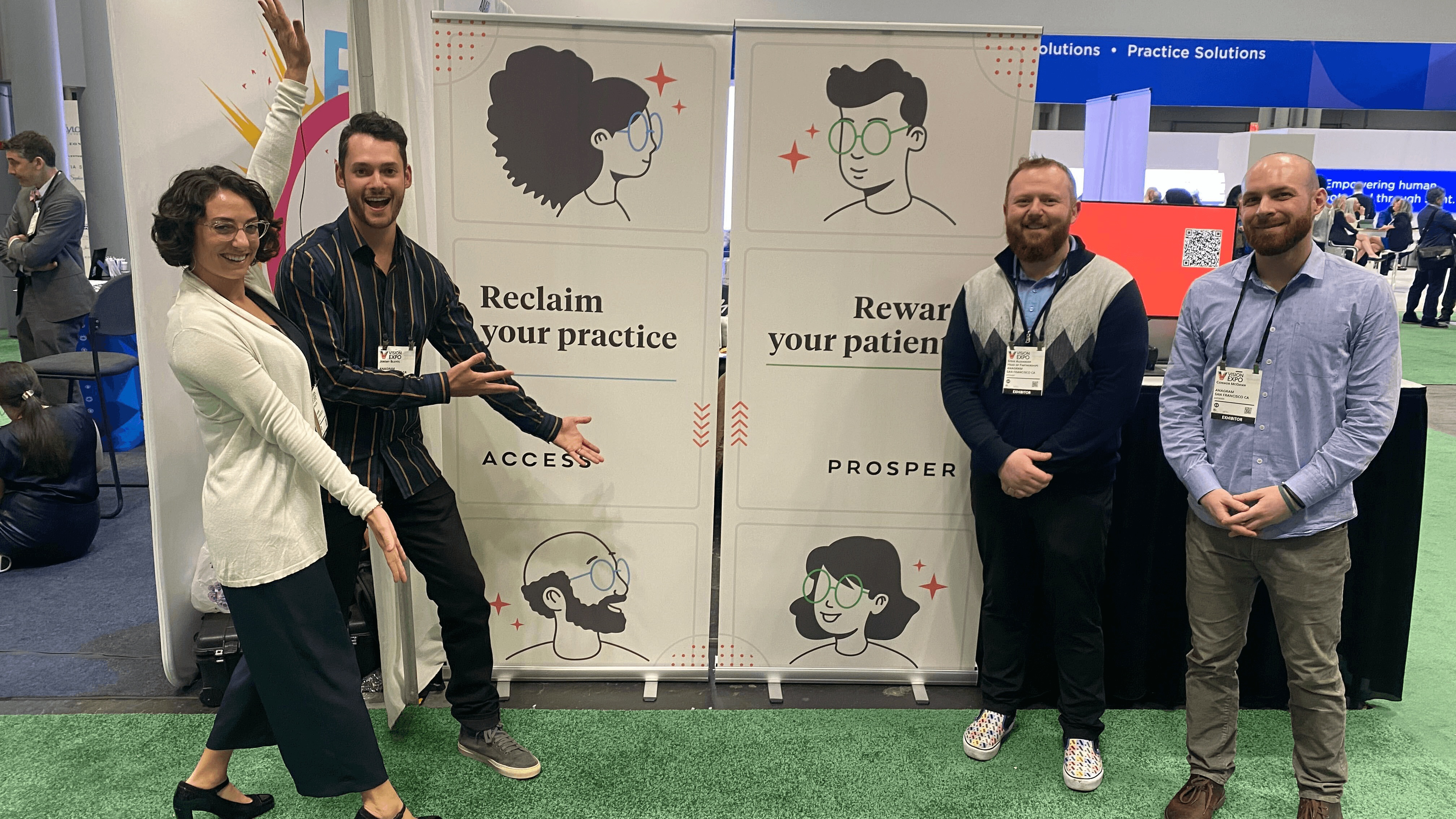
Anagram’s 2022 Vision Expo recap captured that social side of the business: visitors gathered at the booth, partners stopped by, and demonstrations became occasions for conversation. In 2023, the company hosted Spyglass gatherings in New York and at the Velveteen Rabbit in Las Vegas. Hundreds attended, according to Bluvol’s year-end account. Software administration had acquired a social calendar, which is more than most administrative tasks can claim.
There is a practical reason to leave the browser occasionally. A product demonstration has an agenda. A conversation with another owner can wander into the things the agenda missed. A publication and an evening event offer different ways for that exchange to happen. In Anagram’s case, both sat beside the continuing work of adding functions to the application.
The next question at the front desk
The 2023 changes widened the software’s reach within the transaction. Entry Access added in-network eligibility checks, joining the company’s existing out-of-network tools. Universal Search followed, allowing staff to search across plans together. The product sequence followed a recognizable administrative problem: someone knows they have benefits but cannot name the plan. Finding the answer can become a tour of unrelated portals.
Bluvol’s introduction to Universal Search even paused to question the familiar recorded excuse about higher-than-average call volume. The joke works because the experience is so recognizable. A customer calls with a modest question and encounters an organization chart disguised as a phone system. The employee answering the call may face an equally unhelpful collection of logins.
Universal Search was presented as a way to reduce that searching. The ambition was specific enough to picture: keep the conversation moving while the information is found. Anagram now applies that connected approach to eligibility, benefits, claims and payments. The product has grown around adjacent tasks, each of which can interrupt the next one if the information fails to travel with the transaction.
“Jeremy listens to you, makes time and space for you”
Ryan Tibbetts · public professional recommendation
The courtesy of a finished task
Colleagues describe a human counterpart to that attention to workflow. Ryan Tibbetts’s recommendation emphasizes Bluvol’s willingness to listen and make room for others. Aaron Smith describes strategic thinking and care for the team. These are colleagues’ judgments, with the intimacy and partiality that implies. They add something a product announcement cannot: an account of how working beside the founder feels.
Bluvol has also praised the practical help provided by investors. In a testimonial about Healthy Ventures, he singled out introductions, strategy and connections: “they put in the work.” The emphasis is on participation. A funding announcement records who supplied capital; this account points to the conversations and introductions that follow it.
In May 2025, Anagram announced recognition for ease of use, customer support and functionality, based on reviews collected through Gartner Digital Markets. Those categories fit the company’s assignment. Administrative software is encountered through the task immediately at hand, and the experience includes what happens when the user needs help.
One later detail makes a fitting place to pause. Anagram’s help center carries a short guide to claim-confirmation emails, credited to Bluvol and dated March 10, 2026. It describes sending a message after a claim has been submitted. The action is small: tell someone that the work is done. Across a career involving business school, a founding partnership, financing and successive product releases, that courtesy still belongs in the picture. Someone was waiting for an answer. The system should give them one.