A meeting can look remarkably like progress. There is an invitation, an agenda, a collection of people who have stopped doing something else. Jennifer Thangam Easwaramurthi once treated unproductive meetings as a scheduling problem. Then she changed her diagnosis. The calendar, she decided, was showing her where the organisation had lost its direction. A crowded week could be a map of unresolved decisions. The invitation was merely the envelope.
A few times a year, the DataPattern co-founder and CEO conducts what she calls a clarity audit. She looks for discussions whose intended outcomes were never established, check-ins that keep returning to the same issue, and conversations that produce plenty of words with little movement. It is an unusually concrete entry into a founder’s thinking. Start with the recurring invitation. Ask what decision keeps failing to arrive.
A career carried forward
Her professional story begins at Tata Consultancy Services, where she started as an Assistant System Engineer. In June 2025, looking back over 23 years, she credited that first employer with teaching her discipline, collaboration, and integrity in delivery. The account gives considerable room to other people: leaders who mentored her and colleagues who supported her. Her explanation of becoming a CEO includes the people who helped her become an engineer.
That choice of emphasis matters. A career retrospective can turn previous employers into scenery on the way to the current title. Easwaramurthi describes TCS as a continuing influence. The lessons belong to her present work, rather than a completed chapter filed away with an old badge. Her gratitude has names attached to it, including Mohan Veeturi, Sharmilee Prakash, and Vasundhara Sundarrajan. The beginning remains part of how she explains the destination.
Her education includes Madras Institute of Technology, Anna University, with attendance listed from 1998 to 2002. Engineering study, an entry-level systems role, and later company leadership give the story its broad outline. But the thread she chooses to describe is more human than a sequence of promotions. She remembers the environment in which she learned to work with others. A job title records responsibility. Her recollection records where some of that responsibility was learned.
The departure with a personal stake
On January 26, 2024, Easwaramurthi announced her departure from Bank of the West/BMO and her next role as co-founder and Chief Digital Officer at DataPattern. Her farewell included the friendships and challenges of the banking chapter. She described the move as a new beginning with professional and personal significance. Working alongside her life partner was part of the appeal. The next organisation would bring two parts of her life into closer proximity.
There is a particular warmth in that detail. Corporate announcements often arrange life into tidy compartments: employment over here, everything else somewhere offstage. She allowed the personal stake into the announcement. It helps explain why the decision meant more to her than a change in stationery. At the same time, she gave her former colleagues their due. Excitement about what came next did not require dismissing what had come before.
The subsequent account of her career identifies her as DataPattern’s CEO. Together, the two announcements show a move from banking into company building, followed by a public reflection on leading the business. They also share a tone of gratitude. Her story of forward movement repeatedly makes space for the relationships that made earlier work worthwhile. Ambition and appreciation occupy the same paragraph quite comfortably.
A calendar that asks awkward questions
The clarity audit is the most tangible example of how she describes leadership in practice. Its three warning signs are easy to recognise: an undefined outcome, an issue that keeps returning, and a conversation that fails to produce action. Each asks something slightly embarrassing of the organisation. Who knows what this meeting is meant to settle? Who owns the decision? What will be different when everyone closes the window?
In her November 2025 account, the remedy involves clearer decisions, explicit ownership, and progress people can see. She links these signals to trust. That connection gives the exercise more weight than a campaign for an emptier calendar. If a team can understand where a decision sits, people have less reason to keep assembling merely to discover whether anything has happened. The meeting has a job to do, and its job can finally be named.
Read as a management practice, the audit treats repeated conversation as a clue. It asks the leader to examine the conditions around the work. That is a useful distinction within her own approach: the people attending are already giving their time. The next question concerns what that time is being asked to accomplish. Even the most elegant invitation cannot supply an outcome that nobody has defined.
- Define the outcomeWhat is this discussion meant to settle?
- Name the ownerWho can move the decision forward?
- Make progress visibleWhat has changed since the last conversation?
The cost that hides between tasks
In March 2026, she addressed the consequences of unclear leadership: duplicated work, unexpected missed deadlines, and capable people becoming disengaged. These are the costs she asks leaders to notice beyond a budget sheet. Her argument puts direction among a leader’s responsibilities. An organisation may have talented employees and substantial technical resources while still leaving people uncertain about what successful work should produce.
What is interesting here is where she places accountability. The symptoms appear in employees’ working days, but her explanation points upward toward leadership. Read alongside the meeting audit, this becomes a consistent concern with wasted effort. Time spent revisiting a decision and time spent producing overlapping work both suggest that people need better signals. The practical question becomes whether the organisation has explained the work well enough for people to proceed.
Giving automation a human purpose
Her February 2026 writing on AI begins with the team. She describes manual data sorting and repetitive tasks as work that can bury more valuable contributions. Automation, in her account, should free people to lead, innovate, and think strategically. The ambition is to give employees room to use abilities that routine work consumes time around. Her stated return on technology includes what people can do with the hours it releases.
This is an aspiration about how technology ought to be used. It offers a clear way to read her priorities without turning them into a claim about measured results. The imagined beneficiary is a person whose working day changes: less time on repetition, more time available for judgment. It is a people-centred explanation from someone whose earlier career reflection also placed colleagues and mentors near the centre of the story.
“Vague input produces vague output.”Jennifer Thangam Easwaramurthi, April 2026
In April, she made another connection between AI systems and leadership. Both, she argued, depend on the clarity of what is asked of them. Technical expertise alone cannot rescue an imprecise request. Her observation brings the conversation back to the person setting direction. Before asking a system or a team for an answer, a leader needs to examine the question. It is a modest-sounding requirement with considerable work hidden inside it.
When the numbers need a plot
Easwaramurthi’s September 25, 2025 article on data storytelling extends that concern into communication. She argues for translating analysis into narratives people can understand and act on. Her example is Spotify Wrapped, which presents listening information as a personalised visual story. She points to the relationship between numbers, human interest, and business aims. Information needs a form that helps its audience understand why it matters.
The example has a welcome familiarity. A listening history is easier to recognise as a story when it concerns your own year. In her account, visual presentation and narrative help technical and non-technical audiences find common ground. This is the same broad problem approached from another side: how does an organisation make something complex sufficiently understandable for people to respond? A dashboard has to earn attention, just as a meeting has to earn time.
Beside the sign, without every answer
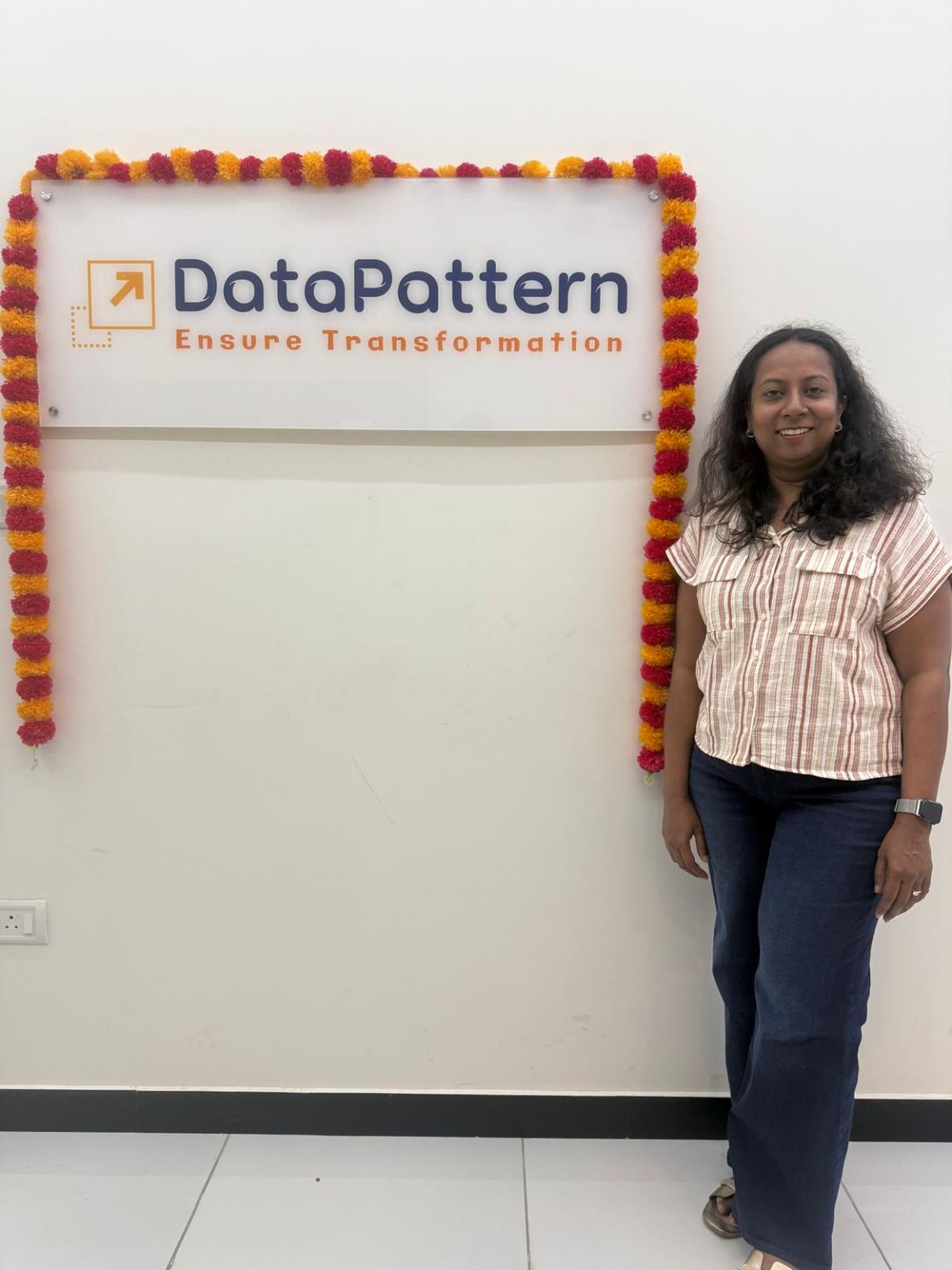
In an office photograph she shared, Easwaramurthi stands beside a DataPattern sign framed with flowers. The company’s phrase, “Ensure Transformation,” sits beneath its name. Her accompanying reflection concerns mornings when she arrived without a clear answer and still had to lead. She describes the difficulty of retaining people’s belief in the direction when the route ahead is uncertain. It is a candid qualification to the clean confidence of an office sign.
Leadership, in that account, includes showing up before the answer is complete. The distinction between uncertainty and direction helps make sense of her recurring interest in clarity. A leader may be unable to explain every future turn while still owing people a usable account of the present task. Her reflection puts that tension in ordinary terms: walking into work, taking responsibility, and needing others to move forward with you.
Less complexity for its own sake
By September 22, 2026, her discussion of project delivery returned to simplicity. More data, systems, integrations, and decisions can make technology work harder to coordinate. She emphasised focus, timely choices, responsibility for outcomes, and alignment around a shared goal. The measure she proposed was the business value produced by handling that complexity. Complexity itself receives no prize for attendance.
Across these accounts, her career and her management concerns meet in the working day. The engineer remembers the colleagues who taught her. The founder acknowledges the personal meaning of a new role. The CEO looks for the missing decision behind the recurring meeting. Her questions are practical enough to take back to a desk: what needs to happen, who owns it, and can the people doing the work see where they are going?