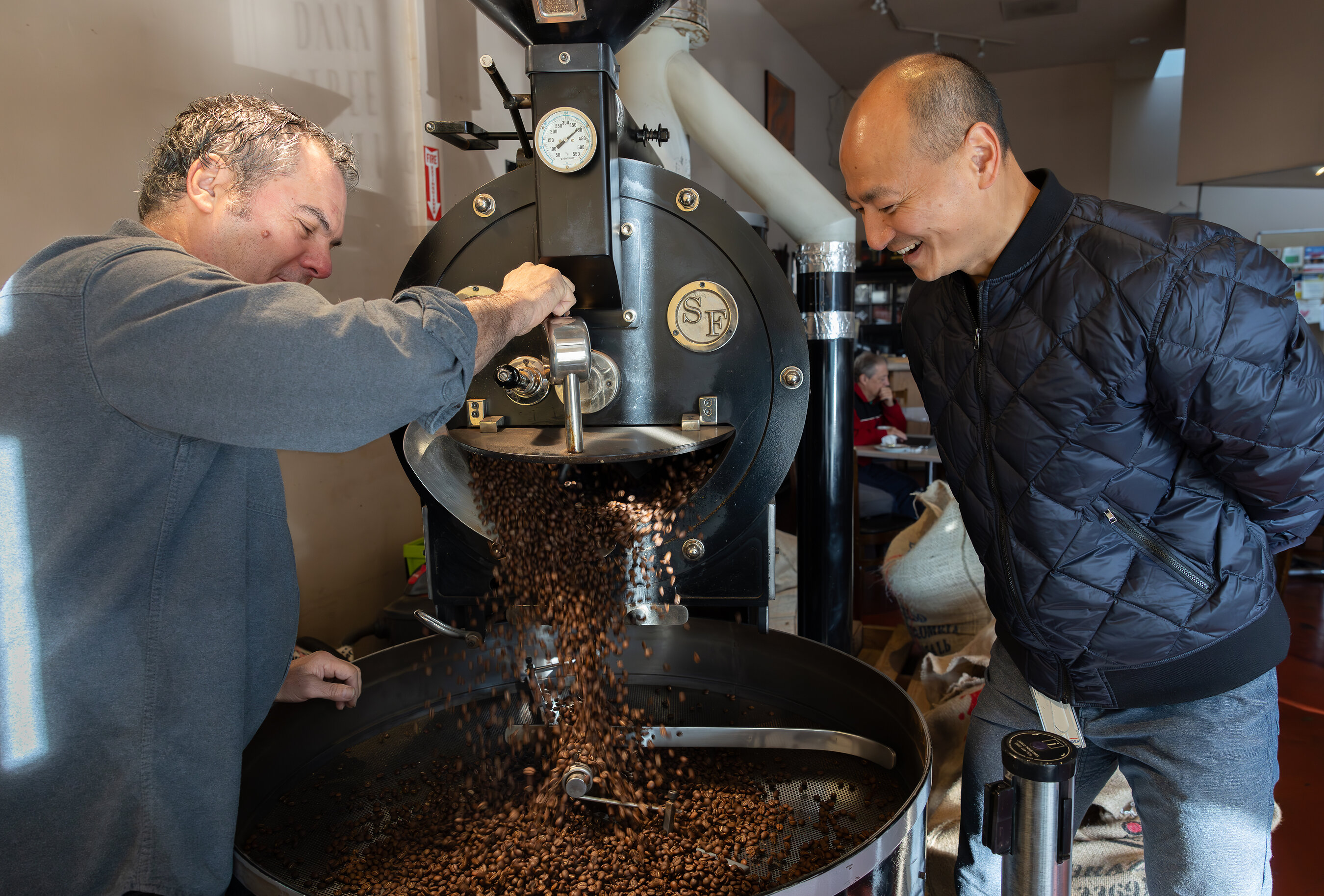
Jeff Zheng is standing beside a coffee roaster, watching the beans tumble out. To his left is Nick Chaput, owner of Dana Street Roasting Company in Mountain View. Zheng is a longtime customer. In the photograph, the machinery occupies the middle of the frame and both men lean toward it, smiling. Silicon Valley has produced plenty of photographs of founders beside machines. This one comes with a considerably better prospect of getting a decent cup of coffee.
The picture accompanied the May 2026 launch of SPOTLIGHTS, NewsBreak’s program for helping small businesses tell their stories to nearby readers. It also offers a useful entry into Zheng’s career. He has spent years working on how computers find information people might want. Here, the information has an owner, a shop and a neighborhood. The person building the distribution system already knows the person tending the beans.
The education of a recommendation
Zheng’s route to that shop runs through electrical engineering and computer science. He earned his bachelor’s degree at Tsinghua University, a master’s at the Institute of Automation of the Chinese Academy of Sciences, and a computer science doctorate at the State University of New York at Buffalo. They describe a founder trained to approach information as something that can be organized, retrieved and studied.
He spent seven years at Yahoo. In Sunnyvale, his work concerned web search relevance and personalized content recommendations. He later founded Yahoo Labs in China, researching mobile search and discovery. The recurring problem was selection: out of everything available, what should a particular person see? A search engine receives a question. A recommendation system must decide what might be useful before the person has worked out how to ask.
That distinction would follow him into entrepreneurship. Zheng founded the Chinese mobile news venture Yidian Zixun before starting NewsBreak. His experience carried across national markets, but the underlying interest remained recognizable. News was becoming something people encountered through their phones, selected by systems that could account for their interests. A reader’s location could become part of that selection too.
It is tempting to turn a career like this into a neat succession of revelations. The documented path is more practical. Training led to research, research to operating technical teams, and those teams to mobile products. Zheng has authored dozens of academic papers and holds dozens of U.S. patents. NewsBreak brought that technical history into a business whose usefulness would have to be judged by people going about an ordinary day.
A national app with a local question
Zheng founded NewsBreak in Mountain View in 2015. Its iOS and Android apps launched the following year. Yahoo co-founder Jerry Yang served as an adviser. The undertaking gave Zheng a familiar technical problem inside a particular setting: finding information relevant to someone’s surroundings. A countrywide platform could organize itself around many small places, each with its own publishers, readers and businesses.
Local information has an awkward relationship with scale. A report can matter intensely within a few miles and barely matter elsewhere. For a national feed, that makes geography useful. For the local publication producing the report, it creates a distribution problem. Readers might need the information without knowing the publication exists. Zheng’s platform sought to provide another route between the two.
In 2020, Harry Shum joined as chairman. Shum had led Microsoft’s artificial intelligence and research organization and previously overseen Bing and MSN. Zheng was building a local news company with connections to people who had spent their careers handling search, recommendation and enormous information systems. The neighborhood was a small unit of interest; the machinery for reaching neighborhoods was anything but small.
By January 2021, NewsBreak reported 12 million daily active users and more than threefold year-over-year user growth. It announced a $115 million Series C led by Francisco Partners, which gained a board seat. The investment brought unicorn status. Zheng described plans to broaden the company’s mission into everything local, including information and services that could help people feel connected to their communities.
The announcement joined financial scale to a deliberately expansive ambition. News could introduce the platform to a reader. Other local needs might keep the relationship going. Zheng was already looking beyond the article someone opened today toward the range of things they might need tomorrow. The coffee shop would eventually fit quite comfortably inside that larger plan.
The people behind the feed
A recommendation system needs material worth recommending. During 2021, NewsBreak added 956 local publications, including the Tampa Bay Times, Idaho State Journal, Vermont Digger and San Jose Spotlight. Licensing offered participating outlets another way to reach mobile readers. For Zheng, publisher relationships were part of the product itself: the relevance of a feed depends partly on the range and depth of reporting available to it.
He also brought experienced media people into the organization. Jim Bell, whose television career included the Today show and major sports productions, joined the executive team in 2022. Zheng welcomed Bell’s creative experience and understanding of the news industry. Search expertise could help distribute a story; understanding the people producing stories required another set of skills.
That April, NewsBreak announced the national launch of its Contributor Network, building on a creator program introduced in 2020. The plan included independent reporters and community voices, with local editorial review for reporters participating in the network. Initial activity in Denver was to be followed by expansion into selected counties in Georgia, Florida, Colorado and Arizona.
This made the undertaking more complicated than a collection of links. Zheng’s company was working with established publications while developing ways for other writers to contribute. Each arrangement brought questions of payment, authorship, editing and responsibility. A feed may look like a smooth sequence of stories on a screen. Behind it sit people with markedly different working arrangements and expectations.
When relevance meets responsibility
The platform’s editorial failures exposed the consequences of getting those arrangements wrong. In December 2023, NewsBreak published an AI-produced account of a shooting in Bridgeton, New Jersey, that had not happened. The company removed it four days after publication and said the inaccurate information originated with its content source. An item selected for local relevance had delivered a false account to readers in the place it named.
There had also been an internal warning. In 2022, consultant Norm Pearlstine raised concerns with Zheng about republishing local material under fictitious bylines. NewsBreak later described the activity as a limited experiment in three counties, ended after ten articles. The company pointed to Zheng’s emailed response recognizing the problem and asking his team to fix it.
The distinction between discovery and authorship matters here. Helping someone find a published report depends on the quality of the report. Producing a new account introduces additional responsibilities for what it says and whose name appears above it. The failures placed those responsibilities directly inside the company Zheng led.
They also complicate his broader aspiration. A nearby story can influence how a reader understands a familiar place. Getting closer to everyday life makes accuracy more consequential. The question for Zheng’s business is whether its systems and editorial practices can earn the confidence required for that proximity.
Let the reader ask
In May 2025, NewsBreak introduced NBot beta, a conversational assistant intended to give readers more control over their experience. Users could ask to change topics and locations, adjust notifications, alter app settings and get answers about nearby information. The company described it as an early-access product, drawing on its search and recommendation work.
For someone whose career has involved predicting what people want, the interface suggests an interesting adjustment: give them a way to say it. A reader could ask to pause a topic or follow an issue without hunting through settings. The idea puts language between the user and the recommendation machinery. Its appeal is easy to grasp for anyone who has ever opened a settings menu and promptly lost the will to finish.
Zheng connected the product to an ambition extending beyond NewsBreak’s own readers: helping publishers and app developers offer more sophisticated experiences that people could customize. He was describing technology that might be useful outside the company’s original news feed. The direction would become more explicit the following year.
A shopkeeper’s story, a publisher’s business
SPOTLIGHTS brought the business-owner side of that ambition into view. Owners answer questions about their businesses, then review, edit and approve an article before publication. NewsBreak distributes it to neighborhood readers and uses localized notifications. The launch offer included a feature article and a push notification free of charge.
“Local businesses have great stories, but they rarely have the time or resources to tell them.”
Jeff Zheng, May 2026
The arrangement gives the owner a defined role in the result. For Zheng, it places a business story inside the same distribution system that carries community information. The coffee-roaster photograph makes the relationship unusually tangible. Chaput has a shop; Zheng knows it as a customer. The audience he hopes to reach consists of people who might know it that way too.
In September 2026, NewsBreak appointed Nicolas Zylberstein chief business officer to support the flagship platform and two newer ventures. Nearby AI focuses on connecting consumers with local businesses and services. NDot AI offers publisher technology for audience growth, recommendations, engagement and monetization. The announcement identified Zheng as founder and CEO of all three.
Zylberstein arrived with experience at ByteDance, Pinterest, YouTube and Disney. His appointment added a commercial operator to Zheng’s widening plans. Publishers needed help building direct audiences; local businesses needed ways to reach customers at useful moments. Zheng was taking capabilities developed inside a news app and offering them to other participants in the local information economy.
The distance to useful
Zheng’s public account of leadership favors team ownership. In a LinkedIn post about NewsBreak’s 2025 workplace recognition, he described employees contributing across teams and leaders who coach and enable. Teams, he wrote, set their own pace and make their own decisions. It is his stated approach to organizing the people behind increasingly varied products.
Away from work, Zheng lives in Palo Alto with his wife, daughter and Shiba Inu. The same career that moves through research institutions, patents and financing announcements belongs to someone whose daily surroundings include a household and a dog. Local life is also the setting in which the founder lives.
Back at the roaster, the beans are falling into the tray. The photograph makes no grand claim about what an algorithm can accomplish. It shows Zheng paying attention to a business he knows. His career has carried him from selecting information on the web to trying to connect people with the places around them. The work ahead will be measured in those encounters: a reader finding a worthwhile report, a publisher finding an audience, a neighbor discovering a shop worth visiting.