In 1997, the Steel Plate Fabricators Association was moving its offices from Chicago to Cincinnati. The address was changing. Someone also had to figure out who would run the place. Jeff Hock, a board member, had a suggestion for Joe Hammoor, a recently retired industry veteran helping with the transition: go meet a woman who worked at a bank.
The woman was Pamela Moore. Hock’s recommendation put Moore and Hammoor in contact, beginning a working partnership that became part of the association’s history. In 1999, Moore became SPFA’s first woman executive director. For a career spent around fabrication, it is a pleasingly human opening: one of the consequential things Hock helped assemble was a meeting.
“Joe you need to go visit this young lady at the bank.”
Jeff Hock, during SPFA’s 1997 move to Cincinnati
Today, Hock is chief executive of HBH Holdings in Cincinnati, with more than four decades of leadership experience in fabrication and process solutions. His professional world includes the companies that manufacture industrial components and the institutions that help an industry function. The bank introduction gives that broad description a useful point of focus. Sometimes a connection begins before anyone has written a strategy for it.
An offensive lineman with an unexpected footnote
Before the executive title came a place on a football roster. Indiana State’s incoming freshman list for 1975 identifies Hock as an offensive tackle from Cincinnati’s Moeller High School. Two years later, his player biography lists him at offensive guard. It also contains a detail that would make a rather good opening question at a manufacturing conference: he had taken a ballet course.
The football biography credited the course with helping his agility. It is a compact reminder of how much a formal career summary leaves out. An industrial executive can have an earlier chapter involving both blocking assignments and ballet. One imagines the football program’s writer enjoying that discovery almost as much as a reader does now.
Hock attended Indiana State from 1975 to 1979 and lists a full football scholarship and Lambda Chi Alpha among his college activities. Those are distinct experiences, rather than a convenient explanation for everything that followed. Football does not automatically produce a management philosophy. The archival detail simply makes the young person visible before the long sequence of corporate roles.
A job offer, then a place on the river
A later connection survives in someone else’s career story. In March 2001, Hock offered Steve Hammoor a job at Enerfab/Brighton Tru-Edge. Hammoor came from the steel industry and began in purchasing. He subsequently moved into sales at Brighton and rose to executive vice president before retiring in 2020.
Hammoor’s own industry recognition records that progression. The recruitment belongs in Hock’s story without transferring Hammoor’s accomplishments to the person who hired him. A job offer creates an opening; the person who accepts it still has to do the work. Here, the opening led into nearly two decades of service across purchasing, sales, and leadership.
By August 2011, Hock was identified as Enerfab’s president of process solutions and fabricated products during an expansion into Natchez, Mississippi. Enerfab was taking over a plant formerly operated by Dynasteel. The announcement called for 75 additional jobs alongside the existing workforce. The plant would operate as Enersteel, making large steel products for industrial customers.
The planned products included storage tanks, pressure vessels, and components for power generation. Hock drew attention to something outside the factory: the Natchez-Adams County Port on the Mississippi River. Access to the port would help the business ship and sell large fabricated products. A factory’s location, in this account, extended all the way to the water.
That is an unusually concrete glimpse of industrial leadership. The object being manufactured has to leave the place where it is made. A large vessel does not become conveniently small when the invoice is ready. Hock’s comment joined production to transportation, making the river part of the commercial proposition.
What sits beneath the holding company
HBH’s portfolio makes the physical character of his working world plain. Bishopric Industries fabricates process tanks and pressure vessels. Brighton Tru-Edge makes tank and vessel heads. Iron Bishop Engineering Solutions supplies engineering services for process tanks and pressure vessels. Engert works in mechanical and plumbing contracting. The names sit under a holding company; the capabilities belong to distinct operating businesses.
In that setting, investment management has an industrial vocabulary. A tank head, a construction contract, and an engineering assignment each point toward different work. They also explain why the group spans fabrication, construction, and maintenance. The portfolio has to account for what companies actually make and deliver, rather than merely where they appear on an organization chart.
The holding company supports its businesses in finance, tax, legal matters, insurance, risk management, compliance, sustainability, and strategic planning. These functions rarely make an arresting factory photograph. They nevertheless describe the corporate work surrounding the workshops and projects. In Hock’s current role, the administrative and physical sides of industry occupy the same frame.
The markets include established industrial sectors alongside data centers, clean energy, advanced manufacturing, and water industries. That range gives his career a contemporary setting without requiring a claim that every new market is his personal initiative. The companies he leads operate where old fabrication skills meet changing customer requirements.
Two names, one transatlantic connection
In June 2025, HBH acquired Germany’s König + Co. The transaction was HBH’s first European acquisition. It connected Brighton Tru-Edge’s cold-form manufacturing capabilities with a company known for hot-form tank heads, cones, and special pressings. The combination was international; the industrial specialism remained quite precise.
König reported that its shares were acquired on June 5. It would continue under its existing name and operate from Netphen and Haiger. Brighton and König would remain separate operating entities and brands. A longstanding business relationship with Brighton had helped lay the groundwork for the partnership. The transaction brought that existing connection into a new ownership arrangement.
Hock later described the acquisition as strategically important in a published testimonial. He also identified the complications of a transatlantic transaction: cultural differences, time zones, legal frameworks, and differing expectations. The language is useful because it gives the deal some texture. Crossing an ocean on a corporate slide requires rather less coordination than completing the transaction.
“The acquisition of KÖNIG + CO. was a strategically important move for us.”
Jeff Hock, on HBH’s 2025 acquisition
Rödl’s account of its advisory work names legal, financial, tax, regulatory, and employment specialists. The acquisition thus provides a visible example of the support disciplines HBH describes. Making industrial companies fit together involves their products and capabilities, but it also involves the careful work needed to carry ownership across a border.
Back in the school gym
Cincinnati remains a separate and persistent thread. Moeller’s 2024 annual report lists Hock, class of 1975, among its trustees and identifies him as chair of the Human Resource Committee. The school that appears beside his name on the Indiana State freshman roster reappears decades later as a place where he serves.
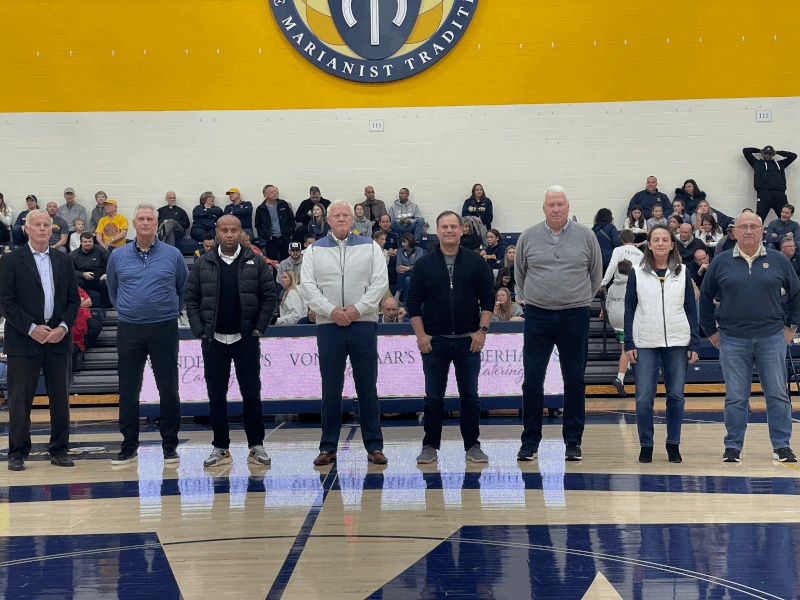
A photograph of trustees standing on Moeller’s basketball court puts that relationship in an ordinary public setting. Hock is fourth from the left, among colleagues being thanked for their work. The image is a useful companion to the industrial history: people lined up in a gym, with the institution itself visible around them.
He is also a board member at Cincinnati’s Friars Club, whose programs combine youth sports, education, and mentorship. In March 2023, the club recognized Hock alongside broadcaster Bob Herzog and Lannis Timmons for contributions to their respective fields. His institutional ties extend to SPCA Cincinnati, which listed him among its trustees in its 2021 financial statements.
Those roles show where some of his service has taken place. A school committee, a youth organization, and an animal welfare organization have different purposes. Together, they give the Cincinnati side of his public life more specificity than the standard executive biography’s passing reference to community involvement.
The question after growth
Hock’s association work earned a formal marker in 2007, when he entered the STI/SPFA Hall of Fame. The recognition addressed his contributions to the association and steel fabrication. His SPFA service also included a presidency from 2000 to 2002, placing the bank introduction within a longer involvement in the organization.
In April 2026, he joined Jon Ward on Forged in Focus for a conversation about Brighton Tru-Edge, manufacturing leadership, and growth. The episode’s subjects included global competition, tariffs, workforce development, quality, safety, and culture. Ward’s description emphasized the difficulty of expanding a fabrication business while preserving what makes it work.
That question gives the earlier episodes a common point of reference. A promising hire has to find a place to contribute. A plant needs a route to its customers. An acquisition has to become a workable relationship between operating companies. Growth creates more connections, and more work to keep those connections useful.
Hock’s public career offers examples at several scales, from an introduction during an office relocation to a transaction across the Atlantic. The small episode still earns its place beside the large one. Before there was a new executive director, there was a suggested visit to a bank. Someone had to think of it, and someone had to go.