The monitors got the money. The chairs got the packaging. Early in JeeShen Lee’s business life, cash was tight enough that better screens and comfortable seats competed for the same budget. His team chose the screens, then used their protective bubble bags to make the existing chairs less punishing. It was a small exercise in priorities, with everyone’s backside invited to participate.
That choice makes a useful entrance to Lee’s story. Today he is the co-founder and CEO of Softinn Solutions, building technology for hotels from Melaka, Malaysia. There are international awards in the company’s history and artificial intelligence in its recent work. Yet the early furniture arrangement gets at something more personal: his habit of concentrating on the thing that lets somebody get a job done.
Before the booking, the factory
Lee studied at Multimedia University, graduating with First Class results in electronics, majoring in computer engineering. He also completed a master’s degree there. Engineering gave him a route into business through particular problems, particular machines, and customers who needed their operations to work.
His early software venture, BizVise, grew out of custom projects for factories. He developed machinery test solutions outside his regular working hours, taking referrals until the volume suggested a business. Bespoke work offered an immediate education in what customers would pay for. It also raised a difficult question: how could the work grow beyond the next individual assignment?
By 2013, he was discussing cloud software for hotels and an ambition to reach Southeast Asia. More than ten hotels in Melaka were already using the early offering. The distance from a factory floor to a small hotel looks considerable on a company description. For the person writing the software, both began with a customer trying to make everyday work less awkward.
A grandfather known through stories
One of the people behind Lee’s ambition was somebody he never met. His grandfather had come from China and built businesses in Malaysia, including shops and rice plantations. He died before Lee was born. Relatives supplied the stories, which gave the younger Lee an example of what a business could become.
Closer at hand, the early venture depended on relationships with less legendary but very necessary jobs. His girlfriend helped with accounting. His family listened when the income was uncertain. A customer became a business partner after they had worked together and learned something about each other. Trust had a chance to develop before the partnership acquired a title.
Caren Tee is part of the subsequent Softinn story. By 2020, Lee and Tee were married and running the company together. The business served more than 1,000 hospitality properties in Malaysia and Indonesia, including 266 hotel brands. Lee described data as a resource smaller hotels should be able to use to understand guests and improve their businesses. The customers had grown in number; the interest in making useful capabilities accessible remained.
The hotels that forgot the salesman
Lee’s account of selling in Kota Kinabalu contains a pleasingly inconvenient discovery. He had travelled there frequently to promote Softinn. Later, hotels he had visited became customers. This sounds like a satisfactory return on persistence until the detail arrives: the hotels that signed up did not know he had been there promoting it.
He credited word of mouth. A hotel tried the product, found it useful, and other hotels heard about the results. “Good products always sell,” he wrote. It is a founder’s conviction, earned here through the mildly bruising discovery that the product could make a stronger impression than its salesman.
The same attention to response appeared in a more public setting. Softinn won Startup of the Year at the 2017 WIT Japan & North Asia conference in Tokyo. Judges had selected it from more than thirty submissions for the semifinals. At the final, the company showed what it could offer small and independent hotels.
Simon Akeroyd of Amadeus singled out the team’s improvement over the competition: they had taken feedback seriously and changed the product presentation accordingly. That is a revealing reason to win a pitch. Lee’s team had persuaded the room partly by demonstrating that it could be persuaded too.
“Good products always sell.”
JeeShen Lee, reflecting on hotel recommendations in Kota Kinabalu
The attraction of a few fewer clicks
Some of Lee’s most characteristic public writing concerns work too small for an awards ceremony. In December 2025, he described an integration between Softinn’s property management system and TP-Link Omada. Hotel reception staff could issue a guest’s Wi-Fi access from the property system, with unique credentials generated from a preset template. They no longer needed to switch systems to complete that task.
A password is a modest subject for a chief executive’s diary. It is also a good place to watch an engineer think. A repeated action crosses an unnecessary boundary. Connect the tools and the action becomes simpler. The improvement is measured in the next shift, rather than in the grandeur of the announcement.
His 2022 presentation on hotel technology explored a larger version of that problem. Distribution systems help guests find and book rooms; operational systems help a hotel fulfil the stay. He discussed how cloud architecture changes as a service grows from ten businesses to a hundred and then a thousand. The technical arrangements have to grow with the people depending on them.
That work continues in the details. Softinn’s April 2026 updates included cancelling multiple reservations together. May brought a preview of Task for housekeeping and maintenance. These are changes to the sequence of a working day: what has to be repeated, what has to be communicated, and where a member of staff must look next. Lee’s business lives among those sequences.
A Sunday spent preparing for Monday
In September 2026, Lee went back to Multimedia University to guest lecture on developing an effective business IT plan. The invitation came through the university’s alumni centre and its Melaka information technology faculty. The lecturer supplied slides; Lee spent half a day on Sunday preparing his contribution.
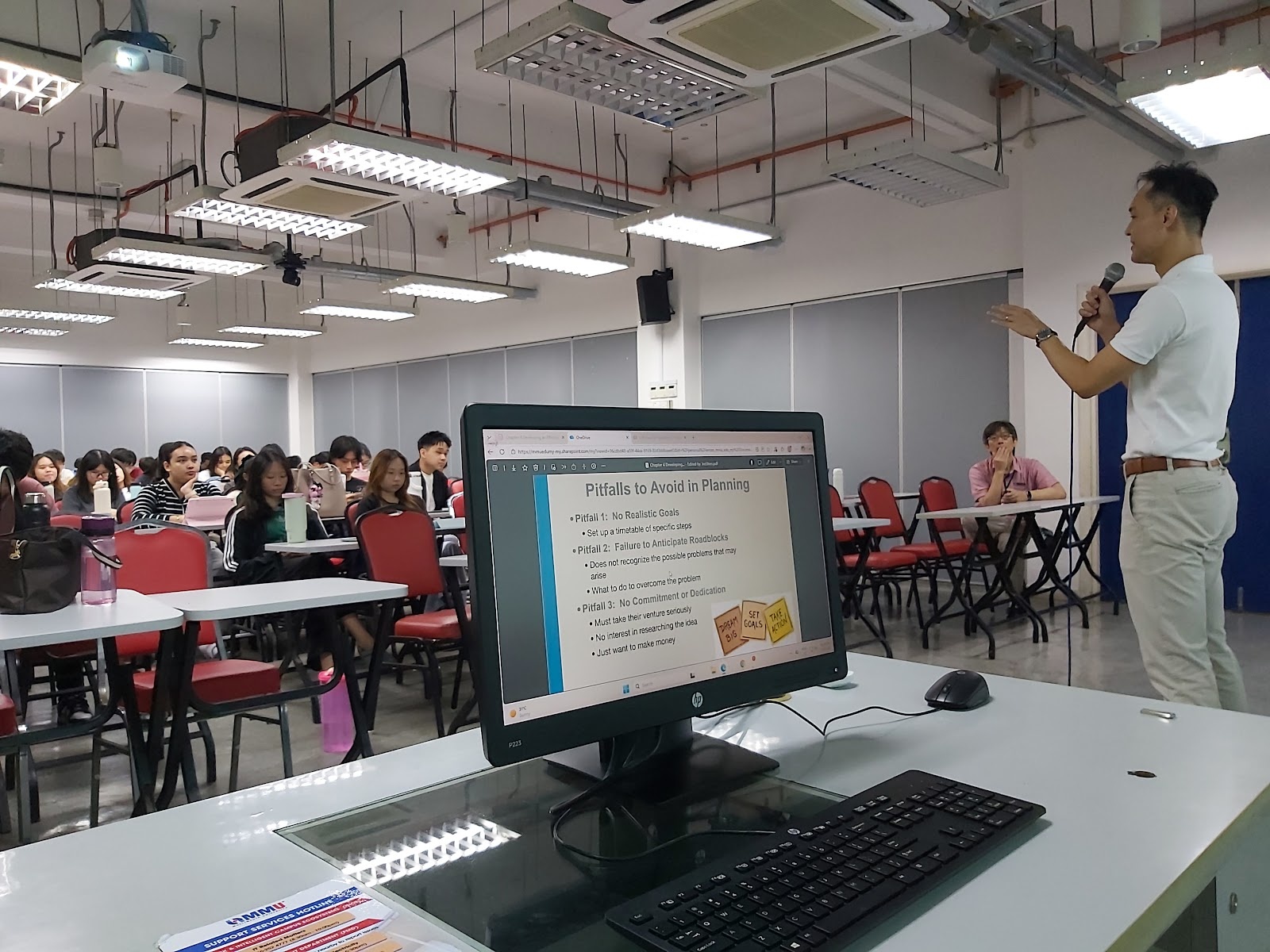
The lecturer told him he was the course’s first guest speaker, leaving both of them without much precedent. Lee later wrote that the students seemed engaged and hoped they had learned something useful. After years of building and explaining software, he still prepared for a room whose response he could not know in advance.
The visit sits within a longer relationship with education and local enterprise. His public roles include advising MMU’s Diploma in Information Technology programme and Putra International College. He also served as president of Startup Melaka. The community’s founding supporters include entrepreneurs, university figures, and other local builders. Melaka has supplied colleagues and customers as well as a business address.
The point guard keeps playing
There is another classroom in Lee’s memories, with a rather different purpose. As a school basketball player representing Negeri Sembilan, he went away for training and national competition. The team slept on thin bedding on a classroom floor. Leaving home with friends and learning to live away from his family became part of the experience.
Basketball had begun at eleven, helped by a court directly in front of his house. From the balcony, he could see people playing. Friends at school loved it too. He liked its competition, teamwork, and the room for creativity in positions such as point guard and small forward.
In his September 2026 reflection, Lee said he was still playing at forty-three. Work and family usually led him to decline competition invitations, although he hoped to compete again in the future. For all the changes in his professional life, the court has remained a place he wants to return to. A childhood convenience became a lasting commitment.
The engineer checks in
Lee began 2026 reporting that Softinn had ended the previous year with record sales while remaining profitable. His chosen theme was “Invest and Grow”: hiring, tools, and marketing expenditure after several years spent rebuilding cash reserves. The announcement put a practical spending decision behind the aspiration.
He was also learning about AI models, agents, and development tools, asking what they could do for a hotel owner. By August, he was writing about Adam, Softinn’s first AI reservation feature. He described two weeks to build a prototype, followed by two more for integration and security testing. The second stretch mattered because the feature would interact with real hotel systems and information.
His account treated the launch as an experiment. Would guests use it? Would hoteliers trust it? Those questions allow for answers less flattering than a successful demonstration. They also keep the receptionist and the guest present in a discussion that could easily disappear into model names and technical performance.
In September, Lee made the proximity even more literal. He offered to work with hotels as a forward deployed engineer: observing shifts, mapping systems and manual handoffs, then building integrations and training the team. His proposed engagement began with diagnosis and ended with documentation and a maintenance path. The ambition was to leave the hotel able to carry on.
It is a fitting next assignment for someone whose working life began with machinery that needed to cooperate. The screens are better now. The software has travelled further. Lee still seems interested in the moment a person reaches for a tool and discovers whether it helps. There is plenty of work waiting at that desk.