A museum’s closed day is usually a privilege reserved for the people who work there. Jean-Pierre Aubin found another use for it: bringing children through the doors. In the visits he helped arrange at the Grand Palais, pupils from different parts of Paris could encounter the same exhibitions with the same guides. Breakfast was included. So was a bag to take home. The more consequential souvenir was a reason to come back.
Aubin has spent his working life in financial markets, where access has a rather precise meaning. Who can trade? With whom? Through which broker or platform? His cultural work poses a related question in a very different room: who gets to feel that a museum belongs to them? The answer begins well before anyone has learned to pronounce the names on the wall.
Known professionally as JP, Aubin became one of BGC Group’s three co-chief executive officers in February 2025. That title supplies the conventional opening to his biography. Yet a childhood visit to a museum explains something the title leaves out. His mother introduced him to art early. He remembers the colours, and remembers that many friends growing up in the suburbs did not have the same opportunity. A privilege can look much smaller from inside it.
The education before the economics degree
His formal education led to a master’s degree in economics at the French business school EAD in 1989. The professional route included Barclays’ student training programme and a broking career at Viel-Tradition. He traded futures and options in London and Paris before taking responsibility for continental European operations. These were years spent inside the machinery of markets, learning the business before running larger pieces of it.
He joined BGC in 2005. European expansion became an early part of his assignment: ETC Pollak was acquired that year, followed by Aurel in 2006. The work also included developing operations in Copenhagen and Nyon. This sort of career seldom offers a single cinematic breakthrough. It accumulates through offices, acquisitions, product lines and people who must work together after the announcement has disappeared from the news.
In August 2008, BGC announced that Aubin would move to New York in September as global head of listed products. The remit covered voice and electronic broking across equity derivatives, cash equities, futures, options on futures and structured products. He would report to BGC president Shaun Lynn. The company was asking someone who had helped expand its European business to carry that work onto a wider stage.
At the time, Aubin described his interest in developing the company’s hybrid model of voice and electronic brokerage. That combination matters. A trading business has customers with established habits, particular needs and large transactions to execute. Installing technology is one task; persuading a market to use it is another. An electronic venue has little social life until somebody turns up.
A screen still needs people
Years later, the same practical problem appeared in Fenics GO, BGC’s platform for large trades in listed options and futures. Launched in 2019, it addressed parts of the market where complex strategies and large orders had continued to rely on voice brokerage. Aubin’s account of the challenge was specific: straightforward contracts had moved onto screens, while more complicated business had stayed with the telephone.
The platform combined electronic execution with features familiar to voice-market participants, including anonymity. It also offered an audit trail and processing advantages. Its recognition as Risk’s OTC trading platform of the year in 2021 provides a useful window onto Aubin’s professional concerns. The point was to make a market function better for the people using it. “Best execution is today the number one priority for our clients,” he said.
There is a temptation to describe every financial executive as a visionary and leave the machinery out. Aubin’s working history is more interesting with the machinery left in. Listed products, regional management and digital platforms are concrete responsibilities. They involve changing how transactions happen while keeping customers willing to transact. The unglamorous details are where a business earns permission to change.
The sponsor and the awkward artist
Art introduced a different set of judgments. Aurel BGC’s cultural sponsorship began in 2011 with the Grand Palais exhibition Matisse, Cézanne, Picasso: The Stein Family. The exhibition’s subject supplied a fitting entry into patronage: collectors whose support helped artists make work before the rest of the world agreed on its value. For a financial firm, backing an exhibition also meant putting its name beside decisions made on other grounds.
Aubin’s taste ran strongly toward American art. In a 2016 interview, he discussed collecting Keith Haring and the interest of supporting Haring’s 2013 Paris retrospective, The Political Line, with its criticism of money and finance. The pairing had a pleasing awkwardness. A financial company was helping an audience see work that could be uncomfortable for a financial company. Sponsorship need not require the artist to become an agreeable dinner guest.
The Robert Mapplethorpe retrospective at the Grand Palais in 2014 offered another encounter. Aurel BGC was its exclusive patron. Aubin later recalled meeting Patti Smith, who wanted to thank him. The public photograph catches them together at the opening on 24 March: the broker in a suit, the singer beside him, the exhibition providing the reason for their meeting. Different careers had arrived at the same room.
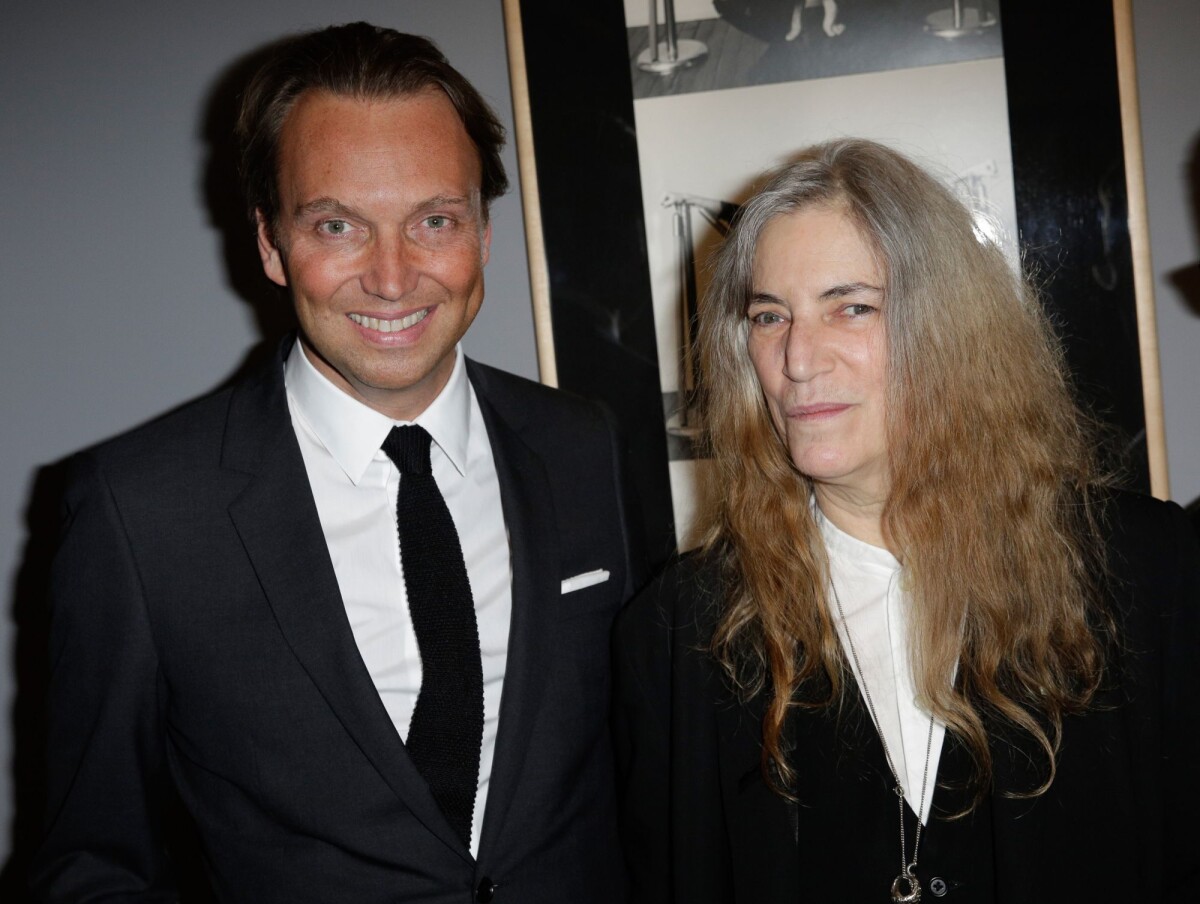
His cultural commitments became institutional as well as personal. He joined the board of the Réunion des Musées Nationaux in 2015. In 2023, he received the rank of Commandeur des Arts et des Lettres. France’s recognition placed his support for culture alongside a professional biography otherwise populated by brokers, exchanges and derivatives. A curriculum vitae can accommodate more than one kind of value.
Give the children a room of their own
In 2022, he created the JP Aubin Family Foundation, sheltered by the Fondation de France. Its purpose joins culture and education through partnerships with museums and artistic events. That choice gives the project a particular shape. A museum already has collections, curators and educators. A donor can help those resources reach children who might otherwise encounter them much later, or never.
The Grand Palais offered a substantial opportunity. Its restoration involved many patrons, each supporting different parts of a complicated undertaking. The Aubin foundation’s commitment enabled a new exhibition space dedicated to children. The building’s scale could have encouraged another adult occasion, another opening-night photograph. Instead, part of its future was being planned around visitors who might still need help reaching the display.
The support extended to the design and fitting out of the Palais des enfants and its inaugural exhibition, Transparence. There was earlier groundwork, too: between 2017 and 2019, Aubin supported educational kits produced by the GrandPalaisRmn for schools and leisure centres. The museum visit and the classroom need not operate as separate episodes. Materials can travel in the other direction.
Ages 2-10, with accompanying adults.
Palais des enfants · Grand Palais, Paris
The Palais des enfants opened in June 2025. Designed for children aged two to ten and their accompanying adults, the 620-square-metre space brings art and science into the same experience. Its first exhibition explores transparency through artworks, audiovisual material, interactive devices and hands-on experiments. A soap-bubble character accompanies the route. The dress code for curiosity is reassuringly informal.
That blend has a practical intelligence. A child can investigate a material, look at an artwork and test an idea without deciding which school subject has claimed the afternoon. The space was conceived with Universcience, joining scientific and artistic education. Its physical design acknowledges something adults can forget in museums: looking is an activity, and small visitors may want to do more than stand still.
Two appointments, one long view
February 2025 brought Aubin’s appointment as co-CEO alongside John Abularrage and Sean Windeatt after Howard Lutnick’s departure from BGC. Aubin continued as chief executive of EMEA, a position he had held since 2008. His promotion followed years as global co-head of financial services brokerage. Shared leadership put three experienced executives at the head of a business whose products and clients span markets and regions.
Only months later, the children’s space opened in Paris. The two developments make an unusual pairing on a calendar: responsibility for a brokerage group, and support for a place where a bubble can explain a scientific idea. Both grew from commitments made years earlier. The foundation’s name also remains on the Grand Palais’s 2026 list of patrons for Transparence, alongside MAIF.
“Rendre ce qui vous a été donné.”Jean-Pierre Aubin · “Give back what you have been given.”
For Aubin, giving back has a remembered starting point: a mother who took her son to museums. His career supplied the means to repeat that opportunity at a different scale. A board appointment, a decoration and a foundation make the commitment visible. The more revealing detail remains the closed-day visit: children from different schools, the same exhibition, and enough time to look.