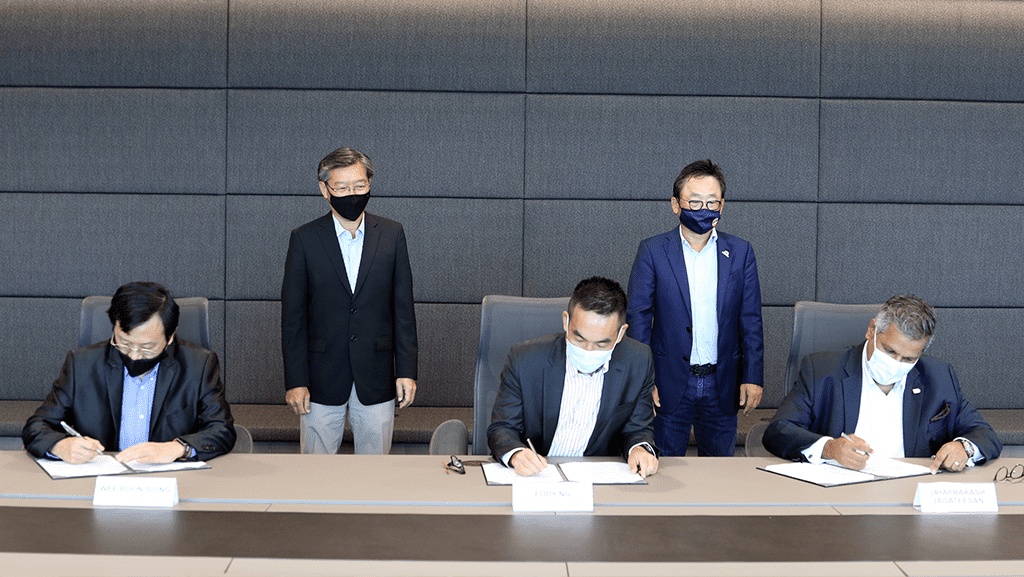
At the signing table, Jayaprakash Jagateesan sits on the right, pen in hand. Beside him are colleagues from RHT and PSA; behind them stand the leaders witnessing the agreement. The photograph, taken on 10 August 2021, has the familiar furniture of corporate life: documents, name cards, a table large enough to make everyone behave. Its subject is less familiar. A port operator and a professional services group are exploring digital assets for sustainability in ports and supply chains.
Jagateesan is there as chief executive of RHT AlDigi Financial Holdings and executive director of SDAX. The proposed work brings together finance, intellectual property, blockchain, sustainability advice and an exchange. It is a crowded list of disciplines for one set of signatures. It also offers a useful introduction to a career spent putting different kinds of expertise in the same room.
Before the token, the company
Known professionally as Prakash, Jagateesan helped establish RHT Holdings in 2011 with the founders of RHTLaw Taylor Wessing. The business supplied corporate advisory and capital markets services. By 2019, it had become RHT Fintech Holdings, carrying its professional services background into a field whose vocabulary was changing rather faster than its obligations.
The continuity matters. Helping a company raise money involves more than introducing it to someone with money. There are structures to choose, disclosures to prepare and responsibilities to allocate. Jagateesan’s earlier work put him among the businesses handling those jobs. Advisory, compliance and investor relations may lack the glamour of a launch announcement, but a company eventually has to answer their questions.
As RHT Holdings chief executive, he described a group serving businesses from their early establishment through preparation for a public listing. Its clients included multinational corporations, real estate investment trusts, listed companies and private entities. Corporate governance, risk management and advisory services belonged in that offering. The commercial proposition was coordination: different professional needs handled through one group.
That ambition acquired a concrete capital markets milestone in November 2016, when Singapore Exchange welcomed RHT Capital as a Catalist Full Sponsor. The accreditation expanded its corporate finance advisory capabilities alongside its existing continuing sponsorship work. Jagateesan called it “a major milestone for RHT Capital”. His explanation dwelt on what the group could now do for clients, connecting the accreditation to a broader range of professional services.
It is a revealing emphasis. The achievement sits inside an operating system of people and businesses. A new capability becomes useful when someone can combine it with the capabilities already there. Read through that lens, his move into digital finance looks like an extension of the organisational work that came before it.
An exchange with institutional memory
Jagateesan became a co-founder of SDAX, bringing that professional services setting into the development of a digital asset exchange. His education also spans the two subjects: a Bachelor of Science in Economics from the University of London, followed by a blockchain strategy programme at Oxford’s Saïd Business School. The Oxford programme was executive education, an additional course of study in a developing technology.
His work at AlDigi ranged across alternative assets, ESG investing and blockchain. He had also led investments, deal structuring, integration after acquisitions and business exits. These activities require different decisions at different stages. Buying a business, joining its operations to another and eventually selling an interest are separate jobs, even when a biography places them neatly beside one another.
On 1 February 2021, SDAX received approval-in-principle from the Monetary Authority of Singapore to operate a digital asset exchange. Jagateesan was its executive director. The exchange had drawn on the RHT network: legal specialists advised on the application, while compliance expertise supported the platform. Its planned offering centred on digitised asset-backed securities for accredited and institutional investors.
The institutional arrangements give the technology a setting. Blockchain could help record ownership and transactions, but the exchange still needed legal, regulatory and capital markets knowledge. SDAX assembled those disciplines around the platform. A trading screen is a compact piece of design; the responsibilities behind it occupy considerably more space.
In a published contribution in August 2021, Jagateesan argued that Singapore could build digital finance on its existing reputation and financial expertise. He paired greater efficiency with the safeguards expected of financial institutions. The argument placed innovation within a familiar obligation: people using a financial service should still be able to expect protections from the institution providing it.
“This is a major milestone for RHT Capital.”Jayaprakash Jagateesan, November 2016
Gold, ports and the work between them
SDAX’s partnerships put physical assets alongside digital processes. In March 2021, it signed an agreement with Singapore Precious Metals Exchange to explore cooperation on bullion. The proposed work included tokenised physical gold and silver, custody capabilities and possible bullion-linked indices. Jagateesan appeared in the announcement as SDAX executive director, alongside leaders from both exchanges.
That agreement described a framework and intended developments. Its significance lies in the connection it proposed between a physical asset and the services required to make a digital representation useful. A piece of gold does not acquire a custody arrangement merely because someone gives it a token. The relationship with a metals exchange addressed an ordinary, consequential part of the problem.
The PSA agreement later that year brought a different set of questions. How might digital asset structuring and investment support sustainability efforts across ports and supply chains? RHT’s proposed contribution covered consultancy, tokenisation and an exchange platform. Jagateesan’s role sat at the junction of those services. The agreement opened an exploration; its signing photograph captures the participants at that starting point.
By September 2024, the business he had co-founded was raising capital for its next phase. SDAX closed a US$50 million Series B2 round led by Oman-based Muscat Precious Metals Refining Company. The announced priorities included client acquisition, wealth and fund management, and regional expansion, with plans for an exchange in Oman. Rachel Chia was SDAX’s chief executive at the time.
That distinction keeps a founder’s story in proportion. An organisation grows through the work of successive leaders, employees, investors and partners. Jagateesan’s connection to SDAX continued through board roles; in May 2023 he was identified as deputy chairman and co-founder. His present role is non-executive director. The exchange’s later milestones belong to the institution and the teams carrying it forward.
The door marked education
Another part of Jagateesan’s public life concerns people who need financial support before their professional careers can begin. At the Singapore Indian Education Trust, he serves as chairman. Its records also show his earlier work as general secretary. The role places him within an organisation that has to raise money, assess applications and sustain assistance over time.
At SIET’s annual general meeting in May 2025, Jagateesan joined council colleagues in presenting the trust’s progress. The reported 2024 assistance included S$658,347 in interest-free study loans and grants for 178 students, alongside the SINDA-SIET bursary programme. These are organisational results, produced by a council, a secretariat, donors, volunteers and partners. They give his community role a scale beyond the title.
His chairman’s message on the following financial year describes attention to assessment processes, operational manuals, digital systems and financial monitoring. The same document records approximately 1,008 students supported across programmes in 2025. There is an instructive combination here: the human purpose of education assistance alongside the procedural work needed to deliver it consistently.
A trust has to make repeated decisions about real applications. Fundraising creates the means; governance helps direct them. An operational manual will never make an especially moving speech. It can, however, help the next application receive the attention it deserves. This is where the less visible work of an organisation meets the person hoping to benefit from it.
A round with somewhere to go
Golf supplies a more informal connection. Jagateesan took up the game in 2004 through colleagues, then joined a group called MGR that organised charity events. In a 2023 interview, he described the course as a setting for conversation with partners and friends. He named Tiger Woods and Vijay Singh among his favourites, admiring Singh’s practice and unusual shots.
There was a pleasantly unpolished detail, too: he said his handicap had risen from 16 to 22 as playing time became scarce. A busy diary had registered its opinion on the scorecard. He hoped to play more as additional colleagues took up the game.
By August 2026, that sporting setting had a direct educational destination. The SIET-SINDA charity tournament at Sembawang Country Club brought together 140 golfers and raised S$436,314 before matching support. Jagateesan spoke as SIET chairman about students completing their studies and contributing through work or community service. The beneficiaries, rather than the scorecards, supplied the event’s purpose.
The institutions that keep a door open
His community commitments also include ONERHT Foundation, which appointed him to its board effective 1 May 2023. At the time, its remit covered education, environment and sustainability, disadvantaged groups, arts and sports. The appointment announcement also recorded roles connected with a school and a hockey disciplinary subcommittee. His work extended into institutions where finance was only one part of the responsibility.
Jagateesan said he wanted to support a culture of giving. That aspiration belongs alongside his commercial work without making the two interchangeable. An investor, a student and a charitable beneficiary approach an institution for different reasons. Each depends on people who can turn a purpose into arrangements that work.
Across these settings, his career offers a portrait of the work between an idea and someone else’s opportunity. There are companies to organise, partnerships to negotiate, boards to serve and funds to direct. The signing table in 2021 shows one moment of that work. The student assistance programmes show another. Opening a door is a useful beginning. Keeping an institution capable of opening it again is the longer assignment.