There is a small act of hope hidden inside every online form. Someone asks; someone else answers; both parties pretend the answer will travel somewhere useful. For years, the form itself could make no such promise. It gathered the words, arranged them into rows, and retired with the serene finality of a clerk stamping a document. Jay Choi has built much of his career around what ought to happen next.
When Choi arrived at Typeform as chief executive in November 2024, he inherited a product with a rare advantage: people felt affection for it. Its one-question-at-a-time rhythm had rescued surveys and sign-up sheets from the visual charm of tax paperwork. More than 150,000 customers used the service. Hundreds of millions of interactions passed through it each year. Yet affection, Choi understood, is not the same as permanence.
A customer might make a registration form for a conference, collect the names, host the conference, and cancel. Nothing had gone wrong. Quite the reverse. The tool had completed its assignment and politely made itself unnecessary. Inside Typeform, these customers acquired a name worthy of a minor Evelyn Waugh character: happy churners.
The phrase is funny because the predicament is exact. A successful product had become episodic. Choi's question was how to preserve its agreeable simplicity while giving customers reasons to keep it switched on. The answer would lead beyond forms into the work that surrounds them: qualifying a lead, enriching a contact, following up, interviewing a customer, and making sense of what was said.
A career made of feedback loops
Choi did not arrive at this problem by a straight path. He studied computer engineering at the University of Michigan, then earned an MBA at Northwestern's Kellogg School of Management. He began in strategy consulting at Deloitte. After business school came Danaher, an industrial technology company, where product work sat close to general management, research, sales, and the inescapable discipline of a profit-and-loss statement.
That combination became his professional habitat. He has described his background as a bounce between product and general-manager roles. The motion matters. Product leaders are paid to imagine what can be built; general managers must account for the consequences once it is. Choi learned to speak both dialects.
The route to the Submit button
In 2015 he joined Qualtrics, then a fast-growing company with roughly $100 million in annual recurring revenue. A substantial contract at the time might be worth $10,000 and land on the desk of a research director. Seven years later, Choi recalled, teams were negotiating $10 million deals with chief executives. Qualtrics had passed $1 billion in annual recurring revenue and gone public in 2021 at a valuation above $13 billion.
Scale changed more than the number of zeroes. A survey tool became an experience-management category. Choi led product and general-management work, including an employee-experience business that grew from $50 million to $300 million in recurring revenue while renewal rose from 70 percent to 90 percent. The company had learned to elevate feedback from an occasional research project into a continuing system for running a business.
Brief chapters at AppFolio and Glia followed. At Glia, where he became the first chief product officer in 2023, he brought product strategy, management, and marketing into one team. His test for joining a company sounded almost suspiciously uncomplicated: product, potential, people. Good technology, a large enough opportunity, colleagues with whom one could bear a calendar full of meetings.
The director who crossed the table
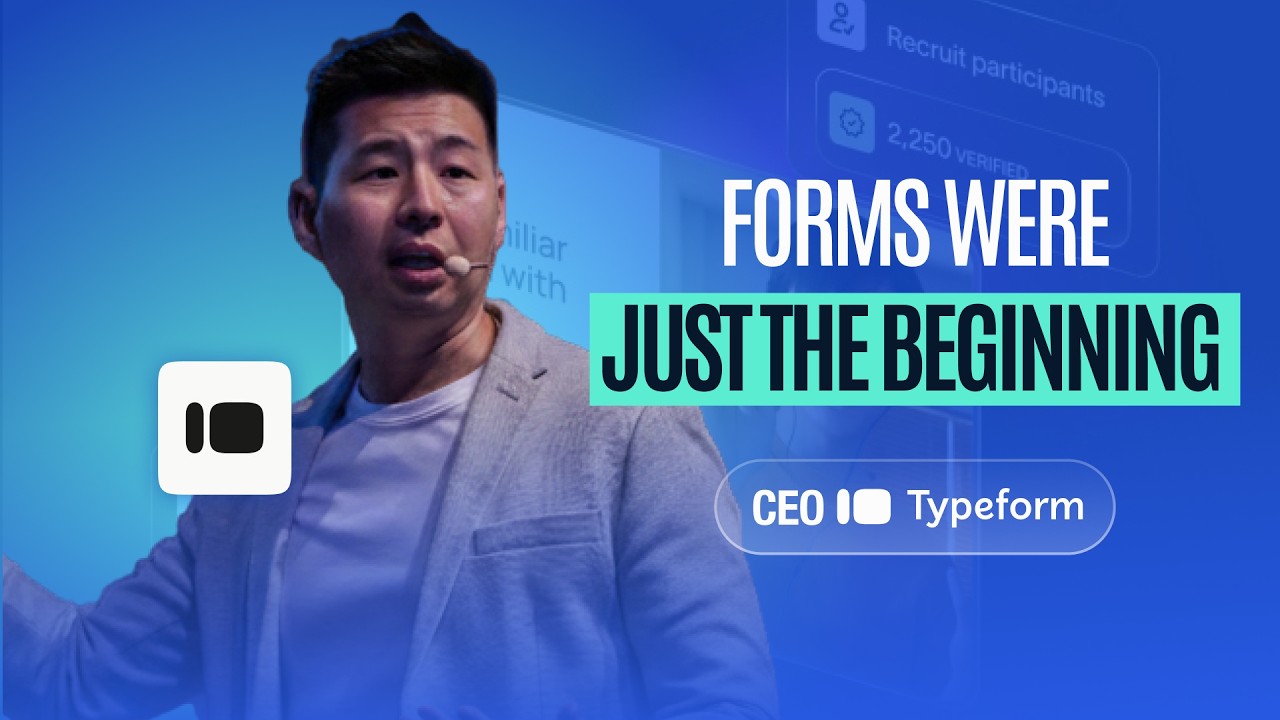
Typeform first brought Choi in as an independent director in February 2024. The appointment was logical: he knew customer-experience software, category design, and product-led growth. It also let him inspect the company before he had to run it. He worked with the board and leadership on product investment and growth. Nine months later, he crossed from adviser to chief executive.
The timing carried a neat echo. Typeform had just crested $100 million in annual recurring revenue, close to the point at which Choi had joined Qualtrics. The comparison was useful without being destiny. Typeform possessed an admired brand and a product-led engine that brought millions of visitors and hundreds of thousands of sign-ups. It also had the word form in its name at the precise moment generative AI was making simple software easier to reproduce.
Choi framed the response in two halves. Defense meant making the core product quicker and more informed: describe the form you need, point to a web page, and let the software propose a draft using patterns learned from millions of interactions. Offense meant building things that had previously been impractical. A response could trigger enrichment, scoring, an email, or an adaptive research interview. The form would become a door rather than a room.
This argument reverses one of product management's tidier commandments. Depth was once the reliable defense: choose a narrow job and perform it exquisitely. Choi believes AI has raised the value of breadth. A single lead-generation form may be easy to reproduce. The chain that sends it into a CRM, enriches the record, scores the prospect, drafts the follow-up, respects enterprise permissions, and survives a security review is a less inviting weekend project.
The enterprise piece can look unromantic beside an AI demo, which is precisely why it matters. Typeform was present in 95 percent of the Fortune 500 when Choi discussed its reach in 2026. Inside a large company, the practical sales conversation often concerns single sign-on, privacy, administration, and the hundreds of free accounts that have accumulated as shadow IT. Centralizing those accounts demands trust and controls. The form may be charming; the procurement questionnaire is not. Both have to work.
Plain words for strange machines
The breadth could easily become an excuse for a fog of fashionable nouns. Choi resists. Typeform uses AI for translation, so the feature is called Translate AI. A click turns a form into French, German, Hebrew, Chinese, or another language. The customer is spared a lecture on orchestration. “If they can't understand it,” Choi has said, “it's going to be really hard for them to get the benefit from it.”
The same pragmatism appears in Typeform's technical choices. The company aims to remain model-agnostic, selecting different models for different jobs as prices and performance change. Early on, switching to a newer model produced an awkward executive question: it was certainly more expensive, but was it better? The team invested in observability so taste could become measurement.
Pricing receives similar treatment. Choi's team may simulate 30 versions of a page, select two or three candidates, and test them in a smaller geography before expanding. They watch the mix of plans, average selling price, and annual adoption. The internal maxim is disarmingly free of marble tablets: “There's no such thing as perfect pricing and packaging. It's just the next evolution.”
Fifty conversations before lunch
By 2026, the strategy had acquired two substantial expressions. Growth Flow connected lead capture with enrichment and automated action. Research Flow used AI moderation to conduct qualitative interviews at a scale closer to a survey. A product manager who might spend weeks arranging 50 customer conversations could gather responses within hours, with follow-up questions shaped by what each person had said.
Choi's public manner tends toward cheerful precision. Former colleagues at Glia described an infectious enthusiasm and steady optimism; his own explanations quickly turn from aspiration to mechanism. At Typeform's annual Re:Connect gathering, held in Malta one year and Vienna the next, he celebrated team award winners and the rare chance for a distributed company to share a room. The warmth does not cancel the operator's appetite for a measurable signal. It makes the spreadsheet easier company.
There is an appealing circularity here. Choi is using AI to make software listen more like a person, while insisting that its value be explained in language a person would use. The ambition is technological; the sales pitch is almost domestic. Ask a better question. Understand the answer. Do the next sensible thing.
None of this abolishes the modest form. Wedding invitations and quizzes still introduce people to Typeform. Choi values those uses as part of the product-led engine. His wager is that some customers will discover a path from a temporary question to a continuing program: research that repeats, leads that keep arriving, relationships that require tending.
It is easy to imagine the form as the dullest object in software, a rectangle awaiting input. Choi sees instead a piece of unfinished choreography. The answer comes in. The useful work begins. Somewhere, a happy churner may find a reason to stay for the second act.