Jaspreet Singh has a dinner-table problem. His elder brother worked on voice and video calling at WhatsApp, a job people could immediately understand. Guests would settle into a long conversation about it. Eventually, someone would turn to Singh and ask what he did. Enterprise data protection required rather more explanation. The family had, in effect, produced one brother who helped people talk and another whose work became interesting when something went wrong.
Singh could laugh about the imbalance. By the time he told that story, Druva had announced a $100 million annual recurring revenue run rate. He also described a company that had reinvented itself through three major pivots. The apparent dullness of backup concealed a fairly unsettled business life. He had spent years changing what the company sold, how it delivered it, and what he himself needed to become.
A kitchen with a balance sheet
Before any of that, there was food. During an internship in Germany, Singh discovered that his Dutch roommate and other residents had an appetite for Indian cooking. Singh and friends supplied it. They collected money, bought groceries, and kept a balance sheet. The arrangement ended when they were thrown out of their hotel. Fortunately, he recalled, he had an apartment. His first business education came with an unusually direct lesson in premises management.
He was studying computer science at IIT Guwahati, where he graduated in 2004. His father’s Air Force career had taken the family around India. Moving between places and meeting different people belonged to his upbringing long before the international sales calls. The student cooking operation gave him something more specific: the pleasure of finding demand and making an arrangement that met it.
His plans had once included Infosys and an eventual MBA. A conversation with a friend who wanted to build a startup helped unsettle that itinerary. After graduation, Singh joined Ensim. The next lessons would arrive through software work rather than a business-school timetable. The kitchen had closed, but its little accounting department had left an impression.
The customer who changes the assignment
Through open-source projects, Singh met Milind Borate, who encouraged him to apply to Veritas. He passed the interview and joined the storage software company. Borate later left to start his own business. Singh grew bored and followed him, initially as an engineer. Their relationship supplied both technical confidence and a route out of a comfortable career. The future co-founder was first someone whose judgment he trusted.
Druva emerged from work on disaster recovery and the protection of important corporate data. There was a difficulty a better technical demonstration could not simply erase. Large businesses were cautious about trusting a young company with essential systems. When Singh went out to sell, he also heard that the product was difficult to use. The people expected to buy it were providing an education its builders needed.
The team turned toward endpoints: the laptops and other devices on which employees increasingly carried company information. That offered a more approachable problem than persuading an enterprise to entrust its central storage to an unfamiliar supplier. Druva developed the endpoint product in 2008 and began selling it in 2009. An overseas customer and subsequent financial-services customers helped provide the commercial evidence behind the idea.
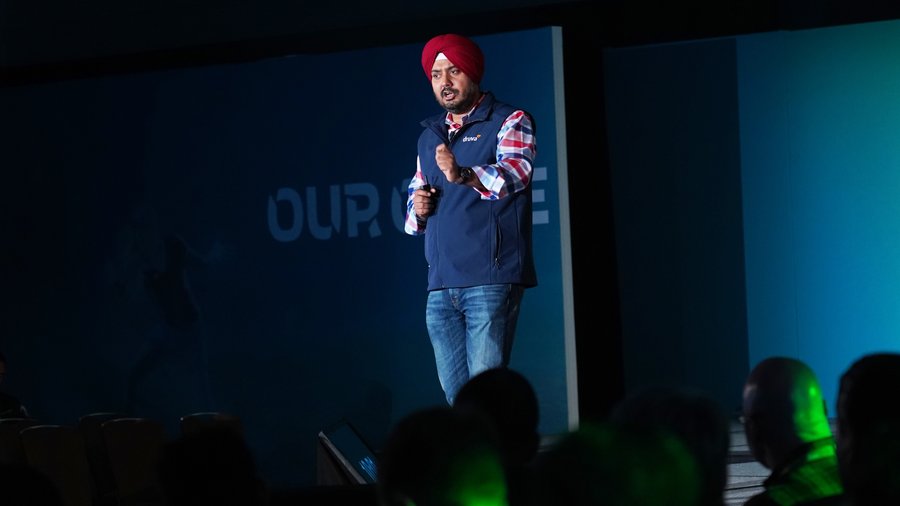
The business was founded in Pune by Singh, Borate, and Ramani Kothandaraman. Pooling savings and building software was only the opening move. They had to discover which part of the data-protection problem customers would let them solve. Singh later described Borate as his guru. It is an affectionate description of a relationship that joined technical apprenticeship to the less orderly education of starting a company.
The founder gets a new job
Singh began as a developer, then took responsibility for sales, operations, and marketing before becoming CEO. He found that explaining a solution he believed in suited him. Selling required him to make the engineering useful to someone else. A system could be clever, yet still fail to answer a buyer’s immediate question. Why this product? Why this supplier? Why take the risk now?
“All good founders are good sellers.”Jaspreet Singh, 2013
Venture backing from Sequoia arrived in 2010. Singh moved to Sunnyvale in 2012. The distance between Pune and California was now part of his working life, along with the challenge of building an organization capable of selling internationally. The early ambition had become a set of practical responsibilities: finding people, setting expectations, and learning which of his instincts deserved to survive contact with the market.
Hiring proved painful. He spoke candidly about replacing his marketing team and making mistakes in matching people to roles. Liking a candidate did not settle whether the person could do the work the company needed. His views on online marketing also collided with established assumptions about enterprise selling. He wanted customers to find and try a product; experienced advisers emphasized the familiar machinery of corporate marketing and channels.
His account of entrepreneurship was an upward spiral: make a product, position it, sell it, raise money, then repeat at a different scale. That description gives the founder little opportunity to graduate. The next turn brings a new customer, a different market, or a job the previous team was never hired to perform. He had left engineering with a good deal of engineering still ahead, now applied to an organization.
The cloud changes the terms
Cloud delivery expanded the question from where data lived to who should operate its protection. A company buying a service could expect the supplier to handle infrastructure and keep the machinery running. Druva built its platform on AWS and used a subscription model. Customers bought an ongoing capability, while the company assumed the work of operating it. The sales promise and the technical architecture had to agree.
In a 2020 discussion of Druva’s partner strategy, Singh described a focus on midsize organizations and the role of channel partners. Partners could help customers adopt cloud services and build additional services around the platform. Selling had become a system involving people beyond Druva’s own staff. The founder who once went into the field himself now needed a repeatable way for others to make the case.
SaaS annual recurring revenue reported by Druva
In August 2023, Singh announced that Druva had passed $200 million in SaaS annual recurring revenue. At that point, it managed more than 275 petabytes of data and performed over six billion backups annually for more than 5,000 organizations. These were measures of an ongoing relationship. The company had to keep providing the service after winning the account, including on days when nobody particularly wanted to think about backup.
The figures also put the dinner-table joke in perspective. Plenty of consequential work has an awkward introduction. It asks for attention on behalf of an event everyone would prefer to avoid. Singh’s career had become an extended exercise in making that proposition understandable, then ensuring an organization could deliver it repeatedly.
A little room for luck
There is a pleasing complication in Singh’s account of success: he gives luck some credit. In 2020, he spoke about the need to time the wind. A founder could prepare, persist, read, listen, and build relationships. The market would still have its own weather. This is a useful admission from someone whose company history could otherwise be edited into a tidy series of correct decisions.
“You must time the winds.”Jaspreet Singh, 2020
His emphasis on timing sits alongside a preference for resourcefulness. When Druva raised $147 million in 2021 at a valuation above $2 billion, Singh said it could have raised substantially more. He worried that excess funding could weaken creativity and the habit of solving an actual customer problem. A large financing round was a curious occasion to explain the virtues of having limits, but the argument was consistent with his early experience.
He was willing to compare entrepreneurship to grapes struggling to produce concentrated wine. The metaphor had travelled some distance from a student kitchen. Underneath it was a practical preference: money should support the work without becoming its purpose. The 2021 valuation was a measure attached to Druva. The everyday work still involved customers, products, and choices about where to spend attention.
The next thing people need back
By March 2025, customer demand had brought another architectural change. Druva was expanding its service delivery to Microsoft Azure after years of building deeply on AWS. Singh explained that customers wanted choice across clouds, while Druva still had to operate and secure the service end to end. Making that choice feel simple to a buyer required considerable work behind it.
He also acknowledged that Druva had pulled back from a planned public offering in 2021-2022 as market conditions changed. His discussion of a possible listing was conditional, tied to investor appetite and the company’s opportunities. Even after years as CEO, the schedule remained subject to forces outside his office. The wind analogy had acquired a financial application.
- DevicesWork leaves the desktop
- Cloud servicesInfrastructure becomes a service
- AI workspacesContext becomes something to recover
In July 2026, Druva announced recovery and governance capabilities for Microsoft Copilot and Claude Code, alongside MCP integration and a service-reliability agent. Prompts, conversations, generated files, and project context had joined the things businesses might need to retain. The company described capabilities in general or limited availability. In September, it added behavioral intelligence to identity recovery and ransomware detection, bringing more evidence into decisions about what to restore.
For Singh, the question has become how to reverse changes and preserve context as AI takes a larger role in work. The product boundary has moved again. There is a recognizable continuity with those early sales calls: discover what customers are struggling to protect, make the answer usable, and earn enough confidence to be trusted with it.
His career offers plenty of milestones, but its more interesting feature is the unfinished education. The student learned to charge for dinner. The engineer learned to sell. The salesman learned to hire, and the CEO kept finding new versions of the original problem. Perhaps the next family dinner will finally give enterprise backup its full hour. Singh would at least have a new opening line.