Jaspar Carmichael-Jack’s company had a small problem with its most recognizable advertisement. It said “Stop hiring humans.” The company, meanwhile, needed humans. By August 2026, Artisan was retiring the line and discussing a job opening for its first human business development representative. For a founder who had bought attention by the billboard, this was an unusually useful vacancy. A person with a telephone could help explain what three words on a wall had left out.
Carmichael-Jack, the British co-founder and CEO of the San Francisco startup, had made a business out of selling AI employees. Ava, its outbound sales agent, would research prospects, write to them and arrange meetings. The appeal was plain enough: salespeople spend hours preparing to sell. What if software did more of the preparation? The trouble arrived when the advertising made the disappearance of the salesperson sound like the point.
The distance between those two ideas is the territory Carmichael-Jack now occupies. His story involves an early appetite for commerce, a services business, a marketing agency, venture funding and a fair amount of deliberate mischief. It also involves discovering that a company’s customers can have a more interesting use for its product than its own slogan suggests.
A shop before a startup
His first shop had a fairly short commute. At seven, he recalls selling candy from his bedroom. At thirteen, he was buying and reselling internet domains. These are pleasing details because they contain both versions of the future entrepreneur: the seller who needs someone to want something, and the internet operator who can make a market without renting a storefront.
He grew up in Surrey and decided against university. In his account, he never applied. After finishing school in London, he started an app for booking cleaners. He later described the idea as a tarpit. The vocabulary is revealing: a business can attract effort without allowing much forward movement. Starting early gives a founder time to learn that distinction, although the lesson rarely arrives at a convenient price.
Assist, his on-demand services platform, used an outsourced development team. He said more than 3,000 service professionals signed up in the six months it operated. A marketplace needs people on both sides, however, and a signup total is only part of its story. His later assessment of the venture was considerably less celebratory than the number might suggest.
Burst Digital, the branding agency he founded before Artisan, put him closer to the practical business of finding customers. Brand, marketing and sales became working problems. By the time he began selling an AI employee, he had already sold services performed by actual people. The agency experience supplies a useful prehistory to a founder usually encountered beside a provocative advertisement.
The employee who came with her own software
In November 2023, Artisan had raised $2.3 million and secured a place in Y Combinator’s Winter 2024 batch. Carmichael-Jack’s original technical co-founder was Rupert Dodkins, an astrophysics PhD with machine-learning experience. One had skipped university; the other had stayed long enough to earn a doctorate. Their company was trying to make a new sort of office colleague.
The initial proposition treated an AI agent as an addition to a team. Ava would find leads, compose outreach, respond to questions and get meetings onto human calendars. Carmichael-Jack’s stated ambition already included people working alongside the software. The later argument about collaboration therefore has roots that precede the advertising controversy.
His broader plan combined two jobs: automate the work and gather the tools for doing it in one place. In September 2024, Artisan announced an $11.5 million seed round. The accompanying argument was that an AI employee should arrive with the software it needed, rather than leave the customer paying for a collection of disconnected products.
This is a marketer’s complaint rendered as product strategy. A workday can vanish into transferring information between systems that each promise to save time. Carmichael-Jack wanted Artisan to own more of the journey. The seed announcement reported more than 120 customers and $1 million in annual recurring revenue. Those were company figures from a particular moment, rather than a description of the business today.
Selected announced rounds. These are financing amounts, not revenue or personal wealth.
Three words, several consequences
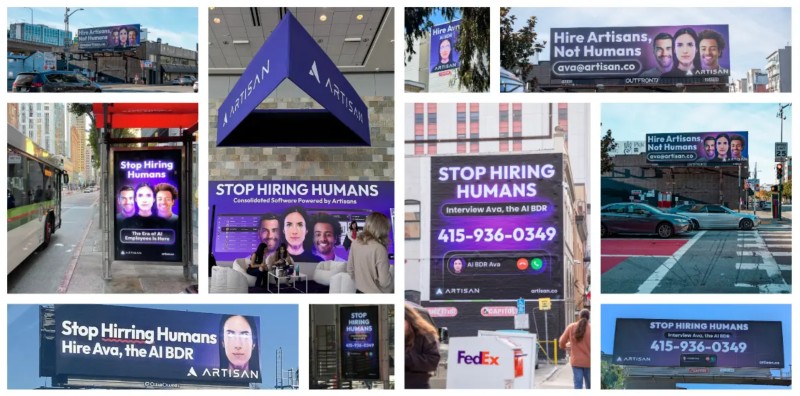
Then came the billboards. Late in 2024, Artisan told San Francisco to stop hiring humans. Other advertisements needled familiar features of working life. The joke was easy to understand and difficult to receive neutrally. A business might hear a promise of efficiency. Someone walking to work might hear that a startup considered them an avoidable expense.
Carmichael-Jack later described the campaign as deliberate provocation. In March 2025, he attributed more than a billion online impressions and over $2 million in new annual recurring revenue across two months to the marketing. Those were his claims about its effect. The response also included threats and angry messages. Attention had arrived with rather more baggage than a conventional advertising report could comfortably accommodate.
Artisan played with the incongruity. A Reddit post showed humans promoting the call to stop hiring humans; the post was removed after moderators learned the company was behind it. By June 2025, the campaign had reached London, including Old Street station. The geography expanded. So did the audience being asked to enjoy the joke.
The episode gives a fairly specific picture of Carmichael-Jack’s public manner. He is willing to make the company conspicuous, and willing to use irritation as part of the method. He also advises founders to build a public presence early. For him, distribution includes the founder’s own voice, face and readiness to be discussed.
The CEO briefly leaves the building
On April 1, 2025, Carmichael-Jack supplied a further joke: he was stepping down, to be replaced by an AI version of himself. “Jaspar 2.0” appeared in a campaign that extended to Times Square. It was April Fools’ Day. The human CEO remained in the job.
The gag had the advantage of applying the company’s advertised logic to its own boss. A founder preaching automation could hardly reserve himself a permanent exemption from the experiment. As comedy, it was tidier than an argument about the future of employment. It also kept the original question alive: which parts of a job can a machine actually take responsibility for?
That April, Artisan raised a $25 million Series A led by Glade Brook Capital. A financing announcement answers one question about a company’s ability to keep building. The working product must answer several others. The joke CEO, at least, had left Carmichael-Jack with those responsibilities intact.
The company’s current co-founder lineup includes Sam Stallings, whose background spans IBM and engineering at another YC startup. Artisan describes her as leading product and engineering. The founder associated with the billboards depends on colleagues doing the less photogenic work of making the proposition function.
The person on the other end of the phone
By 2026, Carmichael-Jack was spelling out the division of labor more carefully. His proposed sales organization includes a human who directs campaigns, defines useful signals and maintains the information the AI uses. He calls that role the GTM architect. Salespeople keep conversations, negotiations and relationships that benefit from a person’s judgment.
In this arrangement, delegation creates another kind of management. Somebody decides whom the system may contact, what it may say and when it should ask for help. The human work moves. A job description built around those decisions sounds rather different from a billboard inviting people to dispense with colleagues.
The architect sets direction
Audience, campaigns, knowledge and boundaries.
Ava runs the outreach
Research, messages, replies and scheduling.
People make the connection
Calls, meetings, negotiation and relationships.
The announced human BDR hire makes the idea concrete. Ava handles much of the surrounding process; the person gets on the phone and meets prospects. This is also a test of the founder’s argument. A company selling a new way to organize sales can try it on its own sales floor.
Artisan’s updated essay says the original slogan was retired in August 2026. Its newer message, “Be more human,” is friendlier. The obligation behind it is substantial. If customers are buying back people’s time, the product has to make those recovered hours useful. A nicer sentence alone cannot book a worthwhile meeting.
Even the robots have an expense account
By October 8, Carmichael-Jack was discussing another complication: AI has operating costs of its own. He described a team of around 50, despite earlier plans to grow beyond 100, and instances where employees’ token bills could make an additional human hire look cheaper. The company had stepped back from maximizing AI usage to pay closer attention to the return.
It is a refreshingly mundane detail in a story full of theatrical ones. The imaginary employee still sends a bill. Carmichael-Jack also emphasized product judgment and knowing a customer’s workflow. Easier software development does not supply either automatically. His ambitions now extend toward an AI account executive for smaller deals, adding another set of responsibilities to the original outbound proposition.
His longer-term aspirations reach beyond sales software. He has argued for shorter working weeks and broader sharing of the gains from automation. He describes a future with more time for life beyond the job. That ambition places a large demand on a business whose customers still expect measurable commercial results.
“a world where people work less and live more”
Jaspar Carmichael-Jack, 2026
The boy selling candy had a clear transaction in front of him. The adult selling AI employees has inherited a messier one: customers want output, workers want worthwhile work, and software needs supervision even when its advertising seems to suggest otherwise. Carmichael-Jack helped make that tension visible. His next chapter will be written in the details of how people and Ava work together, after the billboard has done its job.