Commercial insurance has a talent for making ordinary questions look like a civil-service exam. What does the business own? Who drives the vehicles? What changed since last year? The answers can scatter across PDFs, spreadsheets, inboxes and the recollections of three busy people. Then somebody must gather them, type them again and remind everyone to sign. Jason Keck looked at this ritual and saw a product brief hiding in plain sight.
He did not arrive with the traditional credentials of an insurance lifer. Keck grew up in a hard-working, middle-class part of New Orleans, where baseball supplied his first operating system. He captained his high-school team, caught, hit third and relished playing larger schools as the underdog. Harvard offered a larger field. He studied computer science, specialized in computer networking and played varsity baseball.
The sport nearly claimed his career. During his junior year, after batting above .400, Keck received an invitation to the Cape Cod League, where college players test themselves in front of professional scouts. He could imagine the major leagues. He could also imagine Silicon Valley. A long conversation with Scient executive Balaji Gopinath settled the contest. Keck accepted a technology job; Gopinath became a mentor and remained a friend.
“I always thought I'd be an engineer while also dreaming of becoming a CEO one-day.”Jason Keck
A career built in other people's interfaces
Scient hired Keck as a developer during the dot-com boom. The coding did not contain him for long. He discovered an aptitude for culture and people, spent six months as the wonderfully improbable Chief Morale Officer, and started a summer internship program called Summer Legends to recruit technical talent. The title sounds like a prank conceived near a ping-pong table. The work underneath it - attracting good people and giving them a reason to care - would follow him.
After Scient came telecommunications and consulting work, including Nextel and three years at Accenture. Then the career acquired a soundtrack. At Shazam, Keck led global business development as the music-recognition service negotiated its place across phones, carriers and app stores. Later he built digital-media ventures of his own, Stereotypes and Motion Traxx, before joining Tumblr as head of product partnerships.
Those jobs appear far from commercial insurance, but each sat where product met distribution. A useful tool still needs a route onto a screen. A popular platform still needs partners. A clever experience still has to make sense to someone who did not attend the roadmap meeting. Keck learned the mechanics of getting technology into people's hands, then found an industry where too much of the experience remained in their printers.
The paperwork plot twist
In 2017, Keck reconnected with Mark Peter Davis, managing director at the New York incubator Interplay. One of its companies, the digital insurance agency Founder Shield, had created internal technology to accept client applications. Davis saw the wider opportunity. Independent agencies everywhere shared the same dull burden. Interplay wanted Keck to lead a new company around it.
His first reaction was candid: insurance? He knew nothing about insurance. Curiosity beat familiarity. The industry depended on relationships and specialized judgment, yet important customer interactions were tangled in attachments, scans, faxes and phone tag. To an engineer who disliked wasted time, the mismatch was almost rude.
Broker Buddha was founded in May 2017 and shipped its first version six months later. Its smart forms could present relevant questions, hide irrelevant ones, pre-fill known information and map common answers across multiple documents. A dashboard tracked progress. Reminders went out automatically. Agencies could preserve their own branding, language and client relationship while handing the repetitive choreography to software.
The administrative relay, shortened
The company reported that applications and renewals returned in about 3.5 days, rather than stretching across weeks or months. The number matters because the product's real output is not a prettier form. It is recovered attention. An agent who is not composing the fourth reminder can talk to a client. An account manager who is not retyping a vehicle schedule can notice what changed.
“Do less, not more.”Keck's favored piece of advice
One memorable thing
Keck's advice to startups is admirably unfashionable: define the customer, define the problem and get one thing right. People remember a company for one meaningful pain it removes. Broker Buddha's first wedge was neither a digital insurance carrier nor a marketplace. It was the application and renewal workflow, performed for agencies that wanted a modern client experience without surrendering the relationship.
Focus also created a useful boundary. Commercial insurance is complicated because businesses are complicated. A small, standardized policy may move through an online rate-quote-bind funnel. Middle-market and specialty risks still need conversation and underwriter judgment. Keck's product thesis was to improve how information moves around those people, not pretend the people had become unnecessary.
The constraint did not make the roadmap timid. Broker Buddha added submission tools, electronic signatures, reusable schedules and integrations. Its library grew from the early collection of smart forms into a broader client-engagement platform. Keck described the operating rhythm in terms familiar from software: build, test, learn, then repeat in short cycles. Insurance expertise entered through interviews with agencies, observation of their work and feedback from customers.
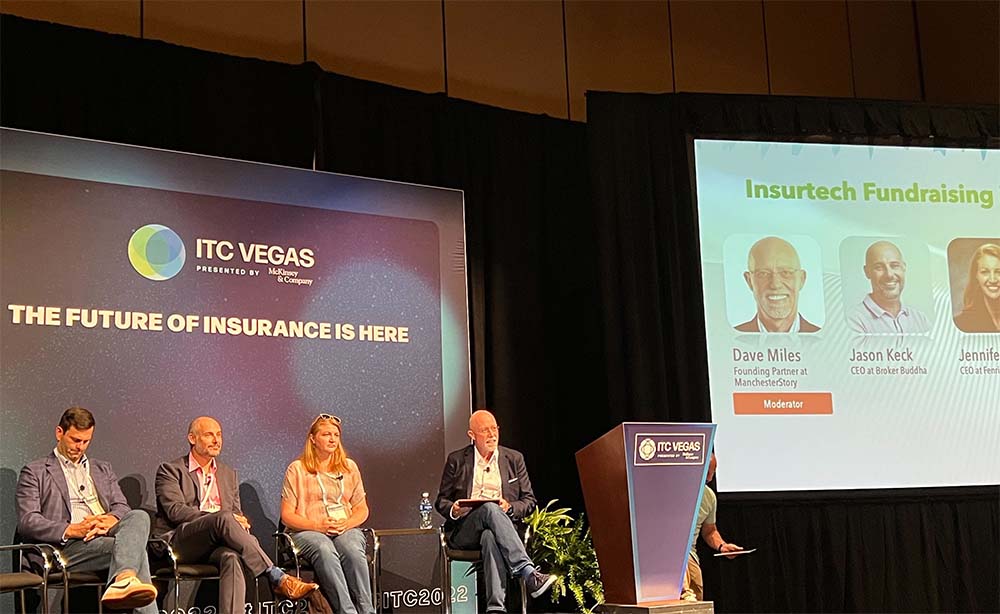
Capital, a buyer and a wider map
Investors followed the workflow. Vertex Ventures US led a $4.5 million seed round in 2019. In 2022, SiriusPoint led another $5 million round, with participation from Vertex and insurance-industry investors. Keck wrote that the money would support the company's mission to eliminate monotonous administrative work and connect the information agents gather with the carriers that need it.
In August 2023, the British insurance-software group Acturis acquired Broker Buddha for undisclosed terms. Acturis already operated in Germany, France and Canada; Broker Buddha became its entry into the United States. For Keck, the deal offered resources and an international software group without closing the New York company's chapter. He stayed as CEO, with the near-term focus on expansion in the US market.
An acquisition can flatten a founder story into a transaction notice. This one preserved the interesting tension. Broker Buddha had been built by an outsider learning insurance from agencies. It was now inside a group with deep industry infrastructure. The next product question became how to connect Keck's client-facing workflow with a much larger operating system.
The AI skeptic builds with AI
Keck's position on artificial intelligence has evolved in public. In a 2023 interview, he resisted calling Broker Buddha an AI company. Startups, he argued, had spent years applying the term to ordinary algorithms and technology. Broker Buddha collected structured exposure data that could enable AI, but the company itself did not need the label.
By 2026, Broker Buddha AI was in public beta. The apparent reversal is more disciplined than dramatic. Generative systems had become useful for document extraction, organization and pre-filling. The company expanded its scope across customer management, market submissions, signatures, loss-run requests, service work and agency-management integrations. Keck's skepticism survived as a product rule: keep a human at the wheel.
Let software prepare the renewal, extract the document and organize the data. Let the account manager review, correct and approve before anything consequential leaves the agency.
That distinction suits insurance, where an answer can affect coverage and an error can create liability. Keck now argues for AI-enabled systems that work inside existing processes. His checklist is concrete: can a person review every critical step? Does the software integrate with the agency's management system? Does it behave like an assistant or force the agency to rebuild its workflow around a prompt box?
The rollout advice echoes his founder advice. Start with one workflow. Measure time saved, rather than counting AI features. Keep people responsible for final decisions. The language has changed since Broker Buddha's smart-form beginnings; the objective has not. Repetitive work goes to the machine. Context, accountability and relationships stay with the professionals.
A podcast becomes a listening post
Keck also turned industry conversation into a product-adjacent habit. Since 2021, he has co-hosted The Enlightened Agent, interviewing agency operators and insurance executives about culture, service, diversity, automation and change. By March 2026, the show had reached 38 episodes. Its fourth series opened with Ryan Hanley on AI, followed by Loss Run Pro founder Reghan Brandt on the stubborn work of obtaining and using loss runs.
A founder hosting a podcast can look like marketing with headphones. Here it also functions as field research. The guests describe the messy work between systems, the emotional cost of poor processes and the places where automation helps or merely adds another login. Those are product conversations, only with theme music.
Keck's own off-duty choices are reassuringly specific. He can rewatch Aliens indefinitely. He reads Brandon Sanderson's sprawling Stormlight Archive to disconnect. He once listed wearing creative black tie at the 2008 Mobile World Congress Awards among the things that made him proud. An entrepreneur against monotony should be allowed a small rebellion against the tuxedo.
The engineer and the catcher
The clean version of Keck's career says he moved from consumer technology into vertical SaaS, raised capital and sold a company. The more useful version is about position. A catcher sees the whole field but spends the game in the dirt, translating signals into action. A partnership executive stands between product and distribution. An insurance workflow platform sits between client, agent and carrier. Keck keeps choosing the seam.
His aspiration for Broker Buddha is correspondingly practical: a connected digital world where insurance professionals spend less time on monotonous administration and more time protecting the businesses they serve. The work is unlikely to make forms lovable. It may make them shorter, smarter and less visible. For a document nobody wished to meet in the first place, invisibility is an excellent design goal.