The customer’s name has not changed. Neither has the address, the business description or the building that needs insurance. Yet somewhere between an independent agency and an insurer, these facts can acquire a peculiar obligation: they must be typed again. The computer has delivered them to another computer. A person is still required to introduce the two.
That small indignity is a useful place to begin with Ivans. Insurance is sold through relationships, priced through judgments and serviced through records. When those records stop at the boundary between companies, a surprisingly sophisticated industry starts behaving like a relay race in which every runner must rewrite the baton.
- The job: connect agencies, insurers and managing general agents so insurance data travels between their systems.
- The advantage: deliver information inside workflows agents already use, rather than requiring a fresh visit to every carrier.
- The stakes: in a 2026 survey, 90% of participating agents said submission friction had caused them to reduce business with a carrier.
Ivans is a division of Applied Systems. Its products cover the business before a policy is written, the information exchanged afterward and the market intelligence hidden in that activity. Its most interesting proposition is wonderfully unromantic: make the handoff less bothersome, and the relationship becomes more useful.
The sale can be lost before the quote
In April and May 2026, 702 independent agents voluntarily completed an online connectivity survey. The findings, published in August, give administrative irritation an economic consequence. Re-entering risk information into multiple carrier portals was the leading submission pain point, cited by 74% of respondents. Commercial submission automation was the capability agents most wanted from carriers, at 79%.
These are reported preferences from a self-selected sample, not a controlled experiment proving that software causes sales. They nevertheless describe a recognizable constraint. An agency has a finite number of people and hours. A carrier that asks for more of those hours makes its product more expensive to distribute, even when the commission looks attractive.
Westfield makes the commercial logic explicit in its Ivans customer story. The insurer wants agents to find appetite and quote within their management systems. Some agents will still prefer its portal. But its digital distribution team treats commercial comparative rating as a requirement for remaining present when an agent looks for a new market or needs to remarket an existing customer.
The implication is sharper than “save time.” A carrier can lose the opportunity to be considered. The agent’s screen is part of the distribution channel.
A business built at the boundary
Ivans dates its history to 1983, when insurance-industry participants were working on standardized electronic exchange. The founding idea was collective: different companies needed a common way to move information. Decades later, that problem still rewards a specialist who understands both the data and the business around it.
Applied Systems completed its acquisition of Ivans’s property and casualty business in 2013. The business continued as a separate division, with an open-platform commitment to existing carriers and agency management systems. That detail matters. Applied sells agency software itself; Ivans’s usefulness depends on connecting a wider field.
The current network includes systems such as Applied Epic, EZLynx, Vertafore AMS360 and HawkSoft. The expertise is in translating insurance work into dependable exchanges: policy records, documents, claims updates and commission information arriving where an agency can use them. A generic messaging service can move a file. The more demanding job is helping that file become part of a working insurance record.
“What I love about the IVANS platform is that it creates the plumbing.”Deb Smallwood, Strategy Meets Action · at the Distribution Platform launch, 2021
First find the market. Then send the risk.
In March 2021, Ivans launched its Distribution Platform to connect commercial insurers, MGAs and distribution partners through one access point. Its ambition extended beyond straightforward risks: the launch described support for automated processing as well as submissions requiring an underwriter’s attention. Better transport does not remove the need for judgment.
Then, in August, Ivans acquired Ask Kodiak. The addition addressed an earlier question in the journey. Before an agent requests a quote, which insurers actually want the business? In insurance, “appetite” is the carrier’s answer: the classes of risk, locations and circumstances it is prepared to consider.
Ask Kodiak lets carriers maintain commercial appetite and eligibility centrally and expose that information through agency tools and APIs. It supports six-digit NAICS classifications, turning an industry code into a practical search aid. A restaurant and a roofing contractor may both be small businesses. Sending their applications to the same list of insurers would be an impressively tidy way to waste everyone’s afternoon.
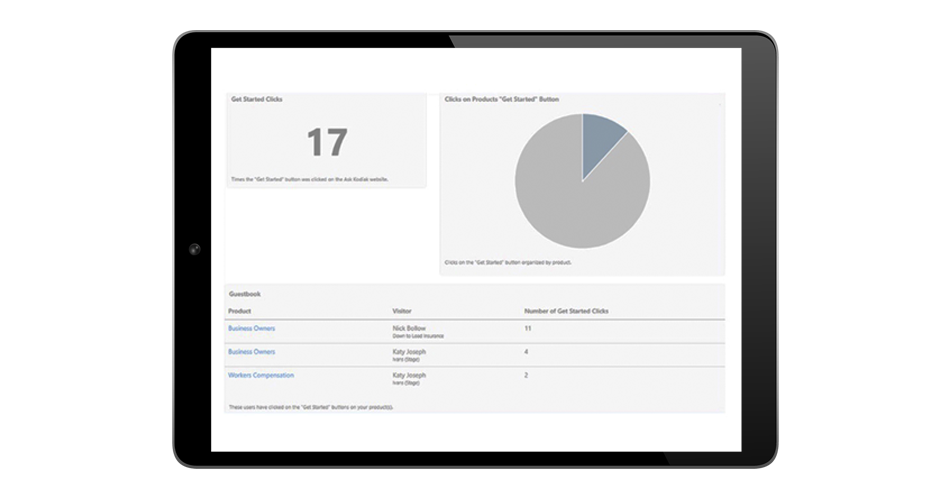
The Distribution Platform brings appetite, structured submissions, attachments and quote responses into connected workflows. Depending on the integration, an agent can continue within the agency application or move to a carrier portal to finish rating and binding. The promise is fewer individually maintained connections, not identical behavior from every carrier.
The policy is sold. The clerical work is not.
Ivans Download handles another stretch of the journey: synchronizing policy-related information with the agency management system. Its supported categories include personal and commercial policies, claims, direct-bill commission statements, and electronic documents and messages. Instead of chasing an update across carrier systems, the agency receives data through its existing workflow.
Each category removes a different sort of interruption. A claims update helps answer a worried customer. A policy document helps keep the record current. A commission statement supports reconciliation. Ivans eServicing adds on-demand inquiries for information such as billing, account status and loss runs. The common objective is to shorten the distance between a customer’s question and a usable answer.
- 01 / FINDAppetite & eligibility
Ask Kodiak - 02 / QUOTESubmit & receive responses
Distribution Platform - 03 / SERVICERecords & inquiries
Download + eServicing
Ivans Exchange is the agency’s connection-management tool. It shows existing and available download connections, supports communication about quality issues and allows policy resends. Ivans describes it as complimentary, with a possible fee for Citizens Insurance of Florida business. For an agency already using the network, inspecting unused connections is a concrete first step.
Once data moves, it becomes a map
Ivans launched Insights in January 2023, beginning with Marketing Insights. The move followed a useful progression. A network that carries policy information can also help participants understand the distribution patterns represented in that information.
The current product offers agency book visibility, searches by market and policy attributes, and premium benchmarks. A carrier can investigate potential distribution relationships or compare premium patterns instead of assembling every view through separate visits and reports. The value comes from the underlying insurance activity; a handsome dashboard alone would have remarkably little to say.
Ivans reports 38,000 connected agencies, more than 700 carriers and MGAs, over 45 integrated management systems and more than 1.5 million daily transactions. Those figures describe network breadth. They do not mean every agency can instantly transact every line of business with every carrier.

The bill includes the handoff
Ivans operates in business-to-business insurance software, selling connectivity and data capabilities to carriers and MGAs through a sales-led process. Its generally free Exchange tool makes agency participation easier. The products serve different sides of the same relationship: carriers want distribution and useful submissions; agencies want less administrative work and faster access to answers.
The meaningful cost comparison includes implementation, maintaining connections and handling exceptions, alongside the software contract. An insurer weighing an integration should count the work that disappears and the work that remains. Faster submission transport is useful; it does not by itself establish a better underwriting result.
Alternatives include direct carrier portals, bespoke integrations and overlapping transaction products such as Vertafore’s TransactNOW. The competitive picture is untidy in a productive way: Vertafore’s AMS360 also supports Ivans downloads. Buyers should compare the particular workflow and supported carriers, rather than assuming one brand replaces an entire ecosystem.
Switch on the connection, then measure it
The lesson readers can copy is practical. Begin where information is entered twice. Check which carriers, transaction types and management-system settings support an automated exchange. Activate an available connection, then measure rekeying, exceptions and turnaround for that workflow before expanding it.
Ivans’s own setup guidance exposes the conditions. A carrier has to enable download; the agency system has to accept it. If a file is missing from the mailbox, the carrier may need to investigate. If it arrived but looks wrong, a resend or system-setting check may be necessary. Connectivity cannot repair an unsupported transaction or make stale appetite information accurate.
The company’s progression from exchange to submissions to intelligence suggests a broader lesson: the boundary is often where the useful work begins. Insurance already contains plenty of expertise. Getting that expertise and its records to the next person, without another round of typing, is a business in its own right.
Explore the connections
Visit Ivans, browse the company blog or read recent announcements. Follow along on LinkedIn, Instagram and Facebook.
WATCH & TRY