The envelope is the part you notice. Somewhere upstream, somebody has had to decide which message belongs inside it, which address belongs outside it, and how to get thousands of similar envelopes moving together. A direct mail campaign is a small act of persuasion attached to a large coordination problem. Japs-Olson Company, now branded JO, has spent more than a century getting closer to that problem.
- The work: commercial print, personalized mail and postal logistics.
- The advantage: production and mailing under one roof, with one schedule to manage.
- The lesson: judge technology by the work it removes between steps.
Barney Japs and G. F. Olson started the business in 1907. Today, JO’s website reports more than two billion direct mail pieces a year. Those numbers invite a familiar story about bigger presses and faster machines. But the more useful story concerns the spaces between machines. Who owns the next step? Who checks the data? Who makes sure the savings on production survive the trip to the mailbox?
01 / The stamp has a say
In 2012, Japs-Olson announced an expansion of its commingling and tracking operation. Commingling combines different customers’ mail streams into one stream for postal processing. A campaign that looks modest by itself can join a much larger flow. The company also described an on-site post office. Consider the implication: the printer was organizing its business around what happened after printing.
“Postage is the single largest cost of any direct mail program.”Mike Beddor, then CEO, 2012
That observation changes where a buyer should begin. If postal handling is a major expense, choosing a format before discussing delivery can lock in costs early. The practical takeaway is to bring the mailing specialist into the brief. Ask about sorting, timing and eligibility before approving a clever shape. Beauty still matters. So does the journey the beautiful thing must take.
- 01DataWho gets what?
- 02PrintMake each version.
- 03MailSort and combine.
- 04TrackFollow the journey.
02 / One roof, fewer loose ends
JO’s services span letters, inserts, catalogs, postcards and envelopes. It offers variable imaging, data cleansing, triggered campaigns and finishes that add texture or metallic effects. Mailing services include co-palletization and tracking. For a marketing team, the appeal is straightforward: these are decisions that would otherwise need to be coordinated across suppliers.
The customers explain why that coordination matters. JO serves financial services, healthcare, insurance, retail and nonprofit organizations. Its website carries testimonials attributed to a national pharmacy, a multinational bank and a global electronics retailer. They remain unnamed. The common requirement is recognizable: a campaign must arrive with the right content, acceptable quality and a schedule somebody can explain.
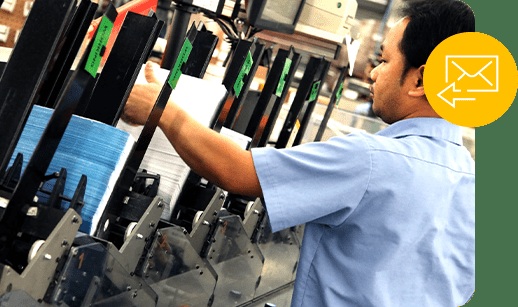
The business sells custom services through quotes and written contracts. This is production infrastructure for organizations running mail programs. IWCO offers a relevant alternative in that market; buyers can compare capabilities and delivery requirements rather than assume that every commercial printer handles the same work. JO’s proposition is the breadth of what stays inside its operation.
03 / The first experiment didn’t work
There is a pleasing complication in JO’s technology history. A Printing News interview describes an inkjet press beta trial in the late 1990s that failed. The company did not return to considering presses until 2014. By then, it already had more than 100 inkjet heads working elsewhere in the plant. Its hesitation was informed by experience.
What changed was a combination of equipment and confidence in the supplier. Patrick Murray identified speed, quality, technology and trust in Kodak as reasons to pursue the PROSPER 6000. His warning was equally useful: define the project with the manufacturer before starting. A beta installation can demand resources for longer than expected. Being first requires room for a slower return.
“Don’t get blinded by the excitement of the new technology.”Patrick Murray, 2021 interview
For a buyer with no spare engineering time or financial cushion, that approach has obvious limits. The transferable idea is the discipline: decide what the machine must accomplish, who will solve problems, and what evidence will justify keeping it. An impressive demonstration is the beginning of that conversation.
04 / Keep the old machine in the conversation
By 2024, Murray was explaining a production system in which digital and offset printing complemented each other. Kodak’s account described 13 web offset presses equipped with PROSPER imprinting systems. Digital capability could sit inside an established process rather than require the whole operation to be replaced.
He also described shorter offset runs with more versions, and pointed to automation as a way to improve efficiency. That is a useful distinction for customers. Personalization changes the production problem: more versions have to move through the plant without turning every change into a separate administrative event. The expertise lies partly in choosing the right route through the available equipment.
Pieces per year. Company-reported output, not a forecast or a measure of campaign response.
05 / The next handoff
Monomoy Capital Partners acquired Japs-Olson in 2023. Wells Fargo and Prospect Capital Management provided transaction financing. The company introduced its refreshed JO identity in May 2025, including values focused on progress, accountability and collaboration. These changes put a new owner and a shorter name around an established industrial operation.
The property transaction put a dollar figure on the physical operation. In May 2023, Angelo Gordon bought the headquarters and connected parcels for $71.2 million, with a 20-year lease attached. That was the real estate sale, a separate transaction from Monomoy’s purchase of the company.
The April 2026 announcement brought more tangible developments: inline envelope equipment, an HP wide-web digital investment, dual-web production and HITRUST certification. JO said the envelope technology had already produced more than 100 million envelopes. Its dual-web capability combines two paper stocks in one mailer, allowing different material choices for the outside and inside.
For the customer, the sensible next move is a specific conversation: bring the audience, versions, format, deadline and delivery requirements. Ask how the whole job will run. No printer can rescue an irrelevant offer simply by producing it efficiently. But when a message deserves to travel, an operation built around the journey can make the trip considerably less complicated.