A dining room table in Reston is a modest place to begin an argument with paper. James Quigley co-founded GoCanvas there in 2008. Invoices, work orders, inspection sheets: the everyday documents of people whose working lives happen away from a desk. There was plenty to replace. A form has a remarkable ability to survive successive generations of technology, usually by requiring somebody to type its contents into the new one.
Quigley had spent years in mobile and wireless businesses before starting Canvas, as the company was originally called. His career included senior positions at inCode Wireless, Aether Systems, Orbcomm and Peak Technologies. These were useful places to learn about work that travels. A field employee has information that somebody back at the office needs. Getting it between the two can consume an unreasonable portion of the day.
The proposed solution let businesses find, customize and publish mobile data-collection applications. It also depended on timing: smartphones had to become common enough, and the word “app” familiar enough, for customers to see the possibilities. The technology in a worker’s pocket was becoming more capable. Quigley wanted the worker’s paperwork to catch up.
Paper was patient. Investors were harder.
Starting in 2008 supplied a brisk education in fundraising. In the early days, the founders were trying to sell a vision before they had a product, against the backdrop of the financial crisis. Quigley later described it as one of the hardest financing periods of his career. The business bootstrapped, then began funding growth with backing from early investors in 2009.
By August 2011, Canvas had announced $1.2 million in Series B funding. The pitch was unusually tangible for a software business. Customers could replace forms and surveys, cut repeated data entry and share information gathered on mobile devices. Quigley identified the opposition with admirable economy: “Our biggest competitor is paper forms.” A clipboard rarely schedules a competitive sales call. It can still be difficult to dislodge.
His business asked customers to change a familiar routine. That makes ease of use commercially consequential. Osage’s portfolio description would later emphasize customers getting started without coding or IT assistance. The proposition put the person who understood the work closer to the tools for changing it. A business did not have to become a software developer before it could improve a work order.
The room was part of the product
Quigley’s interest in working arrangements extended to his own office. The GoCanvas layout took roughly nine months to develop, then changed after the team moved in. Round meeting tables reduced the ceremonial importance of the seat at the head. A nook appeared when employees asked for somewhere quieter. These were small decisions with a recognizable intention: make it easier for people to contribute.
He had an earlier example of proximity paying off. In a townhouse used for coworking, the young business bought a phone system from a neighbor. Another company helped it implement a chat system in three days, against an original two-year plan. It is an excellent advertisement for having useful neighbors, and a rather awkward one for the original schedule.
“Empathy is the currency of innovation,” Quigley said. The thought joins the software to the room: understanding somebody else’s difficulty can reveal something worth fixing. It also leaves room for a junior employee to notice the useful thing first. The founder need not have exclusive custody of the ideas.
“Empathy is the currency of innovation.”James Quigley
Making useful neighbors
Refraction gave that interest an organization of its own. Quigley co-founded the coworking and innovation hub to bring growing companies into contact with mentors, educational institutions, public bodies and investors. A business can have a promising product and still need somebody who knows the next customer, the next hire or the next source of capital. An introduction can be a fairly compact piece of infrastructure.
By early 2019, Refraction had become a separate nonprofit company. Fairfax County had committed $1 million toward its expansion and an apprenticeship program. That separation mattered when GoCanvas changed ownership: Refraction’s work would continue on its own footing. It was becoming something more durable than spare space attached to a software company.
The human version of the argument appears in a recommendation from former employee Nick Linsmayer. Quigley hired him while he was still at university; he began as an executive assistant and later ran Refraction’s daily operations. Linsmayer credits Quigley with coaching him through the transition, describing a leader with humor, strategy and empathy. The recommendation gives those otherwise abstract management words a particular person, and a particular opportunity.
A faster future, with conditions
The K1 investment announced in 2019 brought another test: how to grow a business without losing the reasons people wanted to work there. Quigley’s public explanation foregrounded culture, the team, employee ownership and the GoCanvas brand. He wanted customers and colleagues to understand what the money was meant to make possible.
His account of choosing K1 emphasized cultural alignment alongside experience growing business software companies. He also set out an ambition to double the team while keeping the company in Reston. That was a plan for the next stage, rather than a claim that the work had already been accomplished. Growth announcements have a habit of confusing the two.
The details show a founder negotiating continuity as well as expansion. Capital could fund product development and help the company tell its story in more places. Quigley connected those investments to ideas gathered from customers. The sequence matters: listen to the difficulty, build something useful, then seek the resources to do more of it. Money enters a working relationship with customers and employees that already exists.
- 2008Canvas is founded
- 2019K1 investment announced
- 2021Viyas Sundaram becomes CEO
- 2024Nemetschek completes acquisition
The same question, beyond the customer list
That practical view of empathy also shaped Canvas’s nonprofit work. Its employees worked alongside nonprofit partners to design systems, implement them and train staff. The aim was to make scarce time and resources go further. Small organizations with limited technology budgets could face the same problems of information collection and coordination as paying customers.
There is a pleasing lack of mystery in that approach to giving. A company knows how to support mobile workers and volunteers, reduce paperwork and help information reach the people who need it. It can put that knowledge to use. Software donations become more useful when somebody helps the recipient make the software work.
Quigley’s public service took him into other kinds of collaboration, too. At a Fairfax County hackathon focused on transport and mobility, he supported bringing entrepreneurial thinking into contact with government. The event drew partners including Refraction, universities and other regional organizations. Here, the working materials were public data, local problems and people willing to try something. His recurring interest was in the meeting between groups that had different pieces of an answer.
An exit has more than one author
The company’s later milestones need their own dates and their own names. In March 2021, GoCanvas welcomed Viyas Sundaram as chief executive. Quigley was its co-founder and former CEO when the business reached its next ownership change. A founder’s story continues after the chief executive’s chair passes to somebody else; the company’s story continues through the work of that successor and the team.
Nemetschek announced its agreement to acquire GoCanvas in June 2024 and completed the transaction on July 1. At the announcement, GoCanvas had more than 300,000 active users worldwide and more than 300 employees. The buyer reported $67 million in annual recurring revenue for 2023, with a purchase-price multiple of roughly 11.5 times that figure.
Those figures describe the company at a particular stage. They also explain the buyer’s interest: connecting field work with the wider construction-software business, including Bluebeam. Quigley’s early subject matter remained visible in the transaction. People on worksites were still collecting information, completing checklists and trying to get that information somewhere useful. The scale had changed; the administrative chores were familiar.
Q1 2024
2023
A founder at the committee table
Quigley’s later work includes an entrepreneur-in-residence role at Osage Venture Partners and chairing the Fairfax County Economic Development Authority’s commission. The titles place him on both sides of a familiar conversation: what a young business needs, and what a region can do to help it stay and grow.
At a February 2022 county committee meeting about the proposed Fairfax Founders Fund, he spoke about the need for mentorship and collaborative networks. The proposal addressed limited access to early capital, including unequal access for women and minority founders. Quigley argued that entrepreneurs still needed organizations connecting them with resources. It was an argument about the practical supports around an idea.
The setting is less glamorous than a funding announcement. There are questions about public money, program design and measures of success. Yet it is consistent with the founder who had once needed people to believe in an unfinished product. Helping a region produce more companies requires attention to the awkward early stretch, when a founder has something to prove and few people to ask.
The middle deserves a little more attention
There are honors along the way: InformationWeek named Quigley its IT Hero in 2016, and he became a Mid-Atlantic finalist for EY’s Entrepreneur Of The Year in 2018. His interests extend beyond business. He has chaired the Washington West Film Festival’s board, and his Osage biography lists strategy board games, Thai food and a self-deprecating assessment of his guitar playing. Even a founder committed to strategy is allowed an instrument that resists the plan.
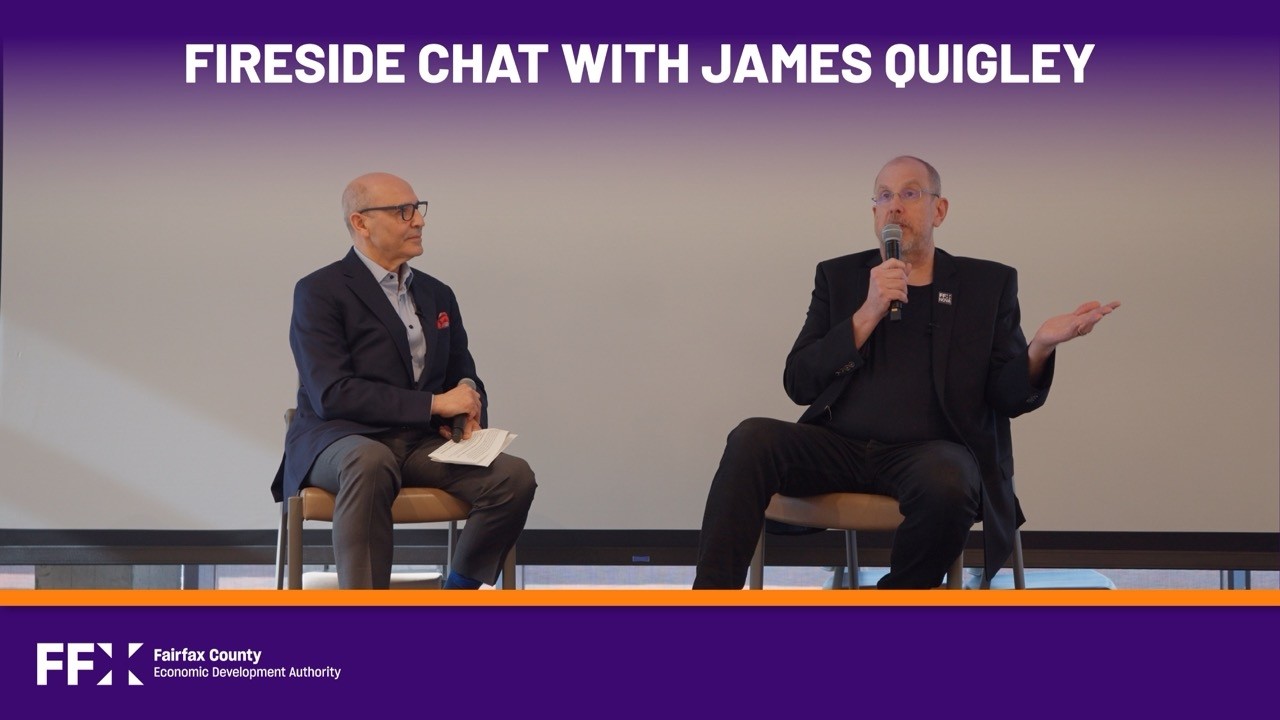
In a fireside conversation with Victor Hoskins featured in July 2026, Quigley returned to the work between a company’s origin and its exit. He stressed continued execution and the effort of bringing a team along through successive challenges. His case for Northern Virginia rested on talent and on connections among businesses, customers, mentors and institutions.
That offers a useful way to read his career. The dining table is a memorable beginning. An acquisition is a memorable ending to a chapter. Between them sit the less photogenic decisions: finding backing, helping a colleague learn, making an introduction, changing a process that wastes somebody’s afternoon. Quigley has spent much of his working life on those decisions. There is plenty of room at that table.