The first joke of JD Dillon’s marketing career was hidden in his job title. Fresh from West Point, Army service and an electrical-engineering education, he joined Cypress Semiconductor as a product marketing engineer. PME, colleagues said, stood for “Pretty Much Everything.” It was a Silicon Valley gag with the useful tang of truth. Technical marketers had to understand the device, the competitor, the customer, the sales channel and the number that might persuade all of them to meet.
Dillon discovered that the number interested him most. Pricing was intellectually demanding and commercially immediate. A brochure could flatter a product. A price had to make a claim about value and live with the answer. He built pricing structure at Cypress, carried the discipline into solid-state storage at OCZ, and later joined Enphase Energy as vice president of marketing and pricing. In July 2017, Enphase was in the hard work of a turnaround. Dillon has described the company’s share-price recovery as a collective achievement, not a lone executive’s victory. The engineer’s reflex remained intact: locate the variables, measure what moved, share the credit.
01 / The operating systemMission, people, margin
Dillon’s preferred leadership formula comes from the Army: “Mission First, People Always.” He defines the commercial mission without incense or fog as profitable top-line growth. The people are the employees doing the work, the customers buying it, and the leaders, directors and shareholders depending on it. There is a useful tension in the phrase. A mission without people becomes a spreadsheet with casualties. People without a mission get meetings, sympathy and no destination.
“You gotta be flexible but, not spineless.”JD Dillon, on the role of a CMO
One early career episode gave the idea teeth. While managing divisional revenue and technical sales enablement, Dillon learned that his vice president was looking for his replacement. He took another director, Ahmad Chatila, to lunch. Chatila offered him a place on his team, but advised him that the best move was to solve the problem in his current job and leave well. Dillon stayed. Six months later, he earned marketer-of-the-year recognition, then changed divisions. His stated lesson was not revenge or clever networking. It was that support helps people perform, and that talented people follow leaders who provide it.
The story also explains Dillon’s impatience with the decorative caricature of marketing. On one podcast, he bristled at the notion of the CMO as the person who makes pretty PowerPoints. His own résumé runs through pricing, product introduction, customer operations, communications and sales enablement. At Tigo, the title eventually grew to Chief Marketing & Customer Experience Officer. His teams cover branding, demand generation and communications, plus technical service and support. The promise and the complaint now sit in the same organization chart.
02 / The roof is realShade happens
At Solar & Storage Live in Birmingham in 2024, Dillon opened from a premise no panel manufacturer can repeal: shade happens. Trees grow. Dirt settles. Bird droppings arrive without consulting the forecast. Panels age and mismatch. A rooftop system sold as a clean rectangle on a slide becomes a living collection of imperfect modules exposed to weather, workmanship and time.
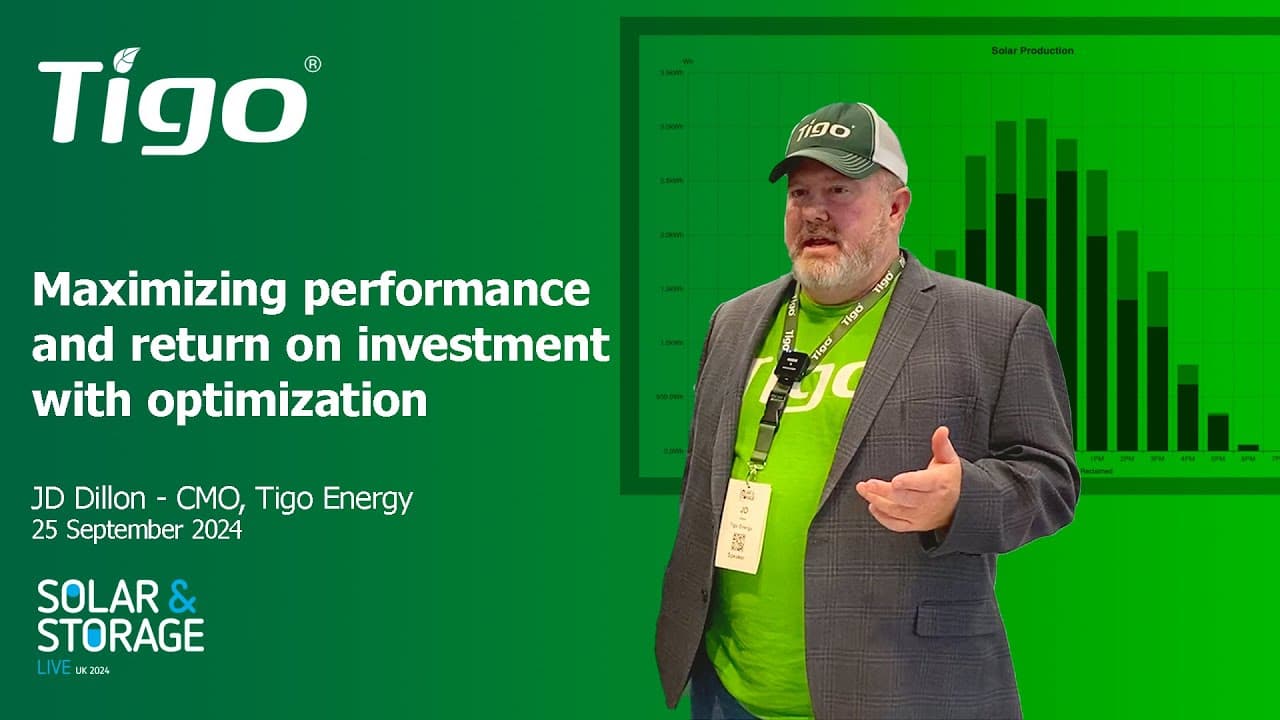
His technical pitch concerned Flex MLPE, Tigo’s module-level power electronics. An optimizer lets each solar module operate with more independence when its neighbor underperforms. Monitoring helps an installer find trouble at panel level. Rapid shutdown reduces voltage at the modules after a shutdown is triggered, supporting safer access around rooftop PV during an emergency. The customer hears three connected promises: more energy where conditions permit, less guesswork when something fails, and a system designed around safety requirements.
The figures Dillon presented included case studies in which sites gained more than six percent energy. The larger argument, however, was about return across the system’s life. Extra yield matters. So do avoided maintenance visits, faster diagnosis and compatibility with the rest of the installation. Pricing taught Dillon to resist evaluating one line item in isolation. A cheaper component can become expensive when it sends a truck back to the roof.
That habit of looking past the sticker price also shapes how he talks about marketing performance. Dillon keeps a dashboard, but has said he wants it “directionally correct” rather than dressed in false precision. The useful question is not whether a result missed a plan by an immaterial sliver. It is whether the business is moving toward profitable growth and whether marketing is reducing friction for sales and customers. The distinction is small on a spreadsheet and large in a meeting. It keeps a team from polishing decimal places while the market changes outside. For Dillon, return on investment is not a ritual defense of marketing’s budget. It is a common language with finance, engineering and the board. That makes the CMO accountable, but it also earns the function permission to influence price, product and experience instead of arriving at the end to decorate them.
03 / After the shipmentQuality becomes a verb
Dillon’s current banner is Total Quality Solar. The phrase gathers reliability, transparency, continuous improvement and customer focus into one operating idea. Tigo’s Green Glove service makes it tangible with design review, training, commissioning help and field support for installers. The emphasis is “done right the first time,” a sentence accountants and homeowners can admire for entirely compatible reasons.
This is also why Dillon keeps returning to software and services. Solar hardware inevitably faces comparison by specification and price. Software can expose what the system is doing now. Service can determine what happens next. In 2026, he pointed toward repowering older solar installations as a growing market, alongside a larger U.S. “middle market” and wider alignment around safety requirements. The first generation of rooftop solar is aging into a second commercial chapter. Inverters fail, needs change, and owners have little interest in replacing every usable component merely to modernize the system.
“The future is indeed software.”JD Dillon, writing about solar commissioning and service
Flexibility matters here in the literal engineering sense: equipment that works with multiple module and inverter combinations gives installers more ways to repair or expand a site. It matters in Dillon’s leadership sense too, with one boundary. “You gotta be flexible but, not spineless,” he has said. A company can adapt its route without misplacing the outcome.
Outside the executive brief, his public details soften the geometry. He has volunteered as a Little League umpire, where every close call offers a tiny seminar in evidence, confidence and unhappy stakeholders. He speaks openly about the support of his wife, Angel, particularly during a difficult transition after Toshiba acquired OCZ. A possible role might have moved their family from California to Nashville. She was prepared to go. The job did not happen; Enphase soon did, followed by a rapid move within California.
He also returns to classrooms. A former colleague, Bassil Elkadi, has recalled getting his first job from Dillon at age 20, then inviting him more than two decades later to speak to marketing students at the University of San Diego. Dillon’s own grandfather taught marketing. His late grandmother, he wrote, read every book in her retirement-home library and told him she would keep learning until the day she died. The family inheritance appears to be curiosity with a work ethic.
04 / The useful closeNo perfect roof required
Dillon’s career is not a tidy conversion story from soldier to engineer to marketer. The roles overlap. The Army supplied a language for mission and service. Engineering supplied respect for constraints. Pricing supplied a test for value. Marketing supplied the work of making those ideas legible. Customer experience supplied the consequence.
That combination is particularly suited to solar, an industry whose product must survive beyond the campaign, the quarter and often the company that installed it. The roof does not care about positioning. It has shade at three, a mismatched panel at four and an owner checking the app at five. Trust is built when the system keeps producing, tells the truth when it does not, and gives someone enough information to fix it.
There is no need for a flawless roof in Dillon’s version of the future. An honest one will do: measured module by module, supported after the sale, safe by design, priced against the value it actually delivers. Pretty PowerPoints may attend. They simply do not get the final call.