When Caroline Morris announced her move to Cordance in January 2024, a former colleague left a small, revealing comment among the congratulations. Evan Kiely said he still used her “one cool thing” letter to bring teams closer together. An executive had changed companies. A practice she introduced had stayed behind.
There is something pleasingly portable about that detail. Job titles belong to an organization chart; a useful habit can find its own way through an organization. Kiely’s comment does not explain the letter’s format or frequency. It does tell us that someone remembered it, used it and thought it helped people work together. In a career concerned with systems, this was a system small enough to carry.
Morris’s own farewell to Lone Wolf, the real estate software company where she had been chief operating officer, gave the credit back to her colleagues. She thanked them for helping shape her leadership and expressed gratitude for their time together. The tone was warm, directed outward and unusually attentive to the people remaining at the company she was leaving.
Today, Morris is Cordance’s chief executive officer. The company acquires specialized business software companies and supports their growth. Its product world includes warehouses, universities and resale shops. The scale has changed since the letter. The question of how people work together has followed her.
History, service, software
Morris studied history at Tufts University and earned an MBA at Harvard Business School. She is an Army veteran and a military spouse. Her public professional record includes service with the 101st Airborne Division and the 160th Special Operations Aviation Regiment, as well as a Bronze Star Medal. These are distinct parts of her background, worth retaining as facts rather than turning into a convenient theory of everything she does.
Her civilian software career took her into education. She held leadership roles at PowerSchool Group and PeopleAdmin, businesses serving K12 schools and higher education. Those markets put software inside institutions with many different users, responsibilities and expectations. A purchasing decision and the experience of the person using the product can sit a considerable distance apart.
She later became COO at Lone Wolf. Her work there centered on customer experience, reliable execution in essential areas and longer relationships with customers. Real estate supplied another setting in which software has to serve people completing consequential tasks. The paperwork may live on a screen; the transaction still belongs to human beings.
Across these roles, the continuity is practical. Morris worked on teams, systems and the customer’s experience of the business. Education and real estate are different markets, but both offered experience with specialized software and the organizations that depend on it. Cordance would make that experience useful across a wider collection of businesses.
The customer who has already signed
Cordance appointed Morris COO on January 24, 2024. Her remit began after the sale and continued through renewal. She would work with business unit presidents on customer engagement, take responsibility for pricing and packaging, and oversee general managers responsible for the readiness of a growing portfolio.
That list contains a business story in miniature. The sale is a moment. The relationship has a calendar. Customers need to start using what they bought, understand its value and decide whether to keep paying for it. Pricing and packaging shape that experience too, because they determine which capabilities a customer can access and what the arrangement costs.
The appointment placed Morris at the junction of those decisions. Her responsibilities connected the customer’s experience to the structure of the business: who runs a unit, how it prepares to grow and how the offering is assembled. It was an operating brief with several moving parts, rather than a single department to supervise.
By January 23, 2025, Cordance was identifying her as CEO in its announcement of an investment in Channel Software. The scope now included the company’s strategy and execution. The earlier remit remains a useful way to understand the role: an acquisition creates a new relationship, and the work of making that relationship useful continues long after the announcement has gone out.
An order has somewhere to go
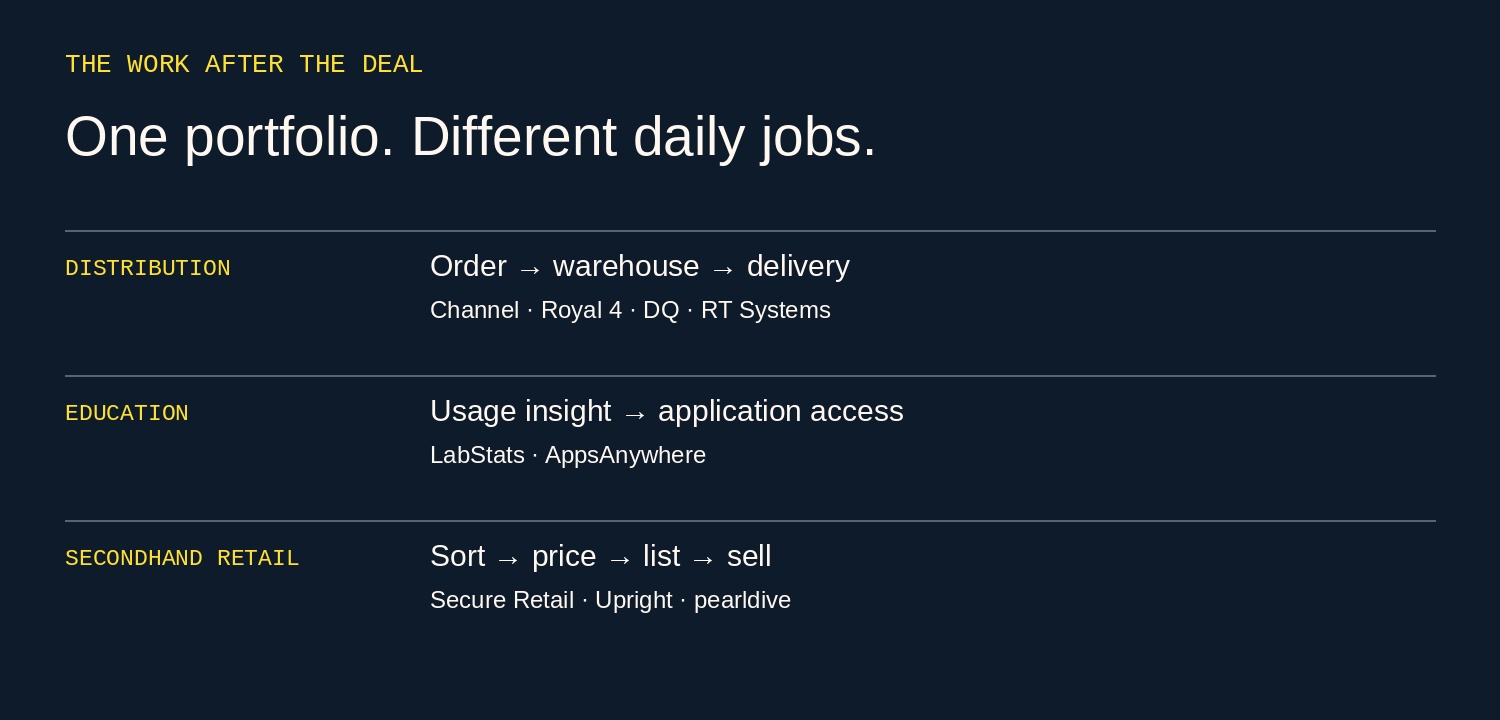
Channel Software makes ecommerce tools for manufacturers and distributors. Its CSX platform supports bulk orders, tiered prices and inventory information, with connections to the enterprise systems customers already use. Under Morris’s leadership, Cordance’s investment added another part of the industrial customer’s workflow to the portfolio. Channel would continue as an independent business unit.
In July 2025, Cordance acquired DQ Technologies, which supplies logistics and fleet operations software. Its tools cover order tracking, GPS monitoring, vehicle maintenance and mobile work. The combination gives a sense of the territory Morris oversees: the order placed online has a life beyond the shopping cart, including a vehicle, a route and someone waiting for a delivery.
March 2026 brought an investment in Royal 4, whose WISE warehouse management system covers work from receiving to fulfillment. At that point, Morris described Cordance as serving more than 1,500 manufacturing, distribution and third-party logistics customers. That figure describes an industrial customer group, rather than a count of acquisitions or employees.
Royal 4 would also remain an independent business unit. For Morris, the operating challenge implied by that arrangement is coordination: giving specialist teams more resources while allowing their knowledge of customers to remain useful. Inventory accuracy, throughput and timely shipping were the outcomes she emphasized. A warehouse has limited patience for an elegant strategy that sends the wrong box.
Manufacturing, distribution and 3PL customers described by Morris in March 2026.
Back to the campus
Education returned to the foreground in October 2025, when Cordance acquired AppsAnywhere. The company, founded in the United Kingdom, helps universities deliver academic software to students and faculty across devices. It was serving more than 300 institutions worldwide and supporting millions of users at the time of the announcement.
Cordance paired the opportunity with LabStats, another business in its portfolio. LabStats supplies usage analytics; AppsAnywhere handles application delivery. The relationship connects two questions an institution faces: which software resources people use, and how to make those resources available. The proposed benefits included better access, more informed licensing decisions and infrastructure planning.
For Morris, this was a return to a sector she knew through earlier leadership roles, with a different set of products and responsibilities. Her comments focused on helping university IT leaders modernize operations and improve students’ digital experiences. The ambitions were expressed through a particular pairing of tools, giving the growth plan a more concrete shape.
There is a useful change of perspective here. A portfolio can appear to be a list of brands when viewed from the acquiring company. Viewed from a university, it becomes a set of services that must cooperate. The student wants access to an application. The institution needs to manage the resources behind that access. Morris’s role sits above both products, where the promise of working together must become an operating arrangement.
The student wants access to an application.
The institution needs to manage the resources behind that access.Two sides of the campus software problem
The backroom gets a vote
Cordance’s secondhand retail investments bring the story to another kind of workplace. In March 2025, it invested in Secure Retail POS Systems. Its S-TAGS product addresses thrift retail, where inventory includes thousands of individual items across different categories. A store dealing in one-off goods has its own demands, and the software reflects that specificity.
A year later, Cordance announced an investment in pearldive, an AI-based sorting and ecommerce listing platform for secondhand retailers. The software helps with identifying, sorting, pricing and publishing items. It already integrated with Upright Lister’s listing workflow, with further connections planned across production, point of sale and ecommerce.
Morris framed the investment around practical value for the people running those operations. The emphasis was on getting more value from items and helping retailers expand their community impact. The announcement described early customer gains, but those results belonged to particular customers. They were examples of what the tools had helped achieve, rather than a universal forecast.
The setting gives her software strategy a human scale. Before a donated item can become an online sale, somebody has work to do. Sorting and listing are less theatrical than an AI product launch, but they are where the product has to earn its place. In this part of Morris’s portfolio, innovation is tied to the movement of actual goods through an actual shop.
The test on the warehouse floor
In June 2026, Cordance acquired RT Systems, a warehouse management and distribution software business serving complex, high-volume environments. Its customers work in sectors including tires, automotive logistics, sporting goods and infrastructure. Morris described the investment in terms of product development, stronger commercial capabilities and helping more customers improve performance.
She also offered a compact test for the whole enterprise: “Software only matters if it makes the operation better.” It is a statement that makes room for considerable complexity underneath. Better can mean accurate inventory, easier application access, a more efficient listing process or reliable support. Each business has to translate the word into something its customers can recognize.
That is the interesting burden of her current job. Cordance’s businesses share a parent, but their customers have different tasks. Supporting them requires decisions about resources, products and people that account for those differences. A common operating approach earns its usefulness through the details of each market.
The colleague who remembered Morris’s letter was describing the same problem at a smaller scale: a practice had to be useful enough for someone else to keep using it. Her career now gives that test a much larger field. After an acquisition, a new title or a product announcement, the work remains with the people who have to do it. Morris’s stated ambition is to make their operation better. That is where the next chapter will be measured.