The keys are in your hand. The salesman has stopped smiling quite so intensely. Somewhere ahead lies an unfamiliar rattle, a maintenance schedule and a bill whose reasonableness you are expected to judge without having attended mechanic school. Jad Dunning helped build a company around that awkward stretch of adulthood. DriverSide, founded in 2007 with Trevor Traina and Adam Jackson, treated owning a car as a subject deserving its own website. Buying one was merely the opening scene.
For Dunning, it was another encounter with a familiar commercial problem: people need useful information before they can make a choice. His career has taken that problem through comparison shopping, local retail, automotive software and children’s streaming. The objects change considerably. A cordless phone and a cartoon have little to say to each other. Yet both can leave the person choosing them wishing somebody had done more of the homework.
A friendship before the first acquisition
Dunning and Traina’s working relationship reaches back to CompareNet, which they started in 1996. They were already friends from San Francisco’s University High School. Traina’s account of the original spark was pleasingly unheroic: he had gone looking for a cordless phone with a particular speaker feature, and the people selling phones could not tell him whether the thing existed. An information gap had presented itself at a retail counter.
CompareNet assembled product information so shoppers could compare their options online. By March 1999, when Microsoft announced its acquisition, the service attracted more than 1.5 million unique users a month. Its database covered more than 40,000 individual products across nearly 100 categories. Microsoft intended to put that material inside MSN Sidewalk, its online guide. A shopping question that had stumped a store could now lead into a substantial database.
The deal also produced a rather San Francisco career announcement. On March 5, 1999, the local society column reported that Trevor and Jad were moving to Seattle to work for Bill Gates. A corporate acquisition had made the same conversational circuit as museum dinners and birthday parties. Software could be a business and local gossip at the same time; San Francisco has never required those categories to maintain separate addresses.
Dunning’s next shopping business brought the question closer to home. StepUp Commerce helped retailers put information and images of their in-store products online. He was its co-founder and president. The practical difficulty was familiar to anyone who has searched the web for something available a few blocks away: physical stock and online visibility did not automatically know about each other.
Intuit acquired StepUp on August 29, 2006, for approximately $60 million in cash. The business joined its QuickBooks segment. Its technology was intended to help local retailers attract shoppers through online product listings, including distribution through Google. There was an appealingly ordinary ambition beneath the transaction: make the contents of a nearby shop easier to discover. A retailer could have exactly the right item and still be effectively invisible to the customer searching for it.
The car was already in the driveway
Then came DriverSide. Its founders picked the years of ownership as their territory: service costs, maintenance, mechanics, accessories and eventual resale. Dunning was publicly identified as CEO by July 2008. Traina was chairman, and the board included investor Mark Silverman and Jeff Bell, whose experience crossed automotive marketing and Microsoft. The familiar partnership now had a different collection of industry problems to untangle.
The timing made the idea particularly concrete. In 2009, DriverSide’s research with Kelton found that 82 percent of surveyed American car owners were keeping their vehicles longer than they had originally planned. The financial crisis had made another year with the current car an attractive proposition. Another year, however, also meant another service interval. Keeping a vehicle and understanding what it needed were separate jobs.
That August, DriverSide introduced a redesigned consumer site with a diagnostic tool organized around what an owner could notice: a sight, a smell, a sound or a sensation. Follow-up questions narrowed the possibilities. Other tools offered repair estimates, maintenance and recall alerts, mechanic listings and answers from staff mechanics. The starting point was the driver’s vocabulary. Nobody had to translate a mysterious noise into a component number before asking for help.
“We save drivers both time and money”
Jad Dunning, discussing DriverSide in 2009
The promise was modest enough to be useful. A browser could prepare an owner for the next conversation about the car. It could supply price context or remind someone that a service was due. The mechanic still had an essential role. For the owner, having a better question to ask was already a material improvement over nodding politely at an estimate.
- 01Notice a noise
- 02Answer questions
- 03Review guidance
- 04Find a mechanic
The other customer wore coveralls
There was also a business on the other side of the repair counter. DriverSide partnered with Dealer.com to add personalized vehicle garages and service tools to dealership websites. Owners gained access to their vehicle information; dealers gained another way to stay in touch with customers after a sale. The garage was useful to the person driving away and to the business hoping that person would return.
Dunning described the partnership in terms of convenience, engagement and protecting a dealer’s customer base. Those are different benefits for different participants, which helps explain the shape of the product. A maintenance reminder can be welcome information for an owner and an invitation to book service for a dealer. The commercial connection lives inside the recurring task.
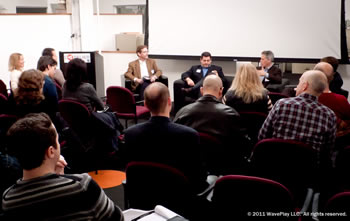
In 2009 and again in 2010, Dunning appeared on SEMA panels with executives from eBay Motors, Google and other automotive internet businesses. The discussions concerned pricing transparency, online behavior, data and the move from desktop computers to mobile devices. DriverSide occupied a useful junction in that conversation: information found online could end in a very physical appointment with a car on a lift.
Advance Auto Parts acquired DriverSide in 2011. In 2013, Advance brought automotive technology products together under the MOTOSHOP name. Dunning remained involved in the work after the transaction, becoming an Advance vice president and MOTOSHOP’s general manager. The progression mattered: the founder was now helping operate products inside the larger company that had bought his startup.
By 2015, the portfolio covered repair information, shop marketing, technician training and shop management. Partnerships with AAA Club Partners, MOTOR and R.O. Writer connected those tools to existing automotive networks and software. A repair business needed estimates, technical information and communication with customers to work together. Each additional login was hardly a prize.
Enhancements announced in early 2017 included mobile-friendly shop websites, training progress tools and management features such as a configurable parts-pricing matrix and QuickBooks export. This was software for the unglamorous hours of a business day. Dunning’s public emphasis was on helping shops work more efficiently and grow. The customer relationship that DriverSide had approached through the owner’s garage now extended into the shop’s daily operations.
From the repair counter to the remote control
The subsequent move into children’s media looks, at first, like a sharp turn. Dunning led the team that incubated Sensical inside Common Sense Media before it became a standalone business in 2020. As Common Sense Networks’ COO, his responsibilities included strategic accounts, content review and curation, legal and business affairs, and finance. His undergraduate degree from St. Lawrence University and law degree from the University of San Francisco sat behind a career that had become considerably broader than either shopping or cars.
Sensical opened its public preview on June 29, 2021. It offered free, advertising-supported streaming for children aged two through ten, divided into three age groups. At launch, the collection contained more than 15,000 selected videos and over 50 topic-based channels. Reviewers screened the material, while explanatory labels helped parents understand why a video had been included.
Here the choice was a family’s: what should a child watch next? Sensical arranged its offer around interests and age ranges, with content from studios and digital creators. Its parent dashboard added viewing information and learning context. The underlying work involved selection, organization and explanation. Those activities had also appeared, in very different forms, in Dunning’s earlier businesses.
There is a parallel outside his executive roles. From 2003 to 2010, Dunning served as a trustee and board chair at Cathedral School for Boys. From 2008 to 2017, he was a board member and chair at SMART, a San Francisco education-access nonprofit serving students from low-income families. Education therefore had a place in his public commitments well before it became part of his media work.
The next audience
Cricket Media acquired majority control of Sensical in February 2025, with Sensical’s Eric Berger becoming CEO of the combined company. Dunning is now Cricket Media’s chief operating officer. The new home brought a streaming service together with a publisher whose children’s magazines had been part of family reading for decades. It was another change of corporate setting for an operator accustomed to working across acquisitions.
In May 2025, Sensical and Billboard announced a family music partnership involving curated programming, streaming channels and a music hub. Dunning welcomed the collaboration publicly on LinkedIn. In April 2026, Cricket Media named him moderator of a webinar about using video in curriculum, alongside content and education executives. The practical questions now included how videos are reviewed, licensed and made useful to learners.
The distance from a comparison-shopping database to a children’s video catalogue is considerable. Follow Dunning’s work across that distance and the recurring task becomes easier to see: organize information so somebody can use it. First the shopper, then the retailer, the driver, the repair shop and the family with a remote control. The keys change hands. There is usually another question waiting.
Follow the next question
- Jad Dunning on LinkedIn
- Cricket Media
- DriverSide
- Sensical
- CompareNet joins Microsoft, 1999
- Intuit’s StepUp acquisition filing
- DriverSide’s 2009 product announcement
- MOTOSHOP’s 2017 product updates
- Dunning’s Kidscreen speaker biography
- The Cricket Media and Sensical acquisition
- Billboard and Sensical partnership
- Cricket Media’s curriculum-video webinar
- Founders Space roundtable photographs