The revealing detail in ALLDATA’s history is a bookshelf. Mark Allison, who runs Allison’s Automotive in Upland, California, remembers the arrival of wiring diagrams and electrical data in a form that replaced shelves of repair manuals. In the company’s fortieth-anniversary account, his explanation centers on finding repair information quickly. The mechanic’s problem began before the wrench turned.
- Factory repair procedures, gathered in one searchable place.
- Mechanical shops, body shops and educators use the information.
- Subscriptions start with a core library; extra tools carry extra costs.
The bookshelf problem
ALLDATA began in 1986. Rod Georgiu, identified as founder and president in AutoZone’s contemporary annual report, helped build a business around making manufacturer knowledge accessible to professional repairers. Its first decade went into assembling the OEM database. The customer bought a route through information that already existed but was awkward to obtain and use.
Delivery changed with the workshop. Early data came on CD-ROMs; later, a rugged console included a printer. Repair moved online in 2001. Each change reduced a different inconvenience: storage, access at the bench, waiting for updated information. The underlying job stayed recognizable. A technician needed the instructions for this vehicle, in this bay, today.
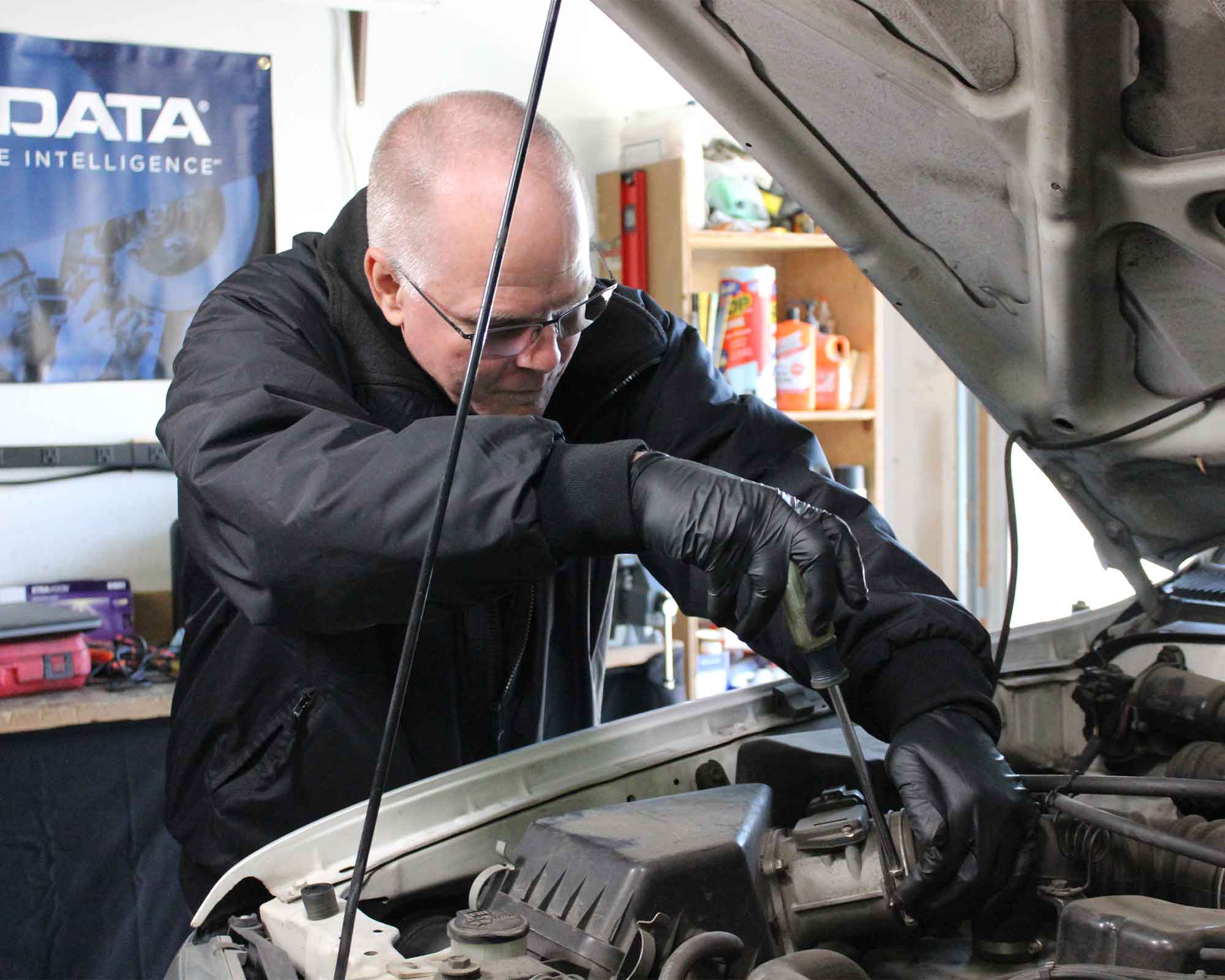
“ALLDATA solved our biggest early challenge: finding repair information fast.”
MARK ALLISON / ALLISON’S AUTOMOTIVE
The value of leaving things alone
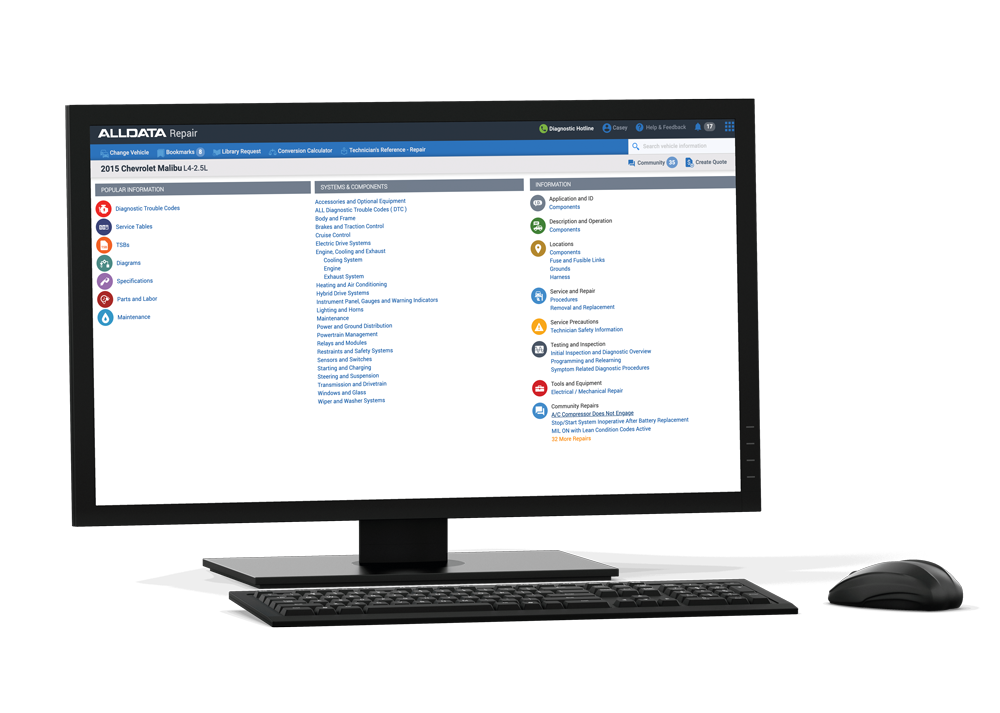
ALLDATA’s distinguishing word is “unedited.” Its core Repair product preserves OEM instructions rather than rewriting or condensing them. Around that material, it supplies consistent navigation, specifications, service bulletins and diagnostic information. It also offers more than 300,000 interactive color wiring diagrams alongside the manufacturers’ originals. The extra layer helps the technician navigate the source material.
The distinction matters in collision work. ALLDATA Collision covers structural sectioning, panel replacement, adhesives and newer construction materials, as well as mechanical procedures. Those are specific instructions for how a vehicle should be restored. An apparently familiar job can carry unfamiliar requirements. Easy access to the manufacturer’s method gives a shop something concrete to consult and document.
Mitchell 1’s ProDemand competes in the same territory, combining OEM information, wiring diagrams, real-world fixes and estimating. ALLDATA’s case rests on its particular library, presentation and connected products. For a buyer, the sensible comparison is the actual vehicles and diagnostic tasks the shop handles.
The audience reaches beyond the commercial repair bay. ALLDATA markets its information to dealerships working across makes, multi-shop operators, educators and libraries. That range points to a useful distinction: the product sells access to specialist knowledge, while the person using it brings the skill and context. A classroom and a collision shop can consult similar material for different reasons. For the instructor, the procedure can anchor a lesson; for the working technician, it can shape the repair in progress.
When the manual needs a colleague
A library can describe a test without making the next diagnostic decision easy. ALLDATA Tech-Assist addresses that gap with a hotline staffed by more than thirty ASE-certified Master Technicians. Subscribers can use live video, and calls can continue on the same vehicle case until resolution. Unlimited calls per case should not be confused with unlimited new cases; verified resolutions replenish the monthly allotment.
Diagnostic Intelligence approaches the same difficulty through software. Starting with a trouble code or symptom, it brings probable causes, known fixes, shortcut tests, OEM procedures and AI-assisted guidance into a focused workflow. These are directions for an investigation. The technician still has to perform the tests and establish what is wrong with the car.
- 01What is specified?Consult the OEM procedure.
- 02What should I test?Use diagnostic guidance.
- 03What happens next?Plan and document the work.
A subscription with a parts counter nearby
The U.S. list price for Repair is $209 a month; Collision is $249. Tech-Assist and Diagnostic Intelligence each add $59 monthly and require a core subscription. That makes Repair plus either one $268 a month before taxes or other additions. Mobile is another $39. The relevant buying question is how much useful work those tools enable in a particular shop.
U.S. published prices checked October 21, 2026. Before tax; selected services only.
AutoZone acquired ALLDATA in 1996. Today, that relationship appears inside the workflow: Estimator, included with Repair and Collision, lets U.S. shops create estimates and order AutoZone parts. An October 2025 update added the included estimating tool and expanded quick access to specifications. The business connection is visible at the moment information turns into a parts order.
From the estimate to the electric truck
Shop Manager Pro, introduced at SEMA in 2025, follows the job through work-in-progress tracking, technician time, inventory and two-way texting. ALLDATA attributes the expansion to customers asking for deeper integration and better visibility. Manage Online offers another operational route, with reporting, customer management and integrations including QuickBooks and CARFAX. Different shops need different amounts of administration around the same repair.
Collision shops have another problem: noticing all the work an estimate implies. Repair Planner reviews estimate lines and flags associated OEM procedures, including required inspections. Launched in 2024, it requires Collision. Its purpose is to put the relevant factory instruction beside the planned job, where someone can act on it.
Then comes the unfamiliar vehicle. In February 2026, ALLDATA announced an agreement to distribute Rivian repair and maintenance data, describing itself as the first third-party provider to do so. For independent repairers, an electric truck makes the information-access problem concrete again. Coverage has to follow the vehicles arriving at the door.
Try it on the awkward job
A useful trial starts with an actual difficult repair. Check the exact vehicle, find its procedure, follow the diagnostic path and see how the result reaches the estimate. Mobile capabilities vary by device and subscription. Factory instructions also assume the reader can perform the work; access alone supplies neither equipment nor training.
Watch the handoff as closely as the search result. A procedure found quickly can still sit apart from the estimate, the customer approval or the technician’s next task. During the trial, follow one job all the way through. That is where a collection of features has to earn its place in the working day.
A single-vehicle owner can take a narrower route through ALLDATAdiy, available in the U.S. and Canada. The transferable lesson for a shop is equally focused: identify where a repair stalls before adding software. ALLDATA’s history makes that a practical place to start. First, find the instructions. Then decide what else the job needs.