The first company Jacob Boyle can remember founding had the grandeur of a conglomerate and the balance sheet of a lemonade stand. He called it Wallet Full of Businesses, Inc. The staff numbered one. Inventory wandered cheerfully from hand-drawn comics and children's books to cookies and clay models. Customers included family, friends, and a neighbor named Ed. Boyle was still in elementary school, but the operating model was already visible: make a thing, show it to somebody, learn what happens.
Years later, the materials became motors, sensors, foam, screens, and code. The customer problem became much harder. Yet the instinct survived. Boyle is an engineer who prefers ideas with edges, wires, and the possibility of failing in public. His career has moved through amphibious robots, medical devices, laboratory equipment, biological 3D printing, and conversational artificial intelligence. Each field offered a different vocabulary. The recurring verb was build.
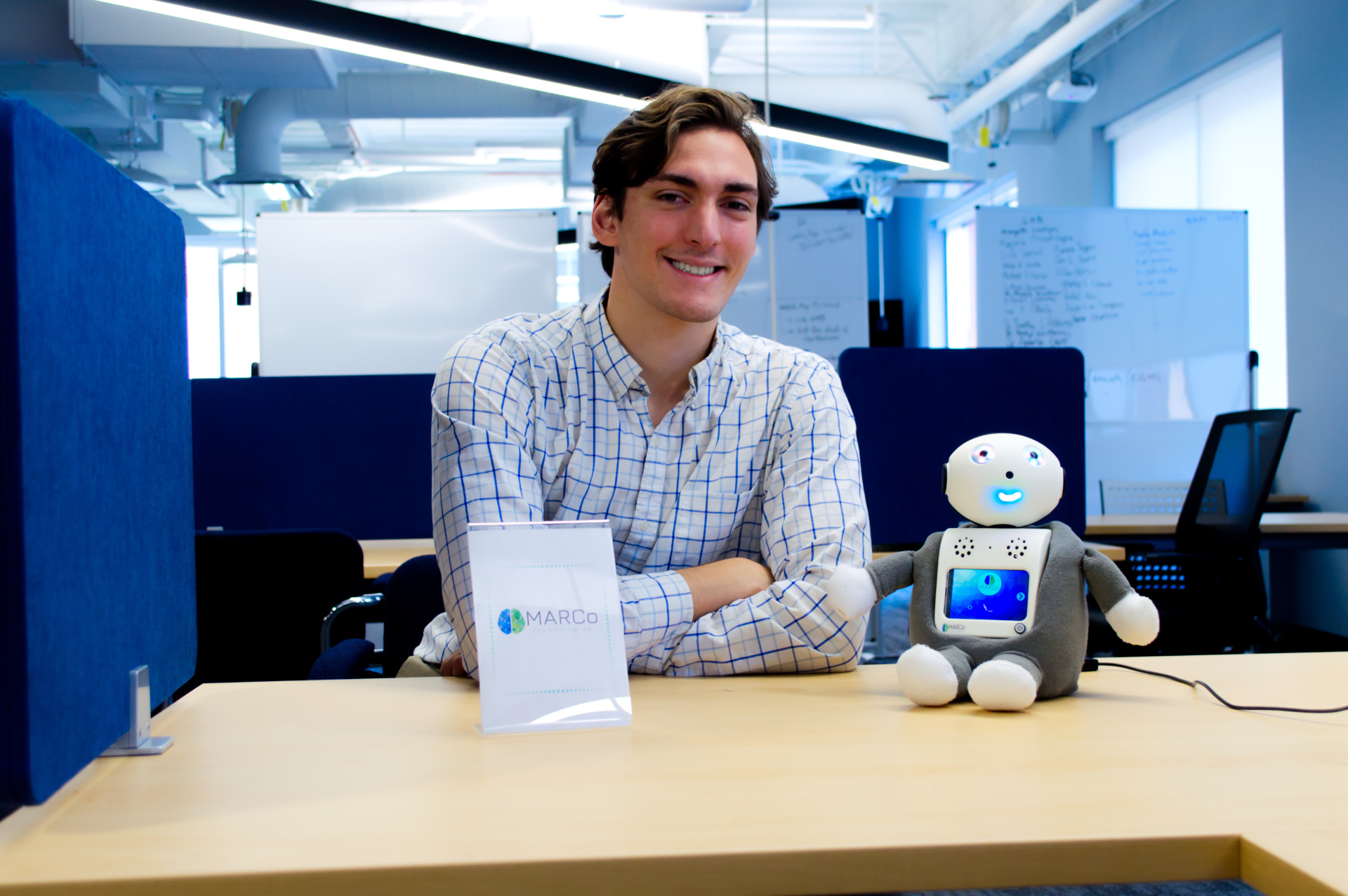
His public work centers on MARCo, a small humanoid robot with a soft body, illuminated eyes, a voice, and a screen set into its torso. It looks like a stuffed toy that has been politely invited to a product meeting. The friendliness is deliberate. Boyle's central product bet is that software behaves differently when it occupies the room with you. A face receives attention that an app icon must repeatedly beg for.
A résumé with a robot in the dorm
Boyle began building robots through FIRST Lego League at 11 and later ran his high-school robotics team. At The College of New Jersey, he studied mechanical engineering with a minor in physics. After his first year, he joined GuardBot, a military-robotics startup, as an intern. The role expanded quickly into lead-engineer work on an amphibious system tied to a U.S. Navy program.
The arrangement made an already busy degree feel almost leisurely. Boyle has recalled traveling between New Jersey, the company office, and a Navy site in Maryland while managing engineers abroad. He went to Sweden for technical meetings. He demonstrated hardware for military personnel. At 19, he sometimes brought a military-grade robot back to his dorm. Most undergraduates worry about whether a hot plate violates housing policy. Boyle had an amphibious machine nearby.
The work also forced a question that technical ambition can postpone but not remove: what will this machine be used for? Boyle had understood the project as bomb-disposal equipment. A conversation during a difficult Navy test made clear that others imagined offensive uses too. He left the defense work and redirected the same skills. The decisive change was less about robotics than about the assignment.
Purpose can be a technical specification.The principle behind Boyle's pivot
That distinction is easy to flatten into a tidy founder myth. The useful version is messier. An engineer does not discard years of training when the mission changes. Motors still need torque. Enclosures still need tolerances. Speech systems still need inputs and outputs. Boyle kept the craft and rewrote the brief. MARCo would be designed around conversation, companionship, structured activities, remote updates, and a handoff to real people when software had reached its limit.
The $30,000 prototype
MARCo became public in 2018 through a business-plan competition at TCNJ. Boyle, then a junior mechanical-engineering student, teamed with accounting student Ryan Chiu. Their prototype was charmingly direct: LED eyes, a squishy foam body, facial recognition, a touchscreen, sensors, and conversational functions. It occupied the narrow aesthetic territory between a lab project and a plush companion.
The pair won first place in the Mayo Business Plan Competition and $30,000. Two days later, New Jersey Governor Phil Murphy phoned to congratulate them and called MARCo "a home run of an idea." The robot received a joke title that explained the product better than a thicket of startup vocabulary. Boyle was chief technology officer. Chiu was chief financial officer. MARCo was CEO: chief emotional officer.
There was another promise hanging over the final. Boyle and Chiu had spent three years on TCNJ's club fencing team, yet each was the only teammate the other had never faced. Boyle told Chiu that a win would finally produce the bout. It is a wonderfully collegiate detail: raise money, build robot, fence co-founder. The published campus account preserves the promise but not the score.
Prize money is an event. A hardware company is a calendar. The years after the contest brought the slower work of turning a persuasive object into a repeatable one: patents, suppliers, software revisions, company structure, demonstrations, partnerships, and the perpetual founder task of explaining a new category without making it sound like a prop from a film.
Boyle and Chiu win TCNJ's Mayo competition and formally begin MARCo Technologies.
Boyle graduates and presents microfluidic-fabrication research at an ASME conference.
U.S. Patent 11,439,346 is granted, and the venture becomes MARCo Health Inc.
Boyle co-authors an AI-reliability preprint with Rutgers researcher Pooja Rangarajan.
He continues as CEO while speaking about robotics and adaptive systems in education.
Why give software a chair?
The ordinary technology instinct is to remove hardware. Put the service in a browser. Then put it in a phone. Then make it a notification. Boyle moved the other way. MARCo's body adds cost, manufacturing complexity, repair questions, and one more object to charge. It also adds presence. The product can turn its face toward a person, display an expression, sit on a desk, and become part of a routine.
This is the insight other builders can borrow without copying the robot. Friction is not automatically the enemy. The right physical constraint can create attention, memory, and trust. A notebook is less searchable than an app, yet many people think differently while holding a pen. A kitchen timer does less than a phone, yet it protects the task from the phone's temptations. MARCo asks whether a dedicated body can make conversational software feel less disposable.
The engineering trade: more manufacturing complexity in exchange for an interface that cannot be swiped away.
Boyle's patent, filed in 2019 and granted in 2022, shows how seriously he treats the body. It describes a robotic system using cameras, microphones, speakers, sensors, access controls, and artificial-intelligence components. The document is the less cuddly twin of the foam prototype. One communicates through expression. The other communicates through claims, diagrams, and numbered components. Together they show the founder's unusual range: make the idea legible to a person, then make it precise enough for an examiner.
From mechanical tolerances to model behavior
Even while building MARCo, Boyle maintained a parallel research habit. At TCNJ he worked with classmates and faculty on controlling material deposition in a 3D-printing process used to mold microfluidic devices. The team presented its paper at an ASME engineering conference. The subject seems far from a soft conversational robot, but the method is familiar: control a messy process closely enough to make the output repeatable.
In 2025, he and Rutgers researcher Pooja Rangarajan carried that reliability question into large language models. Their arXiv preprint tested a psychology-inspired de-escalation framework intended to reduce erratic model responses under difficult prompts. It was a move from controlling deposited hydrogel to controlling generated language, with the same unease about systems that behave well in demos and unpredictably under stress.
The preprint reported large reductions in its chosen erraticism measure, while also identifying work still needed, including broader task testing and expert validation. That caveat matters. Boyle's current work sits at an awkward intersection where a compelling demonstration can outrun the evidence. The responsible posture is neither worship nor panic. It is a test bench: state the mechanism, publish the method, disclose limitations, and invite sharper evaluation.
What another founder can steal
- Choose the mission before the machinery. A skill is portable; its purpose is a decision.
- Make the core behavior visible in the rough prototype. MARCo's early foam body already explained the thesis.
- Treat physical form as product logic, not decoration.
- Publish the method when the stakes rise. Claims improve when outsiders can inspect them.
The long apprenticeship of a friendly machine
By 2026, Boyle's job title had simplified to founder and CEO, while the job itself had sprawled. Company materials and interviews show him moving between business development, product design, AI consulting, public speaking, and partnerships. In March, he spoke at an international education-technology summit in the Philippines about robotics, analytics, and adaptive systems. In April, a public SEC filing again listed him as MARCo Health's chief executive. That summer, the company announced compatibility with INsightium, a professional learning and workflow platform.
The company has also had to correct its own public story. After reports in August 2025 suggested an acquisition, MARCo Health's board said no deal had occurred and that the business remained independent under its original leadership. It was a useful reminder that startup databases turn uncertainty into tidy labels faster than founders can turn conversations into signed agreements.
Boyle's outside interests make his engineering persona slightly less severe. He has described himself as a musician, runner, hiker, amateur 3D animator, and video maker. He is also an Eagle Scout and a black belt. These details do not assemble into a simple character type, which is their charm. The person building an expressive robot has spent years collecting ways to work with hands, movement, rhythm, images, teams, and the outdoors.
MARCo remains the cleanest expression of that collection. It is mechanical engineering wrapped in foam, software given eye contact, and a founder thesis made physical. The company will still face the unromantic tests that every hardware-and-AI venture faces: reliability, manufacturing, evidence, distribution, and enough revenue to pay for the next revision. Friendly eyes do not excuse a loose wire.
But the enduring idea arrived early. At 19, Boyle learned that being capable of building a machine did not settle the question of what it ought to do. Eight years of MARCo followed from choosing a different answer. The childhood entrepreneur still makes things and shows them to people. The inventory has become stranger. The assignment has become clearer.