Company Profile • Health · Robotics · AI
He Built Weapons for the Navy. Then He Built a Teddy Bear That Listens.
Jacob Boyle graduated with $90 and a foam robot named MARCo. Seven years later it has talked with more than 15,000 people across 13 countries - and in a handful of cases, it called for help before things got worse.
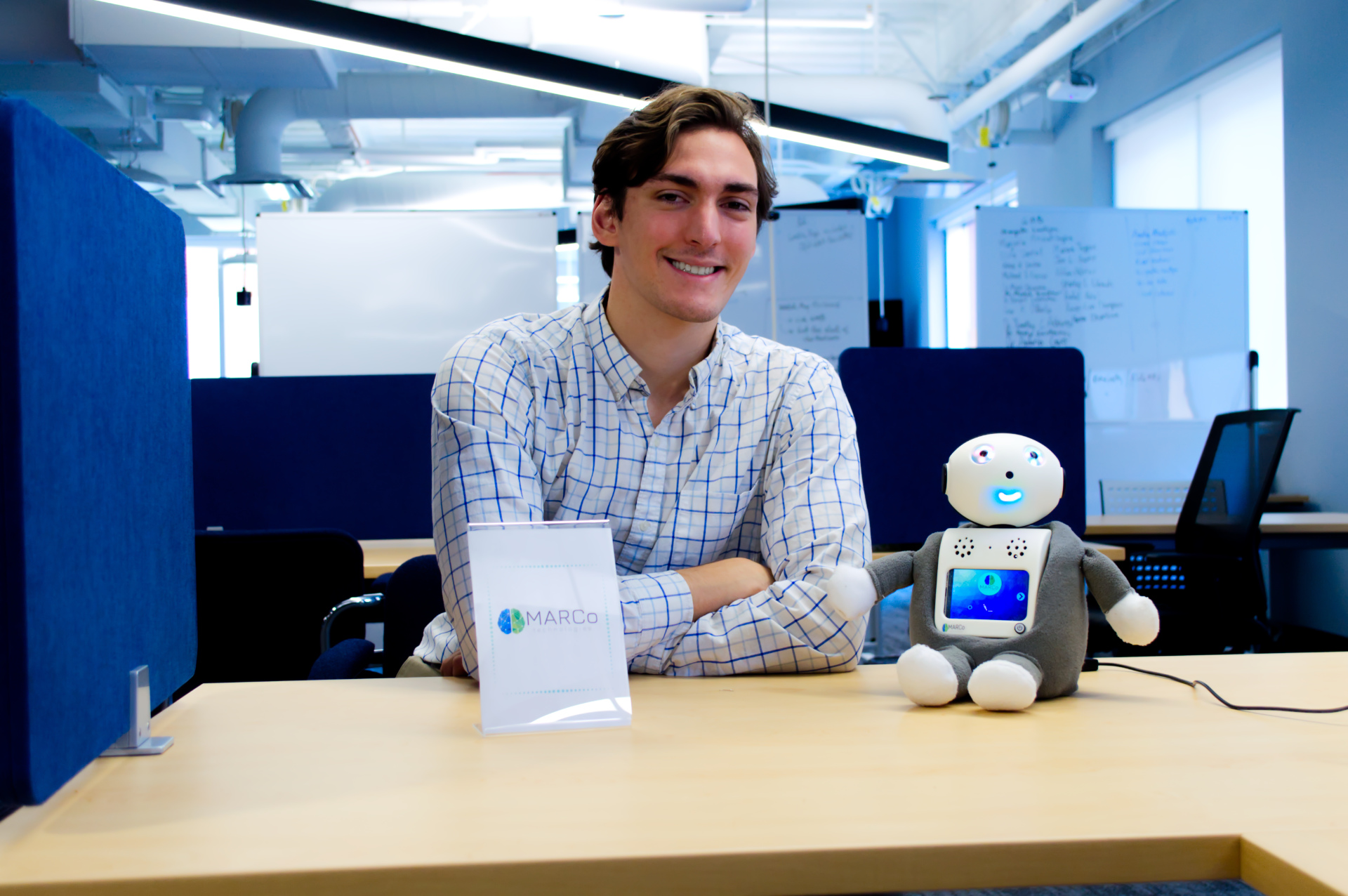
In October 2017, Jacob Boyle was a teenage robotics engineer with a resume most people twice his age would envy. He had started building robots at 11 through FIRST Lego League, run his high school's robotics team, and, after his freshman year of college, gone to work as a lead engineer on an advanced military project - managing engineers across the world on a program backed by a multimillion-dollar Navy contract. Then two things happened in the same stretch of weeks. He learned the robots he was helping build were bound for weapons rather than the bomb-defusing work he thought he was doing. And, buried under the schedule, he missed the signs of a close friend's mental health crisis.
Both realizations pushed in the same direction. Boyle left the defense work and pointed the same engineering skill at a problem he had lived himself: getting help for your mind should not be this hard, this expensive, or this far away. The result is MARCo - the Mental-Health Assisting Robot Companion - and the company he now runs as CEO and founder, MARCo Health Inc., based in Hillsdale, New Jersey.
01 / What it isA robot you can talk to at 3 a.m.
MARCo is not an app pretending to be a friend and not a smart speaker in a cylinder. It is a small, plush robot - under two pounds, roughly teddy-bear sized - with a face, a voice, and the software to hold an actual conversation about how you are doing. It runs on evidence-based therapy models: Cognitive Behavioral Therapy, Dialectical Behavior Therapy, Behavioral Activation, and executive-function coaching. You can talk to it like a friend, do a breathing exercise with it, work through a structured psychology exercise, or just have it check in on you.
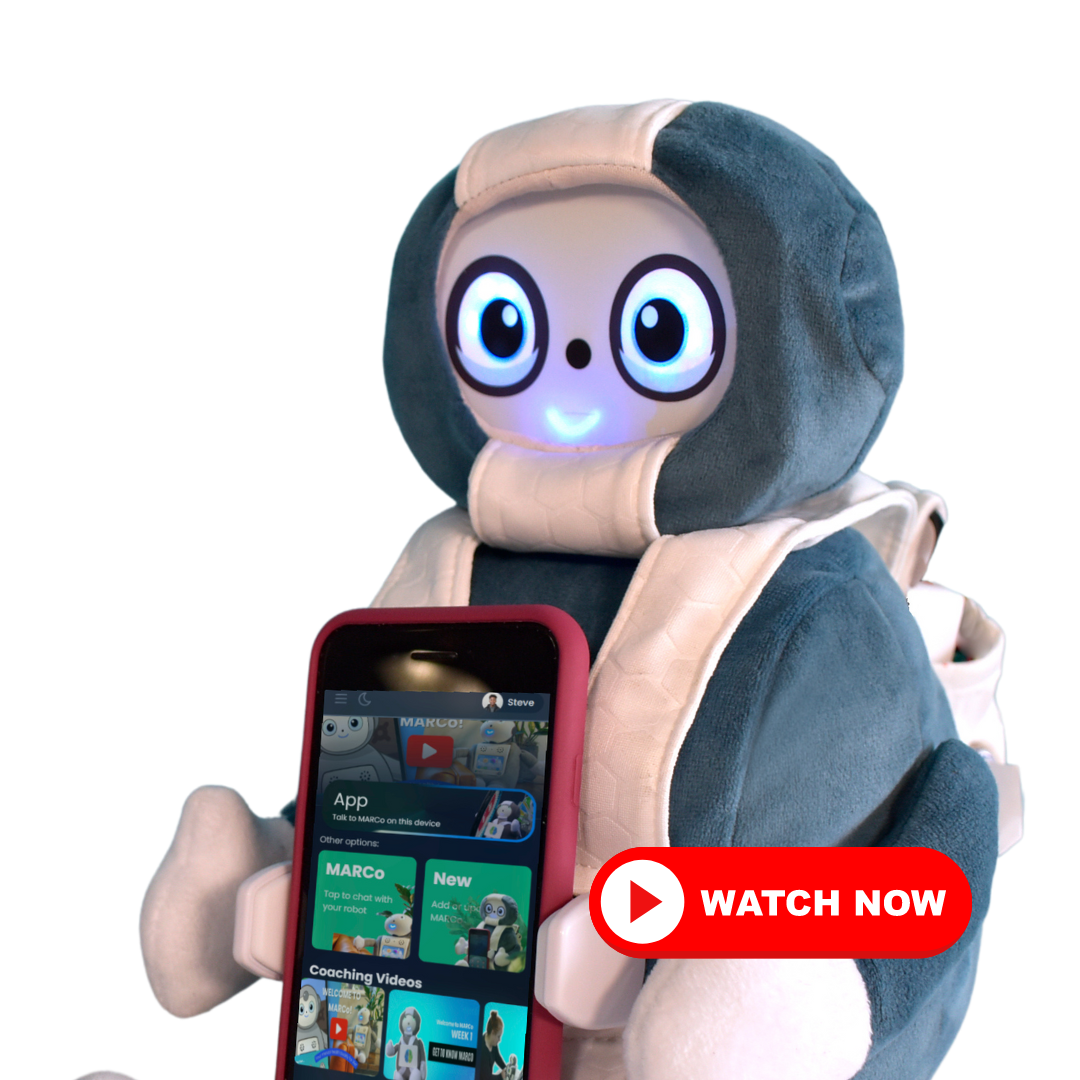
Boyle organizes everything MARCo does around what he calls the five objectives of care. It is the clearest way to understand the product, so here it is straight:
The five objectives of care
- 01CompanionshipTalk like you would to a friend - plus games, uplifting videos, and shared activities.
- 02Guided meditation & relaxationPersonalized meditation routines, breathing, and whole-body relaxation.
- 03Talk supportMARCo acts as a robot therapist, guiding psychology-based exercises toward your goals.
- 04BiofeedbackRegular check-ins on physical and mental state to support you holistically.
- 05High-alert outreachIf it detects a threat of harm, it can contact your pre-set emergency contacts.
That last one is the line that separates MARCo from a chatbot. Most digital mental-health tools stop at conversation. MARCo is designed so that, if a user expresses intent to self-harm, it can reach out to friends, family, or authorities the user has pre-programmed. It is a serious feature with serious implications, and it is central to why the company describes its makers as suicide survivors, psychiatrists, and professional counselors rather than a toy team.
02 / The originFrom a dorm project to a $30,000 prize
MARCo began at The College of New Jersey, where Boyle - a mechanical engineering major with a physics minor - built the first version with classmate Ryan Chiu, an accounting major who became the early CFO. The pitch was blunt: there are far more people who need mental health care than there are licensed caregivers to provide it, and a well-designed robot could fill some of that gap. In April 2018, the squishy foam prototype won the top prize, $30,000, at the school's Mayo Business Plan Competition.
The early robot already had the DNA of today's product: facial recognition to detect emotion and identify users, a touchscreen on its torso for guided imagery and video, LED eyes designed in part to help people with seasonal affective disorder, and active listening that could trigger an emergency response. The judges noticed. TCNJ's business dean called it a rare pairing of technology and a solid plan aimed at a real social need, and New Jersey Governor Phil Murphy reportedly called it "a home run of an idea."
The small number of customers who have directly told me MARCo was a literal life-saver mean more to me than any number of zeros at the end of my paycheck. Jacob Boyle, Founder & CEO
03 / The betWhy give a mental-health tool a body?
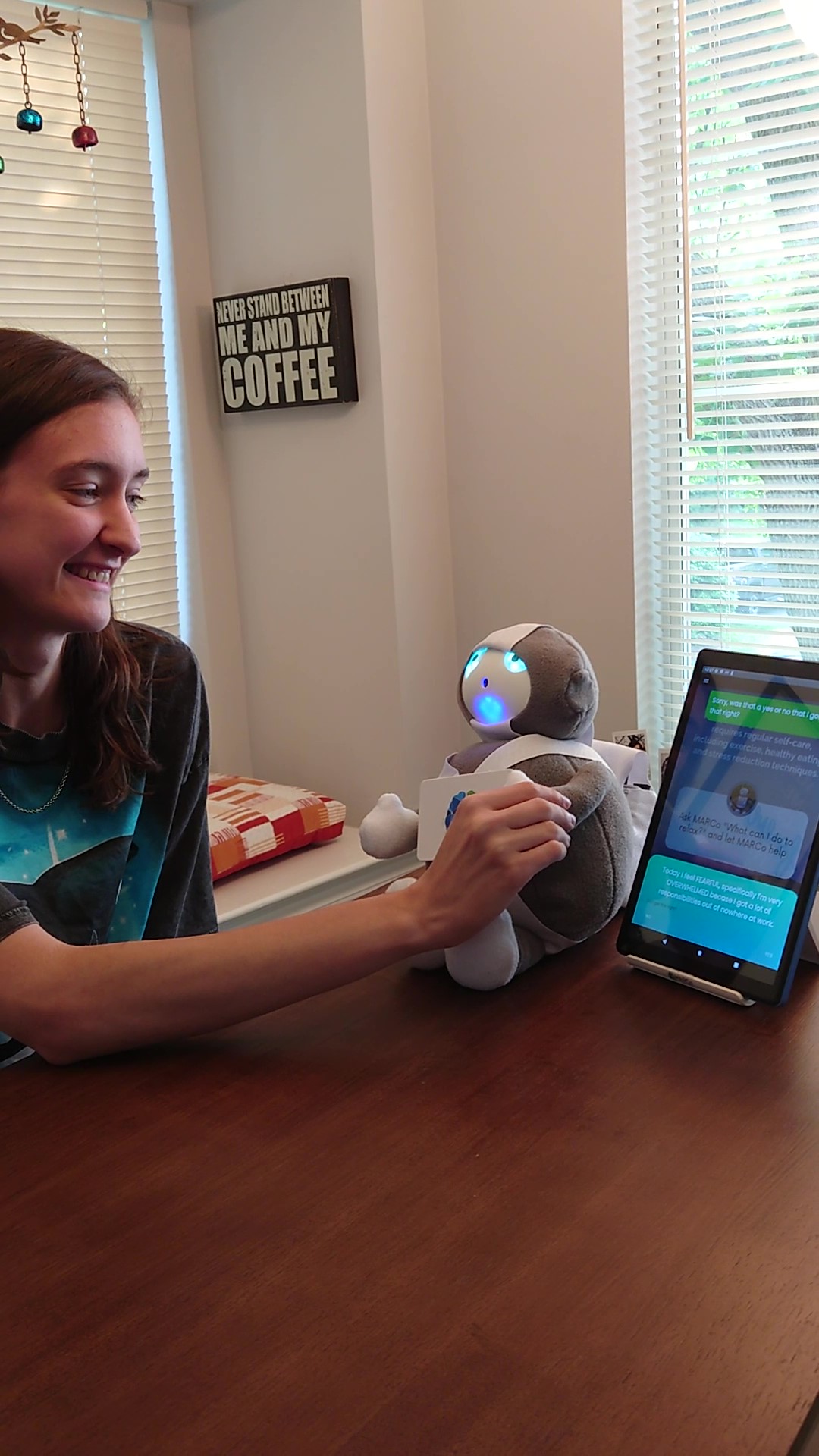
Plenty of companies make mental-health software - Woebot, Wysa, Replika, and meditation apps like Calm and Headspace among them. MARCo's contrarian bet is that a screen is the wrong container. People, the company argues, open up to a physical, present thing in ways they do not to another notification. Its own figure for that claim: users stay engaged with MARCo about 11.5 times longer than with mental-health apps alone.
Take the number as the company's own, but the logic holds up: a robot that lives on your desk and greets you by name is harder to ignore than an icon you swipe past. The 2024 software update leaned into this. MARCo can now hold a natural conversation without rigid menus, shift its persona between friend, coach, and counselor depending on what you need, and remember you across sessions. It is the AI-companion pitch - with the difference that this one has a face and weighs less than a laptop.
04 / ProductsOne robot, several price points
MARCo Health sells a family of robots rather than a single unit, deliberately spanning budgets. The strategy is access: get a capable version into the hands of people who cannot spend much, and offer more hardware to those who can.
There is also a free tier - a mobile app plus standalone tools like an Emotion Wheel, deep-breathing guides, and a "What-If?" app for spiraling anxiety - and a paid Therapist & Professional Dashboard at $180 a year. The dashboard is where MARCo becomes a clinical instrument: therapists, schools, and hospitals can assign activities, watch engagement, and get session summaries returned in SOAP format, the standard note structure clinicians already use.
A single therapy session often costs more than a MARCo-Lite. That price gap is the whole argument.
05 / The businessTwo customers, one robot
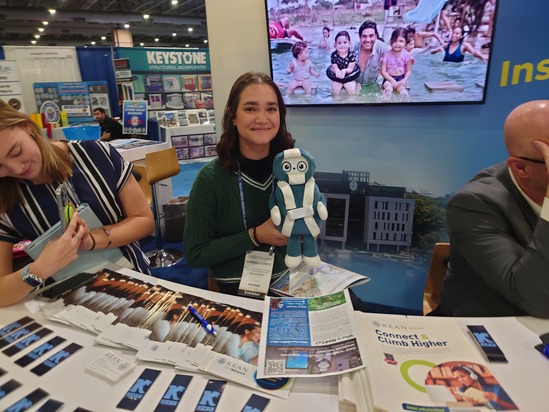
The model runs on two tracks. On the consumer side, MARCo Health sells robots direct - through its own store and through Amazon, Oz Robotics, RobotShop, and at least one local retailer, Fully Promoted in Princeton - with payment plans and financial aid for people who need them. On the professional side, the dashboard subscription turns the same robot into a tool clinicians and institutions pay for annually. Same hardware, two revenue lines: one-time consumer sales and recurring B2B software.
Money has been the hard part, and Boyle is candid about it. He has said he graduated with about $90 to his name while each robot cost at least $500 to build, and that investors were doubly wary - hardware is hard to fund, and mental health is hard to fund, and MARCo is both. So the company pieced it together: the $30,000 prize, grants, roughly $175,000 from investors over the years, and, in 2025, an equity crowdfunding campaign on StartEngine that let ordinary supporters buy in. The public record also notes a merger/acquisition-type funding event in August 2025.
06 / What it costs to build the unfundableThe parts that failed first
The MARCo story is not a clean rocket ship, and Boyle does not pretend it is. He has described running the company while managing his own severe anxiety and depression - operating at founder intensity on the exact condition the product treats. He has described being burned by people he trusted: a trusted advisor, by his account, embezzled roughly $28,000, which forced layoffs and months of disruption during a criminal investigation. The company survived on stubbornness and thin margins rather than a fat round.
For anyone thinking of copying the playbook, the honest lessons are worth taking. Winning a business-plan competition is not funding - it is a runway of weeks. A hardware unit that costs $500 to build and sells at $299 only works if you have a plan to bring the build cost down or a subscription behind it. And a product that can intervene in a crisis raises the stakes on every engineering and safety decision. MARCo's approach - therapy models under the hood, clinicians in the loop, outreach as a designed feature rather than an afterthought - is the part most worth studying.
07 / Where it fitsThe gap between an app and a therapist
MARCo sits in a specific slot: more present than an app, more affordable and available than a human clinician, and explicitly built to hand off to real people when things get serious. It will not replace a therapist, and the company does not claim it should. What it offers is coverage for the hours and the wallets that formal care does not reach - the 3 a.m. moment, the person who cannot afford weekly sessions, the school or clinic that wants to extend support between appointments.
Whether embodied AI becomes a category or stays a niche is an open question. But the through-line from a 19-year-old who quit weapons work to a shipping robot in 13 countries is coherent: take the same engineering that can be pointed at harm, and point it at the moment someone needs a hand. For $299 and change, that is a bet a lot of people have been willing to make.