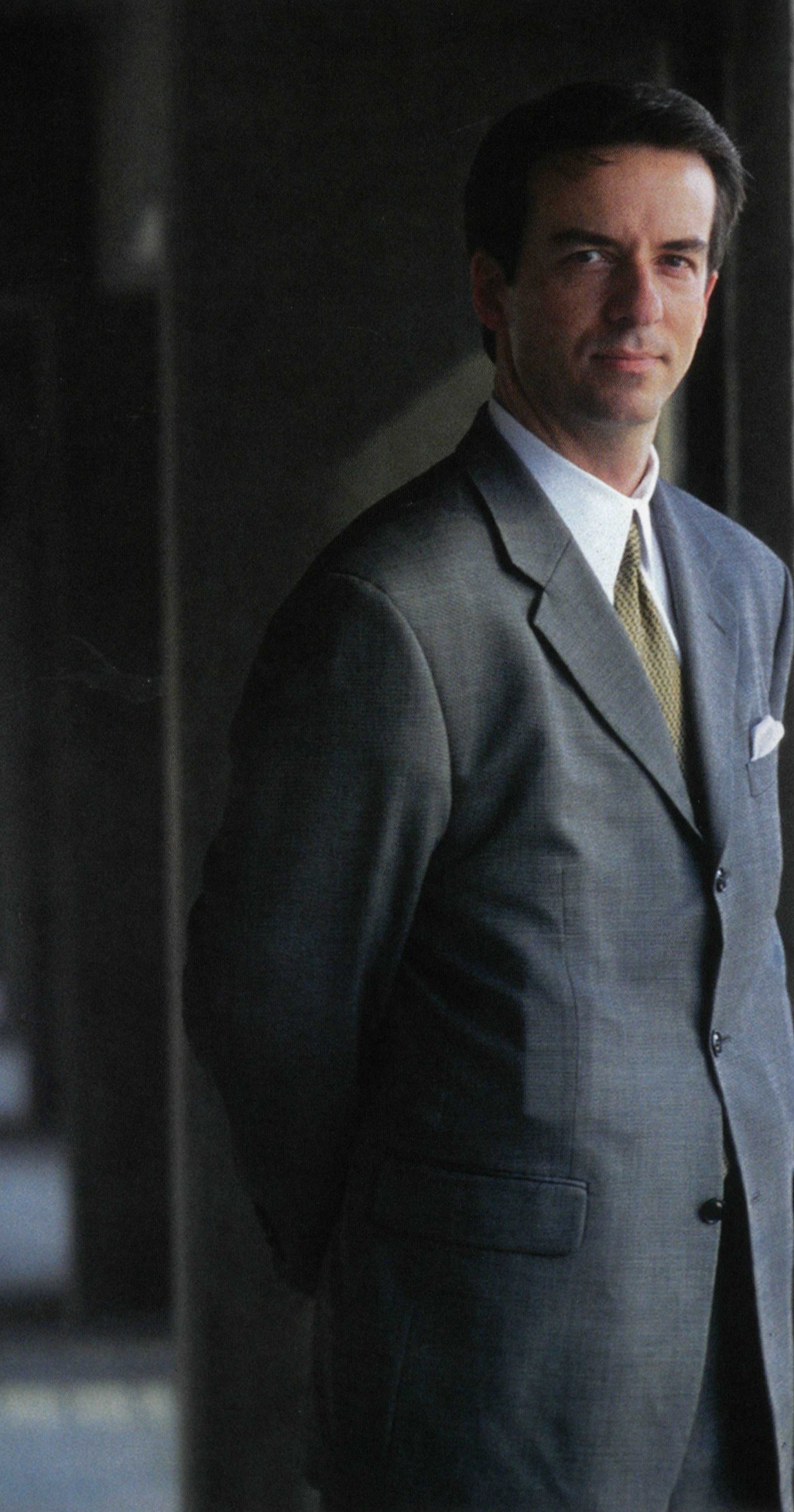
J. Michael Robison made his living finding places for cars to stop. He also wanted Atlanta to get moving. For a parking entrepreneur, a crowded road might look like a promising queue of customers. Robison saw the possibility of a city making itself harder to visit, harder to work in and less attractive to own a piece of. A full garage could be good business. A street nobody could reach was rather less accommodating.
His starting point was modest enough to count without a spreadsheet. In 1989, while still a Georgia Tech student, he used his savings to buy an 18-space parking lot in downtown Atlanta. He had already worked in parking management for another company. Lanier grew out of that practical education: the daily business of arrivals, departures, property owners and customers who generally have somewhere else they would prefer to be.
The business advanced faster than his degree. Robison reduced his studies as work expanded, taking fourteen years, on and off, to finish his bachelor’s. He graduated in management in 1997. That detail gives the familiar student-founder story a useful second act. Founding a company was an interruption to his education; he eventually returned to finish the sentence.
Atlanta was both home and working material. Its roads, developments and commuting habits gave him a business to operate and a set of problems to consider. Over time, the patch of asphalt became an entry into real estate, transportation and civic life. The interesting part of that progression is how often he looked beyond the parking space itself.
A parking operator takes the train
By 2003, Lanier’s alternative transportation work had helped it win the parking contract at Atlantic Station, the redevelopment of a former steel mill site near Georgia Tech. Robison acknowledged that the project had been larger than the company’s usual scale. Its transportation approach gave it a way into the conversation. The ability to manage a garage mattered; so did an interest in how people would reach it.
He was prepared to entertain an outcome that sounded positively impolite in his own industry: a future in which Lanier might leave parking behind. Alternative transportation, he argued, offered business opportunities of its own. There is a certain freedom in a founder who can imagine his company doing something other than the thing on its sign. It leaves room for customers to change their habits.
His concern was also a property owner’s concern. Congestion could damage the attractiveness of the developments his company served. A building’s appeal did not end at its front door. It extended into the journey required to get there, and into the willingness of a visitor or employee to make that journey again tomorrow.
By spring 2006, he was taking MARTA from his Buckhead home to his Midtown office. Lanier operated a shuttle between the Arts Center station and Atlantic Station, alongside programs involving transit passes, carpools and vanpools. The commute supplied an unusually apt illustration of his argument. The parking executive had found a use for the train: it gave him more usable minutes in the day.
“You just can’t have everybody driving.”J. Michael Robison · 2006
TransitThe daily commute02
Shared carsThe daytime errand03
ParkingA place to connect
The spare car as an invitation
Car sharing provided another piece of the journey. In 2006, Lanier partnered with Flexcar to bring the service to Atlanta. Zipcar acquired Flexcar in 2007. By the time Zipcar went public in 2011, Lanier was celebrating a partnership that had helped introduce shared cars into a market accustomed to private ones.
Lanier made its Atlanta parking network available for placing shared vehicles in visible locations. It promoted the service locally and offered discounted memberships. Robison described the initial difficulty as persuading car-sharing operators to enter the market. His company could supply something immediately useful: places to put the cars where potential users might actually encounter them.
The appeal was practical. Someone taking transit could still have access to a car for an errand during the day. That addressed a familiar reason for driving to work in the first place: the possibility of needing a vehicle later. Parking infrastructure could help make a transit trip easier to choose. An empty seat on a train and an available shared car began to look like complementary assets.
This was a business argument with a civic consequence. Lanier could participate in another transportation service while helping Atlanta offer more ways to travel. Robison’s operating footprint gave him a means to test the idea. The garage, usually treated as the destination of a car journey, could also become the place another kind of journey began.
Peachtree, with a different set of wheels
Robison’s interest in streetcars took that reasoning onto one of Atlanta’s defining roads. He founded and chaired Atlanta Streetcar, Inc., advocating a Peachtree corridor connection. The proposal belonged to the city’s long conversation about growth, access and the character of its streets. Tracks offered an opportunity to ask what the road should do for the neighborhoods around it.
The early campaign brought him into a civic network extending well beyond parking. The organization’s board included figures from universities, property companies, cultural institutions and other Atlanta organizations. That range of interests helps explain the appeal of the proposal. Movement along Peachtree affected institutions with very different purposes and very similar problems getting people to the door.
By 2006, the streetcar group had passed its study to the Peachtree Corridor Task Force created by Mayor Shirley Franklin. The ambition of those proposals should be read in their own time. They were plans for a corridor and an argument about Atlanta’s future, rather than a description of the route a visitor can ride today.
His two-year term as chairman of the Atlanta Convention & Visitors Bureau began in January 2006. His agenda ranged from the streetcar to cultural attractions, including support for a civil rights museum and a new symphony hall. Tourism gave his transportation concerns another audience. A city asking visitors to come and stay would do well to consider what happened after they arrived.
An Olympic contract born from a missed deal
Lanier’s event business supplied a different lesson in how connections develop. Robison failed to secure official parking business for the 1996 Atlanta Olympics after hard bargaining. Yet the negotiations brought him into contact with Tim Walsh, who managed parking for those Games. Walsh subsequently joined him as a partner. The immediate deal fell away; a working relationship remained.
Lanier later handled parking for the 2002 Winter Games in Salt Lake City and, with Canadian operator Impark, the 2010 Olympic and Paralympic Winter Games in Vancouver. The Vancouver assignment involved 25 parking venues, 40,000 spaces and provision for as many as 50,000 cars a day. Around 3,000 employees needed training. At that scale, parking becomes a substantial exercise in coordination.
The figures describe an operation taking place far from the medal podium. People still needed directions, staff still needed to reach their posts, and the cold still required gloves and hand warmers. Walsh oversaw the effort in Vancouver. For all the glamour surrounding the Games, the business depended on an abundance of ordinary tasks performed at the right time.
The missed Atlanta contract makes the later work more interesting than a straight sequence of wins. A negotiation can produce value beyond the contract under discussion. In this case, it helped bring two future partners together, and the company they ran eventually returned to Olympic work in other cities. Business history occasionally leaves through the side entrance.
Socrates at the management meeting
Robison’s approach to managing people had a conversational streak. In a 2006 interview, he described asking questions to help managers work their way toward a conclusion. He favored the commitment that came from arriving at an answer themselves. The comparison was to the Socratic method, though the setting was a company handling cars and transportation rather than an Athenian courtyard.
His advice on delegation was equally deliberate. He was willing to invest hours teaching a task that would initially save only minutes. Repeated over years, that investment could free a leader from work that capable colleagues could perform. It is a patient calculation for a founder: accept the inconvenience of explaining something now in exchange for a company less dependent on you later.
He also described the difficulty of turning down opportunities while building the systems required to support further growth. Expansion could outrun the organization’s ability to deliver consistent service. Declining work was painful, he said, but capacity had to catch up. A business selling orderly arrivals could hardly afford to let its own growth become a traffic jam.
“Disclose the problem; do not cover it up.”J. Michael Robison · 2006 management interview
Handing over the keys
In March 2014, Lanier announced an equity investment from Antarctica Capital and named industry veteran Jerry Skillett its new CEO. Robison retired from the company. The announcement presented the investment as support for acquisitions and wider geographic expansion. His departure closed a roughly quarter-century operating chapter that had begun with the downtown lot.
His life also entered public scrutiny outside business. In May 2015, a Nantucket jury acquitted him of all rape charges following a trial concerning a July 2014 incident. He had maintained his innocence. The acquittal is part of his public history and the outcome of the criminal case.
His current professional biography lists him as managing partner of Robison Real Estate Holdings and co-founder and CEO of Ackceptional.com, a Nantucket-based service platform concerned with communication and accountability. The subjects are familiar: property, service and the practical arrangements that shape a customer’s experience. The setting has changed; the operating questions remain recognizable.
Look back across the Lanier years and the most revealing image may still be the parking executive riding MARTA to work. It connects his business interests with an everyday choice, without requiring a grand declaration. Eighteen spaces were enough to begin a company. The journeys beyond them gave Robison considerably more to think about.
- 1989An 18-space beginning in Atlanta.
- 1997The Georgia Tech degree is complete.
- 2010Olympic work reaches Vancouver.
- 2014A new investor and CEO; Robison retires.