A supermarket discount has excellent manners. It introduces itself with a small number, asks very little of your attention, and conceals an extraordinary amount of work. Someone has chosen the product, the price, the week, and the quantity. Someone else will have to explain whether the whole exercise was worth it. Hatem Sellami has spent much of his working life among the questions hiding behind that little number.
Today he is co-founder and CEO of Cognira, the Atlanta-based software business focused on promotion management. His route there passes through Tunisian professional networks, an American research university, a retail software laboratory, and an earlier company called Predictix. The names change. The recurring subject is how to turn complicated analysis into a decision that a retailer can actually use.
Four degrees, then a different classroom
Sellami’s educational itinerary took him to France in 1984 for higher mathematics studies, then to the United States. He began his bachelor’s at Georgia Tech in March 1986. A master’s followed, then a doctorate in computer engineering in 1995 and an MBA in 1996. Four degrees at one institution is a considerable commitment to the idea that there might be something else to learn.
He has called himself an “eternal student.” It is a pleasing description for someone whose subsequent work has involved systems designed to learn from data. There is also a less academic detail from 1996: he served as Tunisia’s Olympic attaché at the Atlanta Games. In the year of his MBA, he was representing the Tunisian Olympic committee within the Games’ organizing operation.
The combination gives his early Atlanta years an unexpected texture. Engineering, business, and a role connecting Tunisia to an international event all appear before Cognira enters the story. The later company would give those American and Tunisian connections a continuing commercial form.
An apprenticeship in what sells
Retek supplied the next classroom. Sellami joined the retail software company and worked on forecasting, eventually taking responsibility for Retek Labs. Along the way came consulting, solution architecture, and product management. Those roles placed him at several points between the science of a prediction and the practical business of delivering it.
The laboratory’s remit included product management, scientific work, and development for predictive and optimization products. His earlier consulting responsibilities had included technical and business assignments, followed by management of predictive solutions consulting. This was a career spent moving through the different rooms of the same problem.
A forecast can be mathematically interesting while remaining awkward to apply. A retailer still needs stock decisions, usable software, and people who understand the consequences. Reading Sellami’s progression from science through consulting to product leadership, one sees why those practical connections would become central to his later companies.
The second company begins before the first story ends
In 2005, Sellami co-founded Predictix. The business worked in retail predictive analytics and optimization, including forecasting, replenishment, planning, allocations, pricing, and promotions. It carried forward the retail questions he had encountered at Retek, with cloud software becoming part of the delivery.
Predictix eventually became part of Infor. The acquisition was completed on June 27, 2016. That date matters because Cognira had already been founded in 2015. These chapters overlap; they are better understood as a continuing involvement in retail analytics than as a perfectly tidy succession of exits and entrances.
Cognira began with consulting and moved toward its own technology. The progression has a practical logic: work with the customer’s problem, understand its recurring shape, then build software around it. Sellami’s public biography also includes the founder and CEO role at RetSci, whose work addresses merchandising and supply-chain decisions through analytics and services. His professional subject has remained unusually consistent.
Two cities in the same sentence
Atlanta and Tunis recur throughout Sellami’s working life. During his eight years at Retek, he spent four in Tunisia supporting clients primarily in Europe. Later, from 2011 to 2013, he chaired the board of Tunisian American Young Professionals. He also participated in its 2011 and 2012 US investment roadshows promoting investment in Tunisia.
That activity gives the cross-border business story something firmer than a founder’s sentimental attachment to home. It includes work performed in Tunisia, professional organizing, and introductions intended to bring investment into the country. The connection runs through both his employment and his life outside an individual company.
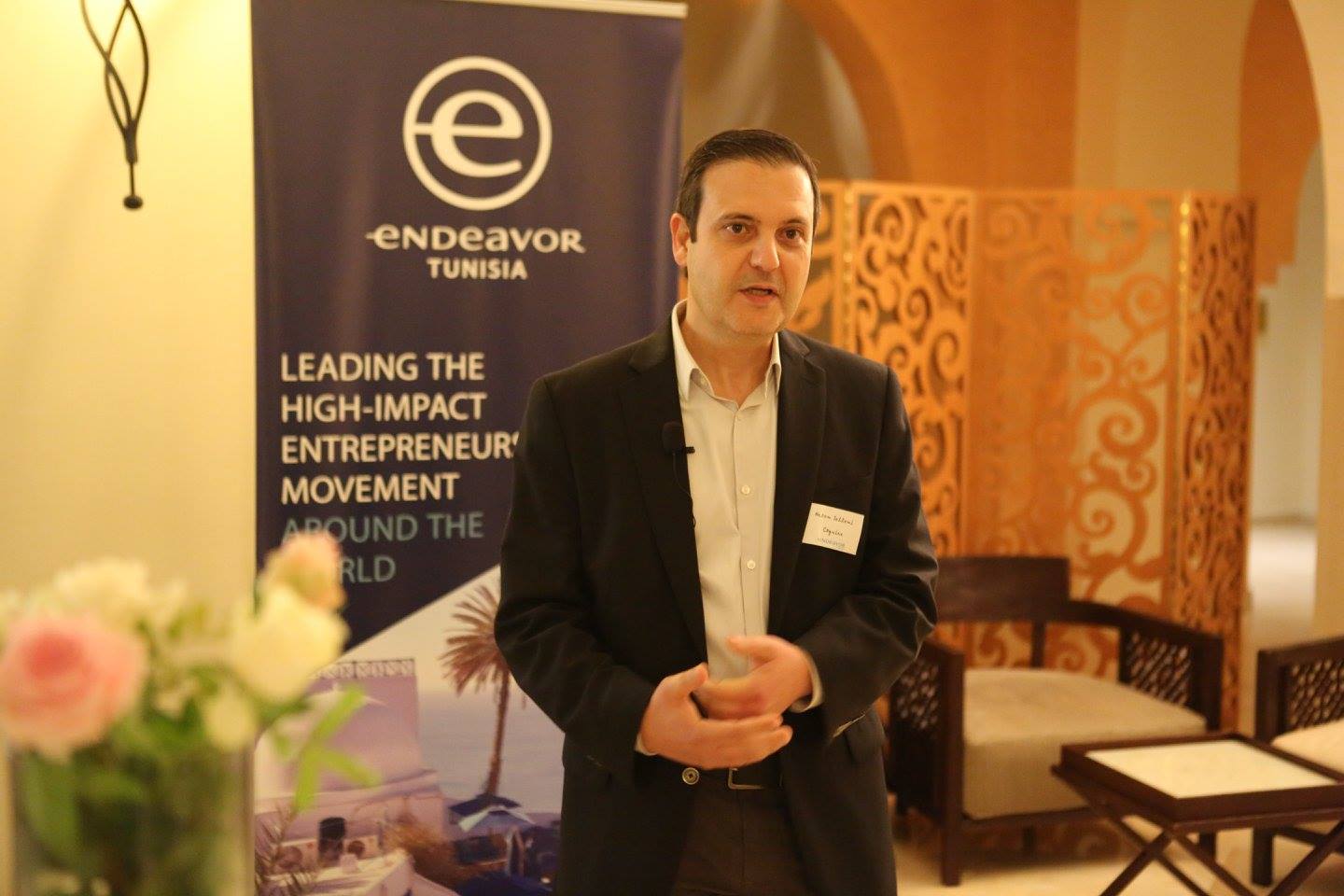
In September 2017, Endeavor selected Sellami and Cognira co-founder Bahadir Ustaoglu into its entrepreneurial network. Cognira received support from both Endeavor Atlanta and Endeavor Tunisia. Endeavor called it the network’s first joint office company. For a business already operating across those communities, the arrangement was an unusually literal fit.
- LearnGeorgia Tech
PhD 1995 · MBA 1996 - BuildRetek Labs
Predictix, 2005 - ConnectCognira, 2015
Atlanta + Tunis
The discount has a complicated private life
Promotion planning is where Cognira’s work becomes easy to picture. A retailer must decide which products to feature, what form an offer should take, and how long it should run. A price reduction, a free item, and a different placement are different interventions. Each introduces questions about demand and the financial result.
PromoAI brings planning, forecasting, analysis, and optimization into that process. Its purpose is to help teams examine choices before an offer runs and learn from performance afterward. The weekly promotion becomes part of an ongoing decision process, rather than an isolated date on the calendar.
In a 2021 interview, Sellami said 90% of Cognira’s development team was then based in Tunisia, while the country accounted for roughly half the overall workforce. Those figures describe that period. They also make clear that Tunisia was participating in the creation of the product, with responsibilities extending beyond a representative office.
Even the post had adapted to the arrangement: incoming physical mail was scanned and forwarded electronically. It is a modest detail, and a revealing one. A distributed company still needs someone to deal with the envelope.
Growth acquires a human dimension
Cognira reported a 166% increase in annual recurring revenue in 2023 compared with the previous year. Its workforce grew 53%, and it announced new offices in Portugal, France, Turkey, and the United States. These are company-reported historical results, giving a dated view of the business as it expanded.
Sellami’s response to those figures emphasized the team and its culture. That emphasis also appears in his earlier account of management. He wants employees to have room to grow, take responsibility for their work, and remain entrepreneurial as the organization gets larger.
“People in the company are everything; they make or break companies.”
Hatem Sellami · 2021
The practical tension is familiar. A growing software company needs enough organization to deliver reliably, while preserving the willingness to question how things are done. Sellami’s stated preference is for communication across the company and for employees to feel empowered. The ambition deserves to be read alongside the hiring numbers: growth changes the organization that has to carry it.
Figures reported by Cognira in February 2024.
The software meets the weekly shop
Customer announcements put names and dates to that expansion. In December 2024, Cognira announced that Schnucks had selected PromoAI for its 114-store business. The work covered promotion planning, optimization, and analysis, with fresh and center-store departments sharing an integrated approach.
The Schnucks announcement also described weekly ads, emails, endcaps, and in-store promotions. Those details are useful because they show how many ordinary retail activities sit inside the word “promotion.” The software has to help coordinate work that shoppers encounter in several forms.
In October 2025, Weis Markets selected PromoAI for promotion planning across 200 stores and digital channels. The intended benefits included collaboration among merchandising, marketing, and analytics teams, alongside evaluation of performance and use of trade funding.
Then, in July 2026, Brookshire Brothers completed its implementation. Selection and go-live mark different moments. The latter places software inside the retailer’s working routine. Brookshire Brothers’ announcement described centralized planning, forecasting of financial outcomes, and post-event evaluation. For Sellami, the customer relationship now included the business of using the system and improving subsequent plans.
The eternal student meets a new interface
By July 2026, Cognira was describing another development: Cora, its AI agent within PromoAI. Planners could ask questions in ordinary language, explore previous performance, and investigate the factors behind forecasts. The company also described creating promotion drafts for review, with missing details gathered through follow-up questions.
The human planner remains part of that process. Cora’s role, as described by Cognira, is to make analysis and execution easier to navigate. A question can lead to a comparison, then to a draft, while the person responsible still reviews the work.
It is a fitting current chapter for someone who has moved between research, consulting, software, and management. The technical machinery changes, while his chosen problem keeps its shape: give the retailer a better basis for the next decision.
The shopper, meanwhile, is entitled to remain delightfully incurious. A useful offer should not require a doctorate to appreciate. Sellami has one. His career has been occupied with helping the complicated work happen before the rest of us reach the shelf.