Ivan Barratt wanted thousands of apartments. He had a duplex. Between those two facts sat a rather awkward problem: wanting a large real estate business did surprisingly little to create one. The duplex, at least, had doors he could open.
In the years around the financial crisis, the distance between ambition and reality had become painfully measurable. He had worked on development projects with a mentor. He had bought an expensive condominium. When the market turned, the impressive plans looked less impressive. He and his wife moved back into the duplex. A smaller address made room for a different approach.
There is a temptation to begin Barratt’s story with the later numbers. His company now reports more than 10,000 units acquired and over $500 million in equity raised since 2015. Those figures describe where the business arrived. The duplex explains something about how he learned to move.
The next deal had six doors
Barratt attended Indiana University’s Kelley School of Business from 1998 to 2001, studying finance and real estate finance. He entered the industry eager enough to offer to work for his first mentor without pay. The attraction was practical: get close to someone doing the work, then learn.
Development gave him exposure to large projects before he had a business of his own. It also gave him an early encounter with the difference between a promising deal and a durable one. The downturn left him reconsidering the scale of his plans and the means available to carry them out.
He began buying small multifamily properties. Duplexes came first, then a triplex. A bank-owned six-unit building became an early apartment project, financed with hard money. In his retelling, he places that purchase around late 2010 or early 2011. Six units scarcely suggested an empire. They did provide six opportunities to discover what he had overlooked.
The useful adjustment was psychological. Barratt stopped treating a small deal as a distraction from a large future. A property could be modest and still teach him how to buy, repair, rent, and manage. Repetition gave the ambition somewhere to go.
- 2A duplex
The starting point - 6Bank-owned apartments
An early renovation - 35A larger purchase
One outside investor - 112An apartment community
On-site management
A spare bedroom, with responsibilities
In 2010, he founded Barratt Asset Management, the business that became The BAM Companies. Its first office was a spare bedroom. Property management supplied a way to earn revenue while he assembled the investment side. It also ensured that the business stayed close to the daily consequences of owning buildings.
Management is a less photogenic apprenticeship than acquisition. There are residents to answer, repairs to arrange, and owners who would like to know where the money went. Barratt took on that work before he could afford a large staff. The work generated experience along with fees.
One early step up was a 35-unit project. He remembers one investor putting in roughly $150,000, his own real estate commission going into the transaction, and the seller carrying a note. It was a deal assembled from the resources he could reach. It also delivered several lessons he would probably have preferred to receive by correspondence.
His explanation of those years is unusually plain for a business that can make a routine purchase sound like a lunar expedition. The difficult work came first. The choice of work came later.
“I had to first do what I hate in order to one day get to do what I love.”
Ivan Barratt · January 2023 interview
That sentence gives the spare bedroom its significance. A cheap office helped, but the important economy was in expectations. He accepted work that could support the next stage, even when it bore little resemblance to the role he hoped eventually to hold.
Finding someone who enjoyed the other half
A 112-unit acquisition brought on-site management into the picture. As the properties grew, the business required more than Barratt’s willingness to handle the next task. It needed people who could make good decisions without waiting for him.
Adam Ehret became central to that transition. A former multifamily investment broker at Cushman & Wakefield, Ehret brought a different set of strengths. Barratt has described him as his opposite and a better operator. That is a useful admission from someone whose name originally appeared above the door.
The division is visible in their current roles. Barratt concentrates on equity finance, acquisitions, and strategy. Ehret, BAM’s president and chief investment officer, directs acquisitions, debt financing, and asset management. Their responsibilities intersect, but the partnership gives each room to work where he is most useful.
For Barratt, scale meant learning to leave decisions with other people. In interviews, he talks with pleasure about department leaders developing their own judgment. A founder who starts by doing everything eventually faces a curious assignment: build something that functions when he stops doing everything.
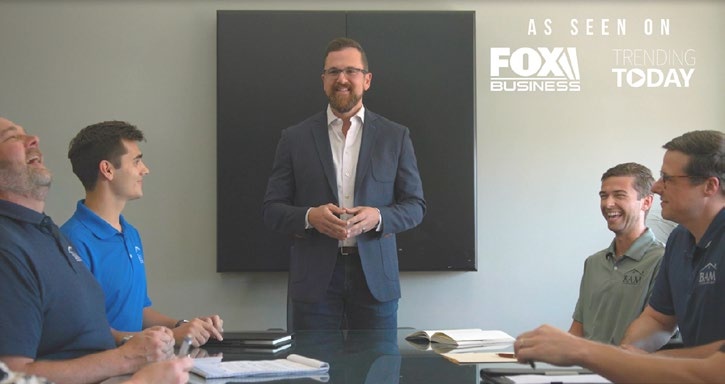
When investors began choosing a manager
The investment structure changed, too. Early deals asked investors to consider a particular building. A multi-asset fund asks them to entrust a manager with selecting several. Barratt has spent time explaining that change to investors because it alters the decision they are making.
His argument is that the people running a property deserve close examination alongside the property itself. A building arrives with a location and a rent roll. What happens next depends on financing, maintenance, leasing, and the decisions of the team. The operator stays relevant long after the closing photograph.
BAM’s structure puts capital raising, management, and construction within related businesses. That gives Barratt’s investment pitch an operational foundation: the organization raising money also has people responsible for what happens at the apartments. It is an arrangement with considerable managerial homework attached.
He has also been candid about undercharging early on. For several years, property management revenue carried much of the company’s growth while other work received too little compensation. Administration, refinancing, and asset management still consumed time. Eventually the fee structure had to acknowledge that people doing necessary work require salaries.
Related businesses within The BAM Companies connect financing decisions with work at the properties.
The people behind the initials
By August 2022, BAM had appeared on the Inc. 5000 for five consecutive years. That year’s company announcement listed three-year revenue growth of 144.5 percent. Barratt’s response was less numerical: he compared his pride in the team to being a proud father.
The language fits an ambition he expressed earlier: to create an organization that would outlive him. Buying another property can increase a portfolio. Developing people who can run the organization addresses a different question about its future.
There are tangible rituals around that aim. In 2025, the company brought more than 200 team members together for its fifth annual BAMcon, with owner questions, speakers, and breakout sessions. Its monthly Positive Impact Friday gatherings give headquarters and property teams time to share a meal and recognize work.
Those details are modest compared with a transaction total. They also describe how a business spread across apartment communities attempts to remain a group of people who know one another. Barratt lives in Carmel, Indiana, with his wife and three children. His public affiliations include YPO and The Penrod Society, the Indianapolis arts organization.
A business lesson with an actual mountain
Barratt has recounted a memory from a high-school climb. The guide advised concentrating on the next step rather than staring at the summit. Years later, he used that story to explain his approach to building a company: choose the right mountain, then keep moving.
It is an agreeable metaphor, helped by the fact that he has also done some literal climbing. The ascent board for the August 2021 29029 event at Snowbasin lists Ivan Barratt with 13 ascents. That event’s route called for 13 climbs to accumulate the elevation gain of Everest.
The detail has a pleasing lack of glamour. Reaching the target required going up the same mountain repeatedly. Somewhere between the first ascent and the thirteenth, the business analogy acquired rather more convincing footwear.
Still looking toward the Midwest
In 2026, Barratt has been making a public case for Indiana and Midwest apartments. His writing connects the region’s investment prospects with industrial activity and housing demand. It is a continuation of the geographic focus that shaped his earlier portfolio.
His September argument about buying amid a difficult multifamily market is more provocative. He says waiting for universal reassurance can mean missing attractive prices. It is an investment thesis, dependent on choosing carefully and understanding the debt behind a sale. Enthusiasm cannot make those details optional.
An August letter made the limits explicit: private real estate is illiquid, funds use debt, and values move in cycles. The caution matters in a career formed partly by a downturn. Barratt’s current work involves weighing opportunities against lessons he acquired when his own plans came apart.
The spare bedroom is long behind him. The duplex remains a useful place to understand the story. It gave him a manageable responsibility when the larger ambition had become difficult to act on. The next purchase added doors. The next partnership added judgment. Eventually, the business became large enough that his most consequential decisions concerned the people carrying it forward.