For a while, Itai Sadan had the sort of problem a founder is supposed to want. Two kinds of customers were buying his software. Small-business owners wanted to get a website online with very little fuss. Web professionals wanted enough control to build websites for other people. Both groups had money. Both had requests. Unfortunately, their requests kept sending the engineering team in opposite directions.
A simpler product pleased one audience and frustrated the other. More sophisticated controls reversed the complaint. At Duda, the website company Sadan co-founded with Amir Glatt, growth had produced a dispute about whom the company existed to serve. The argument could travel from the product roadmap to the wording on the homepage without ever leaving the office.
Sadan and Glatt eventually chose the professionals. They stopped putting acquisition money behind direct small-business customers and built around agencies instead. In a business where a larger audience usually makes a more attractive slide, they had made their audience smaller on purpose. It gave them something rather useful in return: a customer they could describe without adding an “also.”
The garage had a day job
Sadan was born and raised in Tel Aviv. His interest in selling software to small businesses predates Duda by years. At 21, he founded InterSight, working with document storage and databases. He went on to study computer science and mathematics at Ben-Gurion University of the Negev. The small-business customer would keep reappearing, even as the technology around that customer changed.
He worked at Amdocs and SAP, and a SAP position brought him from Israel to the United States. At SAP, his responsibilities included the Discovery System program and relationships with IBM, HP, and Fujitsu. That was a respectable place to observe the technology industry. Eventually, observing other people start companies became less satisfying than starting one himself.
By late 2008, Sadan and Glatt were working on a very ordinary irritation with a large potential audience. People were browsing on phones. Existing websites often looked terrible there. Large internet businesses could afford to fix the problem. A local shop had fewer engineers available, frequently none.
Duda began as a way to convert desktop sites into something useful on a phone. Sadan worked on it during evenings and weekends while retaining his SAP job. The garage in Mountain View was real; so was the salary that allowed the experiment to continue. Entrepreneurial romance is easier to accommodate when someone is still paying the bills.
The first year brought plenty of investor rejection. An agreement with AT&T in early 2010 helped change the conversation. AT&T put its own brand on Duda’s mobile product and offered it to small-business customers. A product that investors had struggled to evaluate now had a recognizable buyer. Sadan left SAP and made Duda his full-time work.
A friendship with a film reference
Glatt was a high-school acquaintance long before he became the other name on the founding documents. Their company’s own account of those years includes a pleasing distinction: Glatt remembered himself as the scout-minded geek and Sadan as the surfer. They had occupied different school crowds. Later, they found enough common ground to build a company together.
One shared enthusiasm was The Big Lebowski. Duda takes its name from The Dude, Jeff Bridges’s magnificently unhurried character. Sadan’s official biography even picks out the film’s rug scene as a favorite. Most corporate biographies make room for a degree. This one also makes room for a rug.
The reference has proved more durable than the original product description. DudaMobile would become Duda, but the founders remained CEO and CTO. A longstanding relationship gave them a place to begin the hard conversations that followed. It did not relieve them of having to persuade everyone else.
Building the replacement before the original stopped paying
Mobile-friendly sites solved a real problem. Then the problem changed. As people used more screen sizes, maintaining separate versions of a website became awkward. Responsive design offered a different arrangement: build a site once and let it adapt to the screen. For a company identified with mobile conversion, that development required attention.
By late 2012, Sadan and Glatt were proposing a responsive website builder to their management team. DudaOne launched in early 2014. The development took longer than they expected. Meanwhile, the mobile business began slowing. The founders had started building a successor while the existing product still mattered, yet the overlap was uncomfortable.
There were roughly two years of little movement in total revenue. The established product was declining while the new product grew from a smaller base. The company also reduced staff to control spending. Underneath a flat total, one business was helping finance another. It was possible to be making progress and still have a disappointing number to explain.
A product change and a customer choice. Each required its own commitment.
Even the homepage became contested territory. How much space should go to the new product when the old one still paid the bills? That is the less photogenic side of a pivot. Someone has to decide what the next visitor sees while colleagues can point, quite reasonably, to the revenue arriving today.
The partner page takes over
The responsive builder put Duda into a crowded market. Choosing agencies offered a more specific place to compete. Professionals were growing faster within its customer base, brought multiple client projects, and wanted the kinds of capabilities its engineering team understood. Sadan saw an audience whose working day deserved more attention.
That working day included much more than arranging a page. An agency needed to manage several sites, collaborate with colleagues, involve clients, and present the service under its own brand. Duda’s white-label model let the agency keep that relationship. Its software could be underneath the work without requiring the agency to send its customer elsewhere.
The shift became visible gradually. A partners or resellers link that once occupied a small part of the website became central to the offering. Eventually, the homepage spoke directly to professionals. Sadan has described using growth and retention data to make the case internally, starting with agreement between the founders and bringing the management team along.
He has also said he would have moved faster. Other platforms developed their own offerings for professionals. Finding a promising customer did not reserve that customer forever. The decision had to turn into product investment, marketing expenditure, and a sufficiently clear message before the opportunity became more crowded.
Company figures reported in July 2026.
A calm voice, and some expensive lessons
Sadan describes calmness as part of how he works. He tries to receive bad news as a problem to solve rather than a reason to collapse. He also believes in celebrating wins without living in them. A founder who has spent years replacing products has practical reasons to keep the congratulations brief.
“Maintaining an even keel allows you to run the full marathon of building a startup.”
Itai Sadan
A public recommendation from former colleague Shadan Mirabedi offers a smaller, more personal detail: Sadan called at home on the evening Mirabedi received a job offer from Duda. The same recollection describes an approachable leader with a sense of humor. A phone call is a modest gesture, which may be why it survived in someone’s memory.
His account of leadership also changes with company size. Early on, the founder handles sales, marketing, hiring, and the immediate question of making payroll. As the business grows, specialists take on those responsibilities. Sadan says he enjoys delegating and giving experienced executives autonomy. His attention returns to an area when the person responsible needs more help than expected.
That is a more revealing description than the idea of a CEO permanently involved in everything. Experience has given him more work he can hand over, and a clearer sense of when he needs to step back in. The title stays the same. The practical job keeps changing.
The next brief arrives by prompt
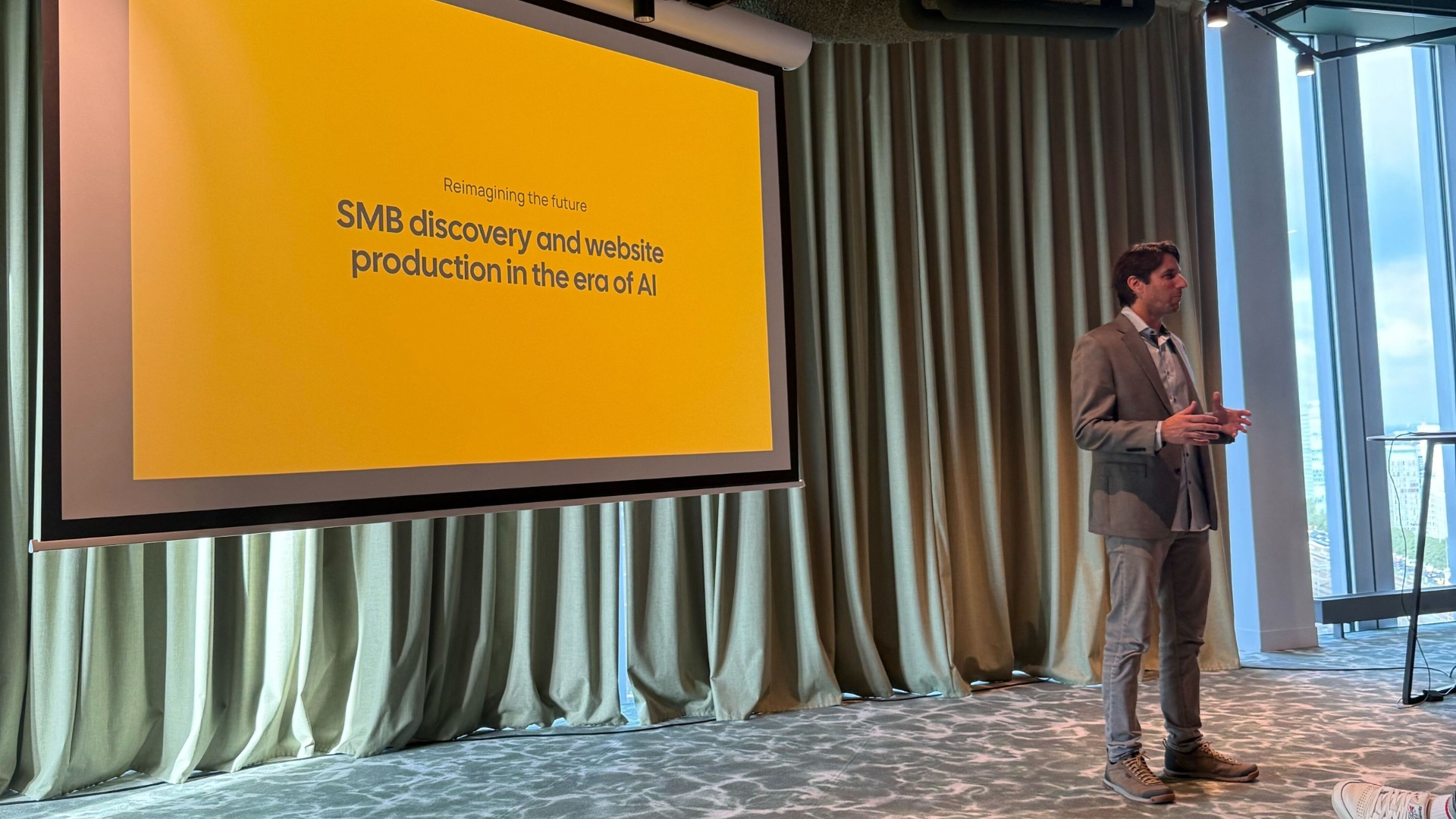
Artificial intelligence has given Sadan another version of a familiar question: when the technology changes, what should the company keep doing for its customers? He was publicly arguing in 2023 that agencies would retain a role as AI spread. Their clients still needed help turning a business objective into an effective online presence.
By DudaCon 2025, Sadan and Glatt were describing conversational creation, AI-generated widgets, and connections that let external AI tools work with Duda. The ambition extended beyond writing copy. It reached into the way an agency assembled and managed the work. A client brief could become a starting point for production.
In July 2026, Duda introduced expanded site generation, a Custom Widget generator, and Duda Vibe, a conversational environment for websites and web applications. The announcement kept returning to the professional running multiple projects: collaboration, client permissions, white-label delivery, and the costs of maintaining what had been built.
Sadan’s comparison for AI is an “exceptionally talented intern.” The phrase allows for speed and ability while leaving someone responsible for the brief and the finished work. His case for agencies rests on that responsibility. Generating something quickly still leaves questions about whether it suits the client, brings useful visitors, and helps the business earn a response.
The local business from his early software career remains at the far end of the chain. Sadan reaches it through people who build for a living. Choosing those people gave Duda a clearer job, and it gives his latest product decisions a test: will this help them do better work for the customer waiting on the other side?
Keep the conversation going
PROFILES & COMPANY
- Sadan’s official Duda biography · Duda company profile
- LinkedIn · Twitter / X · Medium · Forbes contributions
WATCH & READ
- Watch: Sadan’s founder interview on The SaaS Podcast
- The SaaS Podcast: the early deal and agency choice
- An early conversation about Duda and mobile websites
- The DudaMobile-to-DudaOne transition
- SaaS Scaling Secrets: choosing agencies and learning to delegate
- Sadan on temperament and the startup years
- The founders on school days and the Duda name
- Sadan’s 2023 essay on AI and agencies
- The founders’ DudaCon 2025 product notes
- Duda’s July 2026 AI announcement
- July 2026: AI, pricing, and professional judgment
- The Amsterdam conversation about AI and agencies