In February 2024, Isaac Ullatil gave up a job he had held for 13 years. Hallmark, the workforce software company he co-founded, appointed Bruce Cerullo as chief executive. Ullatil would become a strategic advisor. The announcement had the usual ingredients of a corporate transition: a new leader, a growth plan, expressions of confidence. The interesting detail was the work the departing CEO wanted to keep.
He wanted to support strategic initiatives and develop new solutions for clients. After years spent building the organization, he was making room for someone else to run it. “It has been a true honor to lead and build Hallmark,” he said. The sentence was short. The change it accompanied was substantial: a founder moving from responsibility for the whole daily enterprise toward a more selective contribution.
That change gives Ullatil’s career a useful shape. He has worked as a consultant, built businesses, helped develop software and taken on advisory and board responsibilities. The recurring subject is how work gets organized. A company can have talented people and ample information while still making a surprisingly poor job of connecting the two. Ullatil has made a career around those troublesome connections.
Before the software, the process
His formal training began with production engineering at the University of Pune. An MBA at Newport University followed, along with a business management certificate from Tulane University’s A. B. Freeman School of Business. He also holds a Lean Six Sigma Black Belt. Together, those qualifications describe a working vocabulary: resources, variation, process, decisions. They are useful words when the difficulty lies somewhere between a plan and its execution.
His public writing adds another view of those interests. In 2017, he published LinkedIn articles about data visualization, including Picture Perfect Physician Compensation and a follow-up whose title emphasized accessible, actionable information. The emphasis sits comfortably beside the consulting work: collecting figures is an intermediate step. Someone must be able to understand them and use them. Even the titles return to a practical test for technology, asking what the information lets its reader do next.
His career included consulting roles at PwC and ECG Management Consultants. He also founded Core3 Technologies, which merged with Innovative Business Solutions before its acquisition by 3i Infotech. Building a business and seeing it become part of another organization gave his résumé an entrepreneurial chapter before Hallmark. There was already experience of creating something, connecting it to a larger enterprise and moving on.
Team Healthcare supplied another chapter. Ullatil helped lead its international expansion; his professional biography describes markets across North America, Asia, Africa and the Middle East. These were businesses with people, operating requirements and customers to satisfy across borders. The pattern is broader than a succession of titles. He repeatedly worked where a commercial ambition needed an operating structure capable of carrying it.
Two physicists walk into the payroll department
Hallmark’s established product names offered a small joke in a field with little natural appetite for whimsy. Einstein II handled workforce deployment and vendor management. Heisenberg II addressed compensation and contracts. Physics provided the names; administration provided more than enough uncertainty. Behind that naming choice sat a practical proposition: make information useful at the point when somebody has to decide who works, under which terms and at what cost.
By 2022, Hallmark described a platform that could support internal staffing pools as well as outside agencies. On the compensation side, it connected contracts with calculations and reporting. Those are different workflows, but both depend on keeping an agreement attached to what happens next. A beautifully written contract offers limited comfort when the payment process has wandered off to conduct its own experiment.
Ullatil also appears alongside co-founder Neeraj Isaac as an inventor on US patent 10997561, granted on May 4, 2021. The subject is provider compensation management and administration. Its method brings together contract terms, payment rules and compensation factors to generate a compensation plan. It also describes reconciling contracted and actual pay. This is a concrete piece of his record: an executive’s name attached to the machinery of administration.
The patent is revealing for its choice of problem. An agreement contains a promise. A calculation has to express that promise in numbers. When the two diverge, somebody must explain the difference. In that narrow space between language and arithmetic, the company found work worth turning into a system. The invention makes the link between Ullatil’s process background and his software business unusually tangible.
Contract terms + payment rules + compensation factors
A schedule is a negotiation
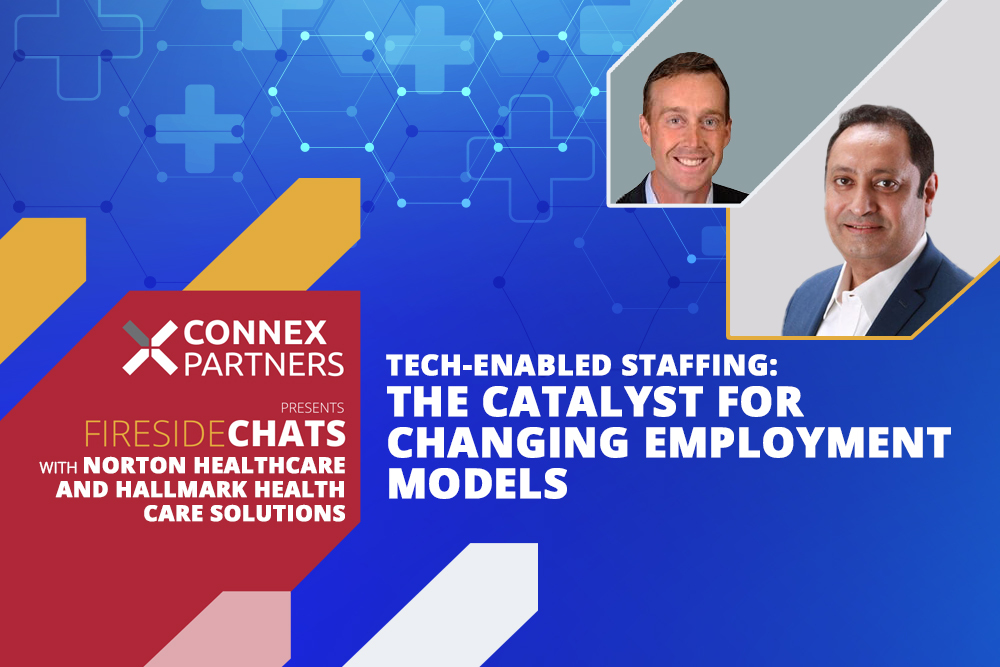
Ullatil’s workforce argument paid attention to the person receiving the schedule. A Connex Partners fireside discussion paired him with Scott Watkins, Norton Healthcare’s senior vice president of operations, to examine flexible employment models and internal resource pools. The stated subject was how technology could help organizations offer greater choice while managing labor costs. The conversation placed an operator beside a software founder, with a shared administrative problem between them.
He also co-authored a paper with Trinity Health’s Gay Landstrom on using technology to engage workers on their own terms. The emphasis on flexibility matters. Availability is shaped by what people will agree to do, as well as what a staffing office would like them to do. A system that can record a preference has more to work with than a roster that simply assumes compliance.
This is the practical appeal of the internal agency idea discussed in that work: give an organization a way to coordinate flexible labor within its own arrangements. The idea asks management to think about the offer as well as the vacancy. Software can support that coordination. The human agreement still has to be attractive enough for someone to accept it.
Growth acquires a different set of problems
By 2021, Hallmark had reached No. 318 on the Inc. 5000 list. In 2022, Ullatil was named among The Healthcare Technology Report’s Top 50 CEOs in its field. Those recognitions marked a period when the company was becoming more visible. They also brought attention to an enterprise built around tasks that rarely enjoy much applause: staffing administration, contracts and compensation.
In October 2023, Summit Partners led a growth investment, with participation from Enhanced Healthcare Partners and Hallmark management. The announced uses included product innovation, customer success and expansion. The financing announcement also emphasized maintaining Hallmark’s vendor-neutral position. For a business helping customers compare labor options, the structure of the business itself belonged in the discussion about trust.
Funding changes the questions a founder must answer. A growing enterprise needs leadership capacity, product development and customer support that can keep pace with its ambitions. In Hallmark’s case, the investment was followed by the February 2024 CEO transition. Cerullo arrived with a background in operating and investing, while Ullatil moved into strategic advisory work. The two announcements mark distinct steps in the company’s development.
It would be easy to let the new title obscure the continuity. Ullatil remained connected to the business he had helped create. His stated interests still involved customers and new solutions. The transition altered where he would spend his attention. That is an important distinction in any founder’s working life: staying useful may eventually involve choosing a smaller part of the daily agenda.
- 2021Hallmark ranks No. 318 on the Inc. 5000
- 2023Summit Partners leads a growth investment
- 2024Ullatil moves from CEO to strategic advisor
The boardroom becomes the next workshop
The next visible chapter spread across several organizations. In June 2024, Azra AI announced Ullatil’s appointment to its board alongside Michele Chulick. TapestryHealth announced him as a director that September, together with Bill Golden. Wellstack announced his board appointment in November. Each announcement brought his operating and technology experience into another company’s governance.
At Wellstack, CEO Rich Waller highlighted the connection between strategy and technology in Ullatil’s background. Ullatil, in turn, spoke about contributing to the company’s data mission. The appointment fits a career already concerned with making information serve an operating decision. His work was moving from building one company’s capabilities toward helping other leadership teams consider how to build theirs.
Enhanced Healthcare Partners now lists him as an operating advisor. The title is a useful bridge between his earlier work and this chapter. He brings the experience of running a company into conversations shaped by ownership, growth and organizational choices. His relevance there rests on having lived through several of the changes that a founder may be considering for the first time.
“It has been a true honor to lead and build Hallmark.”Isaac Ullatil · February 2024
The founder’s next useful question
In December 2025, he collaborated with Enhanced Healthcare Partners on a guide to choosing a private equity partner. Its central concern was the company that has found demand but needs a stronger organization to meet it. The guide asks founders to consider operating experience, working relationships and alignment alongside capital. The questions are familiar ones in a career that has crossed consulting, entrepreneurship and advisory work.
There is a pleasing connection between the beginning of this story and its later chapter. At Hallmark, Ullatil worked on the systems that let organizations coordinate people and promises. As an advisor, he now participates in decisions about how companies themselves should be organized. The scale of the question has changed. The attention to the working arrangement remains.
A founder’s signature is easy to spot on a launch announcement. It is harder to recognize in the less theatrical decisions that follow: a better process, an additional leader, a board appointment, a handover carried through. Ullatil’s career offers plenty of those quieter acts. His next contribution may arrive through a company someone else runs, with a different person taking the daily calls. There is room for a useful working life in that arrangement.
Follow the working life
More on the businesses, ideas and conversations in Ullatil’s career.