In April 2026, Annrai O’Toole gave a software project the sort of deadline that concentrates an office wonderfully. His team would use its own platform to build an Irish payroll application, aiming to pay themselves by May 25. He described the bargain plainly: get it working, or nobody would get paid. Among the many ways to encourage product feedback, this had the advantage of being understood by everyone.
O’Toole was starting again with VCola, after a career that already included IONA Technologies, Cape Clear, Workday and Utmost. He wanted a practical demonstration that the new platform could produce software people would actually run. Payroll supplied the test. A persuasive screen would only get the project so far. Eventually, money and records had to go where they belonged.
The experiment is a useful introduction to him. His career has unfolded in the parts of technology that businesses notice most when something goes wrong: connections between applications, records of who works where, systems that must survive a change. These are consequential subjects with a modest claim on dinner-party conversation. O’Toole has repeatedly found a company inside them.
Before the cloud, there was the connection
At Trinity College Dublin, he studied computer engineering, graduating in 1987 before completing a master’s in computer science. His student life included the Students’ Union, the Engineering Society and the Philosophical Society. Apparently, an engineering education left room for arguments about matters other than engineering. He stayed on as a research assistant, lecturing undergraduates for four years while working on European-funded distributed and parallel computing projects.
That work concerned a problem with lasting commercial consequences: getting separate computing systems to cooperate. O’Toole’s early career also involved European and international standards bodies working on interoperability. The vocabulary sounds remote from ordinary office life. The consequence is familiar to anyone who has entered the same information into two applications and wondered why the computers could not settle the matter between themselves.
In 1991, O’Toole, Chris Horn and Sean Baker started IONA. O’Toole became its chief technical officer and a director. By 1997, the company was listed on Nasdaq. A research setting in Dublin had produced a business that could enter the American public markets. O’Toole had participated in the journey from explaining computing to students to helping build a publicly traded software company.
- 1991IONAConnecting systems
- 2000Cape ClearIntegrating applications
- 2018UtmostSeeing the workforce
- 2026VCola*Building with AI
A connection becomes a career
He left IONA in 2000 to found Cape Clear, where he served as CEO. The new company developed an enterprise service bus, a means of integrating applications through web services. The label is unlikely to sell a beach read. For an organization trying to make different software products communicate, the underlying work matters rather more than its name.
Workday acquired Cape Clear in 2008. Its technology became the foundation for Workday Integration Cloud, giving O’Toole’s second company a continuing role inside another business. The acquisition also began his decade at Workday. He served as general manager for Europe and later chief technology officer for Europe, the Middle East and Africa, with responsibility for technology strategy and innovation.
The change put him on both sides of a familiar founder’s question. He had built a company that someone wanted to acquire; now he was helping operate within the acquirer. Making an integration product and making it part of a broader enterprise platform are connected jobs, with different demands. His Workday years gave the Cape Clear chapter a much longer ending than the transaction alone suggests.
Some of the operating problems were outside the software. In 2015, while discussing recruitment at Workday in Ireland, O’Toole called for high-density city-centre accommodation for young workers. The company recruited developers from overseas, and those people needed places to live. The observation brought the conversation down from technology strategy to the geography of a working day. Hiring does eventually require somewhere to put a suitcase.
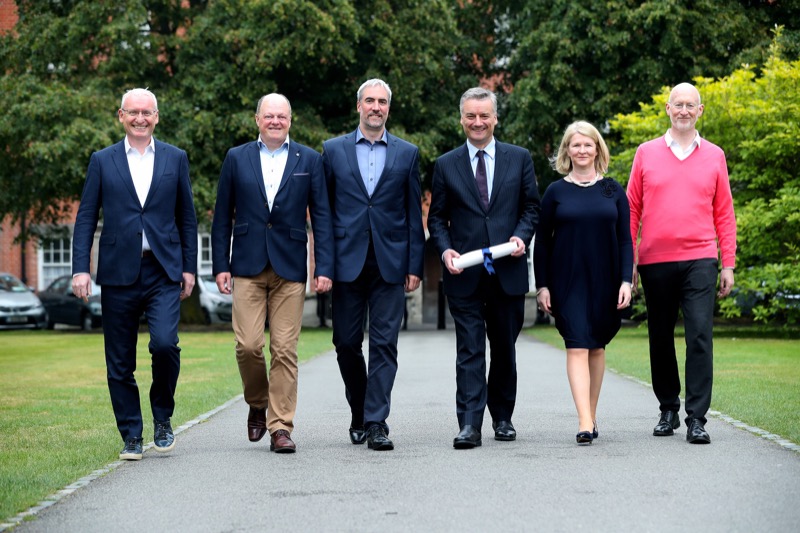
Trinity recognized him with an Alumni Award in 2017. The university that had supplied his engineering education, research work and first commercial setting was now celebrating what followed. The photograph places him alongside other graduates and the provost, a reminder that even a career measured in company names begins with institutions and colleagues.
The people outside the employee list
In 2018, O’Toole left Workday and co-founded Utmost with Dan Beck and Paddy Benson. Beck also brought Workday experience; Benson had been Groupon’s chief technology officer. Their attention turned to people who worked for an organization without appearing on its employee register: contractors, consultants, freelancers and service providers. Employment status could divide the records even while the work brought people together.
Looking back in 2019, O’Toole remembered a Dublin software scene with only a handful of companies when IONA began. By the time he was building Utmost, development teams were much more plentiful. Benson described another change: early products had gone out on CDs in boxes, while cloud software could be delivered directly. The new company’s physical infrastructure needs had shrunk to routers and coffee machines. The founders could laugh at the difference, even as they faced the familiar task of finding customers. Starting again carried accumulated knowledge, but it still required a team and something worth buying.
Utmost’s Extended Workforce System let businesses see employees and non-employees together by location and reporting structure. Its premise had practical force. A manager trying to understand a team needed a view that extended beyond payroll employees. Procurement, HR and the person doing the work each encountered a different part of the same arrangement. Utmost wanted the software to accommodate that reality.
O’Toole’s assessment of a startup’s right to exist was pleasantly unsentimental. A founder’s affection for a product counted for less than a customer’s willingness to use it. There had to be someone on the other side of the desk who wanted what the team was making.
“Ultimately, you only exist if what you have is something that customers see as valuable.”
Annrai O’Toole, on building Utmost, 2019
In May 2021, Utmost raised a $21 million Series B, bringing its disclosed funding to $32.2 million. In October 2022, Beeline announced its acquisition of the business. Beeline emphasized workforce visibility and connectivity, including Utmost Connect’s more than 1,000 pre-built connectors. Even in a workforce company, O’Toole’s old subject of integration was still present.
That sequence gives Utmost a clear place in his story. It followed a decade inside a growing enterprise-software business and addressed an organizational gap its founders understood. Four years after its founding, it joined another company. O’Toole’s subsequent work would reopen a broader question about how businesses get software that fits them.
Custom comes round again
At VCola, his co-founders are David Clarke and Kashif Qayyum, both with Workday backgrounds. Clarke had been a CTO and senior vice president there; Qayyum had been a fellow. O’Toole publicly introduced the venture in June 2026, announcing a €5.5 million seed round led by Base10 Partners, with Frontline Ventures, Acadian Ventures and BOOOM also participating.
His argument starts with customization. Businesses differ, so their applications need to reflect different rules and workflows. In his account, older on-premise software gave customers flexibility while creating expensive maintenance and upgrade problems. Cloud software addressed upgrades but left costly configuration work. A business could change the label on the expense and still find it on the bill.
“No two businesses are the same,” he wrote. VCola’s proposed answer is to capture a business’s requirements in a formal specification, then use that specification and AI to produce its application. The ambition is to make software tailored to the organization economical to own. That is the company’s proposition; the interesting work lies in making the proposition hold after deployment.
The test after the test
The payroll project exposed the distance between a simple starting idea and a working application. O’Toole brought in a payroll specialist for half a day to explain the process. The scope expanded to staffing workflows and support for the company’s Irish and American entities. The team also had to build connections to Ireland’s Revenue Online Service and develop the machinery for running the application in production.
On May 26, he reported that the first Irish payroll had been processed and filed electronically with Revenue. His account described learning payroll while the team was still building important platform capabilities. It was a company-reported result, with a specific application and users attached. The exercise had required expertise from outside the founding team as well as engineering inside it.
Then came the next version. In June, O’Toole described a production upgrade touching configuration, payment workflow and the underlying data model. The migration took approximately two minutes, he reported. His explanation also left room for the continuing obligations: testing against real data, documenting migration decisions and dealing carefully with workflows already underway. The stopwatch measured one part of the job.
By August, VCola had announced a modernization partnership with Concho AI. In September, it introduced Playbooks, reusable prompts for recurring tasks, governed by roles, permissions and approvals. The subjects kept returning to the daily operation of a business: understanding existing systems, deciding who may act, making repeated work easier to complete.
O’Toole’s latest chapter gives the earlier ones a practical continuity. IONA dealt with systems that needed to communicate. Cape Clear carried integration into Workday. Utmost made room for a workforce that employee records could not fully describe. VCola is testing how businesses can build and change applications around their own requirements. After the launch, the funding and the demonstration, there is still another working day to get through. And another payday.