In Monroe, Michigan, paying online was possible. That was the trouble: possible sounded like finished. The city’s old payment platform handled tax, water, and sewer bills, but could not handle other invoice types produced by its billing software. Residents encountered a partial solution. Employees inherited the rest.
- InvoiceCloud connects existing billing systems to digital payment tools.
- Its buyers include utilities, governments, tax offices, and insurers.
- The payoff to watch: fewer calls, envelopes, and manual tasks.
The city chose InvoiceCloud to expand what people could pay and make self-service easier. Within six months, electronic payments rose 41% and paperless enrollment rose 77%, according to the company’s case study. The failure had appeared first at the edges: bills the portal could not accept, questions it could not prevent, work it sent back to people.
The portal was there.
The problem stayed.
InvoiceCloud occupies an unglamorous corner of financial technology. Its raw material is the obligation people cannot unsubscribe from: a water bill, a tax assessment, an insurance premium. The organization sending that bill needs the money recorded correctly. The person receiving it wants the chore over. A payment interface has to satisfy both.
The company presents bills electronically and accepts payments through channels including the web, text, and automated phone systems. Depending on the biller’s configuration, customers can use cards, bank payments, or digital wallets, pay once without registering, or arrange AutoPay. Reminders and paperless enrollment extend the relationship beyond the payment button.
- 01PresentMake the bill easy to find.
- 02PayRemove avoidable steps.
- 03PostMatch payment to account.
Behind the screen sit reconciliation and reporting tools. InvoiceCloud connects the payment experience to the biller’s existing software, helping staff match incoming money to accounts. For insurers, the platform also supports money moving outward: claims payments, premium refunds, and agent commissions. Its expertise lies in these recurring, regulated workflows and their administrative consequences.
Borrow the pipes.
Fix the experience.
There is an unexpectedly domestic detail in the origin story. Bob Bennett, one of InvoiceCloud’s founders, invented the MicroFridge, the refrigerator-freezer-microwave combination familiar to small living spaces. The company’s 2009 launch announcement connected the two ideas: find a common inconvenience and make its pieces work together. Bennett, Bob Lapides, and Todd Wiseman were named in that announcement.
Distribution followed the same practical instinct. Rather than require every buyer to discover another software supplier, InvoiceCloud worked with companies already supplying billing systems. An early relationship involved Northern Data Systems in Maine. Its longtime employee Sam Evrard eventually joined InvoiceCloud in 2011, after 21 years at NDS.
“I think I want to work for those guys.”Sam Evrard, recalling his first meeting with the founders
That partner approach remains visible. InvoiceCloud reported more than 160 integrations as of August 2025. Guidewire’s marketplace lists connections to PolicyCenter, BillingCenter, and ClaimCenter. An insurer can improve premium collection or disbursements while continuing to use the systems that organize its business. The existing software becomes a route into the customer.
Paymentus offers a competing electronic billing and payment platform with multiple payment channels. Digital payments alone therefore do not distinguish InvoiceCloud. Its pitch combines integrations, checkout design, onboarding, and services that encourage people to adopt the tools. A buyer should compare the entire operating job: implementation, payment posting, support, accessibility, and the cost of each channel.
Somebody pays for easy.
InvoiceCloud’s business combines enterprise software with payment services. Contract order forms specify service and transaction charges. A biller can absorb processing fees or pass permitted charges to the payer. That choice matters: the organization may save staff time while the resident sees an additional checkout cost.
Contract-specific examples, not a platform-wide price list.
Martinez’s council document also describes a roughly four-month implementation schedule and waived implementation costs. Software still takes organizational work even when an upfront charge is waived. Testing, staff training, and clear customer communication belong in the calculation. A fee schedule answers what a transaction costs; it does not, by itself, establish the savings.
The ownership numbers need similar care. General Atlantic announced a majority investment in 2018 alongside Summit Partners and management. In January 2024, Vista Equity Partners completed its approximately $4 billion acquisition of EngageSmart, whose businesses included InvoiceCloud. That was a price for the parent company as a whole. Treating it as InvoiceCloud fundraising would tell the wrong story.
A quieter phone is
a useful metric.
Clearwater offers another way to measure the product. InvoiceCloud’s customer case study reports 43 staff hours saved each week after the city changed payment solutions. Monroe’s adoption figures and Clearwater’s time savings describe different outcomes at different organizations. They are vendor-published accounts, useful evidence of specific deployments rather than a promise of the same return everywhere.
Clearwater’s reported staff time savings after switching payment solutions.
The newest products pursue the same administrative burden. Launched in 2026, Service Module uses account context to address routine billing questions and lets customers take actions such as paying or enrolling in AutoPay during the conversation. When a person is needed, the company says the handoff carries the conversation and an account summary.

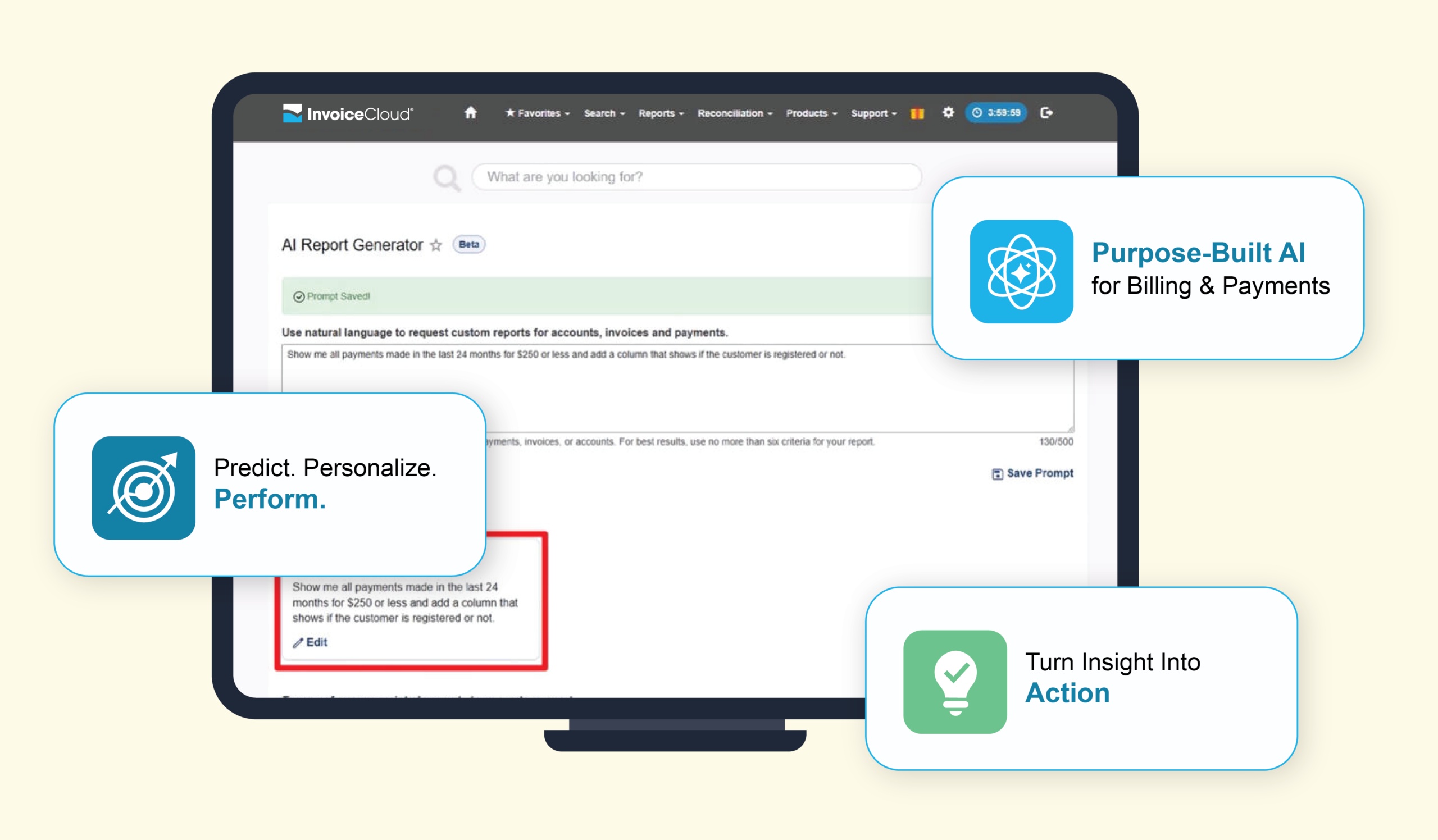
On October 16, 2026, InvoiceCloud announced an approximately INR 350 crore, three-year growth plan for Hyderabad. It reported more than 250 employees in India and over $40 billion in annual payments processed. Payment volume measures money passing through the platform; it is not company revenue.
The lesson a reader can borrow is concrete. Count payment-related calls. Find the bills people abandon online. Measure paper costs and manual posting. Then remove the obstacles one by one. The economics depend on reliable integration, acceptable fees, and payment options customers can actually use. A frictionless screen cannot supply a bank account or make an unaffordable bill affordable. Success begins with knowing which problem the software can solve.