The ordinary bank statement was once a remarkably good place to sell peace of mind. A customer already trusted the institution holding their money. Add a service that watched their credit file, and the sale felt like an extension of that relationship. Intersections built a business inside that small act of trust.
- The original job: spot identity trouble and help consumers recover.
- The turning point: a shrinking bank-sales channel forced a rethink.
- The next chapter: Identity Guard joined the business that became Aura.
A business built inside the bank
Michael R. Stanfield co-founded CreditComm, Intersections’ predecessor, in May 1996. The company went public in 2004. Its specialty was making scattered personal information useful: monitor it, assemble it into reports, warn customers about changes, and provide help when something looked wrong. Identity Guard gave that work a consumer name.
Distribution mattered as much as detection. Financial institutions put the service in front of customers who might never go shopping for an identity-protection subscription. Historical marketing materials from Deluxe offered statement inserts, web banners and branch guides. Security could arrive alongside the paperwork of everyday banking. That was a clever place to meet the customer.
The channel broke before the idea did
Then the machinery became a liability. Intersections’ own 2018 investor presentation described its principal marketing channel as closed following regulatory actions involving financial institutions. The company still collected revenue from legacy subscribers, but that population was running off. A recurring payment can conceal a disappearing route to the next customer.
There was also a service-delivery problem. In a 2015 complaint, the Consumer Financial Protection Bureau alleged that roughly 300,000 consumers had been billed while not receiving full benefits, involving approximately $32 million in billings between 2009 and early 2013. Intersections settled without admitting or denying the allegations and paid a $1.2 million civil penalty.
The business lesson is painfully practical: a subscription begins when the promised service works. Enrollment, verification and billing need to agree. Meanwhile, Intersections explored businesses including veterinary technology and wellness management. By 2017, it had divested non-core operations and returned its attention to Identity Guard, including a version using IBM Watson.
- 1996CreditComm
begins - 2004Intersections
goes public - 2017Identity Guard
refocus - 2019Aura
brand arrives - 2026Qoria
joins Aura
The new unit of protection is a family
The next reset came from outside. A joint venture formed by iSubscribed, WndrCo and General Catalyst completed the Intersections acquisition in January 2019, with cash consideration of $3.68 per share for shares acquired in the transaction. Intersections left Nasdaq. Hari Ravichandran, iSubscribed’s founder, became CEO. In July, the combined business adopted the Aura name.
This distinction matters: Ravichandran founded the acquiring business, not the 1996 company. Aura’s origin story describes his own identity theft and frustration with fragmented protection. The combination brought Identity Guard together with Intrusta antivirus. Rather than ask a household to coordinate separate defenses, the new proposition was to put more of them within one relationship.

“putting the entire family at the center”
Hari Ravichandran, on Leadership Matters
The perimeter kept expanding. Aura’s integrated flagship arrived in 2021. MetLife announced exclusive U.S. employer-channel distribution in 2022, opening a workplace-benefits route. In July 2026, Aura completed its Qoria acquisition, adding a school-safety business with approximately 32,000 school customers. Home, workplace and classroom became parts of the same commercial map.
Aura’s careers page puts customer care and ownership among its stated priorities, alongside hybrid work and a free family subscription for full-time employees. These are the company’s own descriptions. Still, giving employees the household product creates a straightforward opportunity to encounter the experience they are building.
One bill, several kinds of help
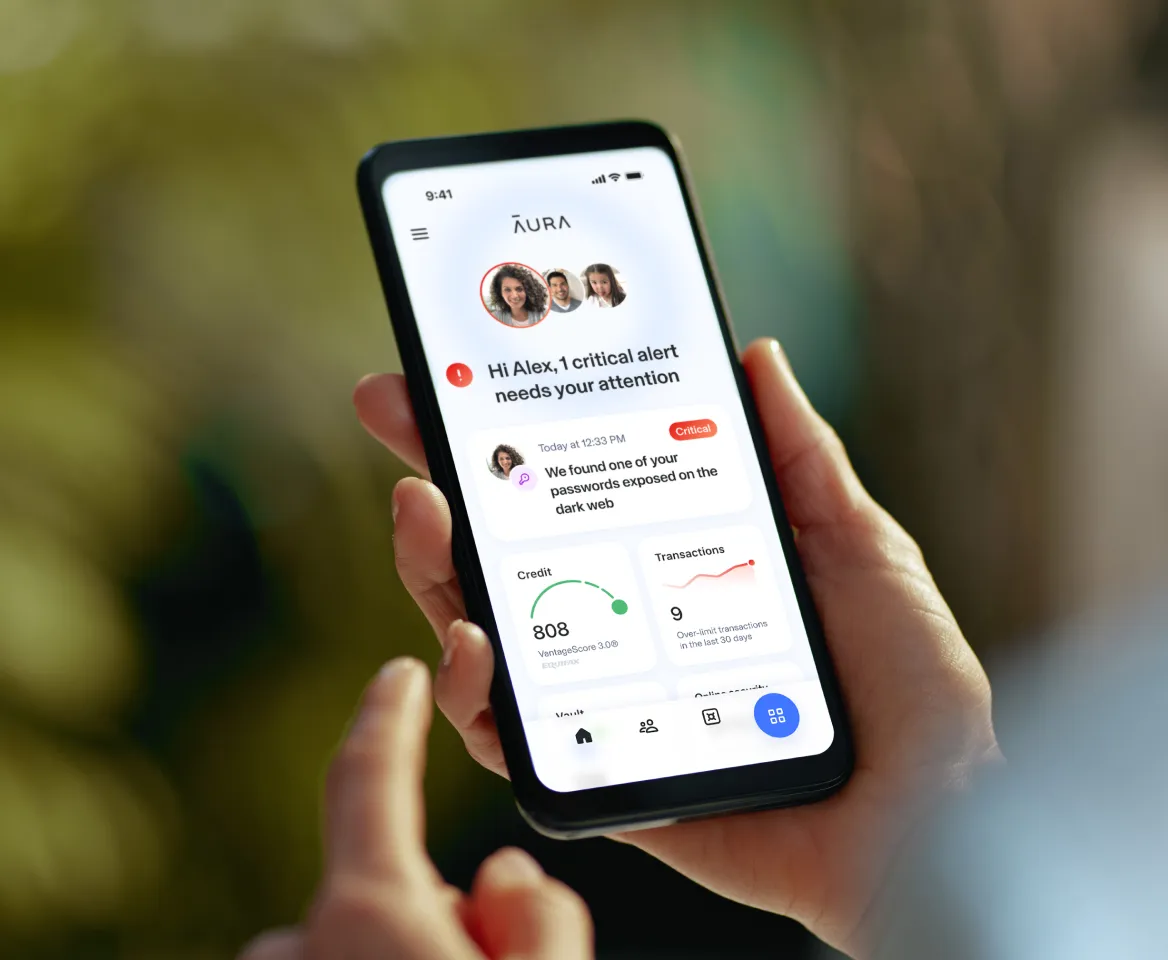
Today, Aura sells subscriptions covering identity and financial monitoring, antivirus, VPN access, password management and fraud remediation. Family offerings add child-safety tools. The attraction is administrative: fewer services to choose, bills to track and interfaces to learn. Norton LifeLock is an obvious alternative in identity protection; individual security tools offer another way to assemble coverage.
Identity Guard remains available under its own name, offering identity monitoring and recovery assistance. For someone arriving through Intersections’ old name, that surviving brand is the most direct connection between the original service and the present business.
That makes Aura’s position understandable without pretending its ingredients are unique. The competition is partly about how much coordination a customer wants to do. Someone already happy with separate tools may gain less from another bundle. A household managing several adults, children and devices has a different calculation.
At advertised U.S. prices checked in October 2026, annual billing works out to $12 monthly for Individual, $22 for Couple and $32 for Family. Those require upfront annual payments of $144, $264 and $384. Month-to-month billing costs $15, $29 and $50 respectively. The family plan covers five adults; its value depends on who actually uses the features.
September 2026’s Trusted Family Access makes the coordination problem concrete. An adult can allow a caregiver to view alerts or manage selected settings, then revoke access. It gives a family another way to help an aging relative while leaving control with that person. It does not give the caregiver unrestricted authority over credit decisions.
Limits belong in the buying decision. Monitoring cannot prevent every theft. Insurance has exclusions. Child-wellbeing insights are informational, not clinical diagnoses, and alerts may be imperfect or delayed. A family still needs to respond. The useful question is whether the service makes that response easier.
The price of getting bigger
Expansion has required substantial capital. Aura announced $200 million in Series F financing in 2021. After separating from Pango in 2024, it announced a $140 million equity-and-debt round in 2025. Those rounds describe different corporate perimeters, so their valuations cannot fairly serve as a simple before-and-after scorecard.
The 2026 Qoria transaction brought another $100 million equity placement and an ASX listing under AXQ. Aura reported $339.7 million in pro forma annual recurring revenue for the combined group at the second quarter’s end, alongside a $12.6 million adjusted EBITDA loss for that quarter. Scale has grown; profitability remained work in progress.
The accounting labels matter here. Pro forma figures describe the businesses together, including periods before the acquisition closed. Annual recurring revenue measures a subscription run rate; it is different from revenue recognized during a quarter. Neither number, by itself, tells you that the combined operation is profitable.
Intersections’ history leaves something worth copying: inspect the route to your customer as carefully as the product. Fix activation before selling another subscription. Add services when they reduce a household’s work. That is the thread connecting a bank-statement insert to a family dashboard: finding a place where protection becomes easier to use.