Consider the peculiar optimism of a software sale. A contract is signed, a forecast improves, and somebody has a very good afternoon. The customer, meanwhile, still has to make the thing work. In a subscription business, that second story eventually determines whether the first one was worth celebrating. TSIA has built its business around the distance between those two moments.
- The work: research, peer benchmarks, and advice for technology services leaders.
- The wager: better customer outcomes can support a healthier recurring revenue business.
- The useful habit: compare performance before deciding what to fix.
The Technology & Services Industry Association occupies an unusually specific corner of the research market. It studies the machinery around technology: implementation, support, education, managed services, customer success, and renewals. These are the departments that inherit the promise after the salesperson leaves. Their problems are wonderfully unglamorous. Who should own adoption? How should services be priced? Which performance gap deserves the next dollar?
The reluctant association man
TSIA emerged in 2009 from three predecessor organizations: TPSA, AFSMI, and SSPA. Its origin account includes an earlier recruitment call from J.B. Wood to Thomas Lah. Lah was skeptical of associations. The attraction was the proposed emphasis on research and benchmarking. Here was a way to give services leaders something more concrete than another occasion to exchange business cards.
“I was completely underwhelmed by the industry associations I had seen.”
Thomas Lah, recalling his initial reaction
The early obstacle was credibility. TSIA’s retrospective describes polite interest and modest offers of support; it says adoption grew as actual benchmarking arrived. Today Wood is president and CEO; Lah is executive director and executive vice president. The company’s stated values favor evidence and practical guidance. That describes its research philosophy; it does not, by itself, tell us what every working day inside the company feels like.


An average needs the right neighbors
A services margin is easy to put on a slide. Deciding whether it represents a problem requires context. TSIA’s Performance Optimizer compares operating results with relevant peers, identifies gaps, and offers improvement priorities. The distinction matters: a score can provoke anxiety; a suitable comparison can help a manager choose an intervention.
There is a revealing detail in TSIA’s data protection rules. An industry aggregate requires at least nine data points; a peer aggregate requires six. Below the threshold, the output is “Not Enough Data.” Benchmark data remains active for comparisons for 60 months before being archived. The useful number has conditions attached to it. A smaller, more familiar peer group does not automatically produce a publishable result.
Minimum data points under TSIA’s published benchmarking policy. These are disclosure thresholds, not customer counts.
The audience includes leaders in enterprise software, SaaS, infrastructure, industrial equipment, and healthcare technology. Adobe, Cisco, and Dell appear on its customer-success research page. Its LinkedIn profile describes a community of more than 40,000 industry leaders worldwide. That is a community figure, not a tally of paying companies. The common denominator is responsibility for making technology useful and commercially sustainable.
A subscription to better questions
The new TSIA Portal launched in February 2024. It brings research and member resources into an online workspace. TSIA Intelligence adds two distinct shortcuts: AI Inquiry answers broader questions across the research a user can access, with citations; AI Content Assistant works on the particular report, webinar, or other asset in front of the reader.
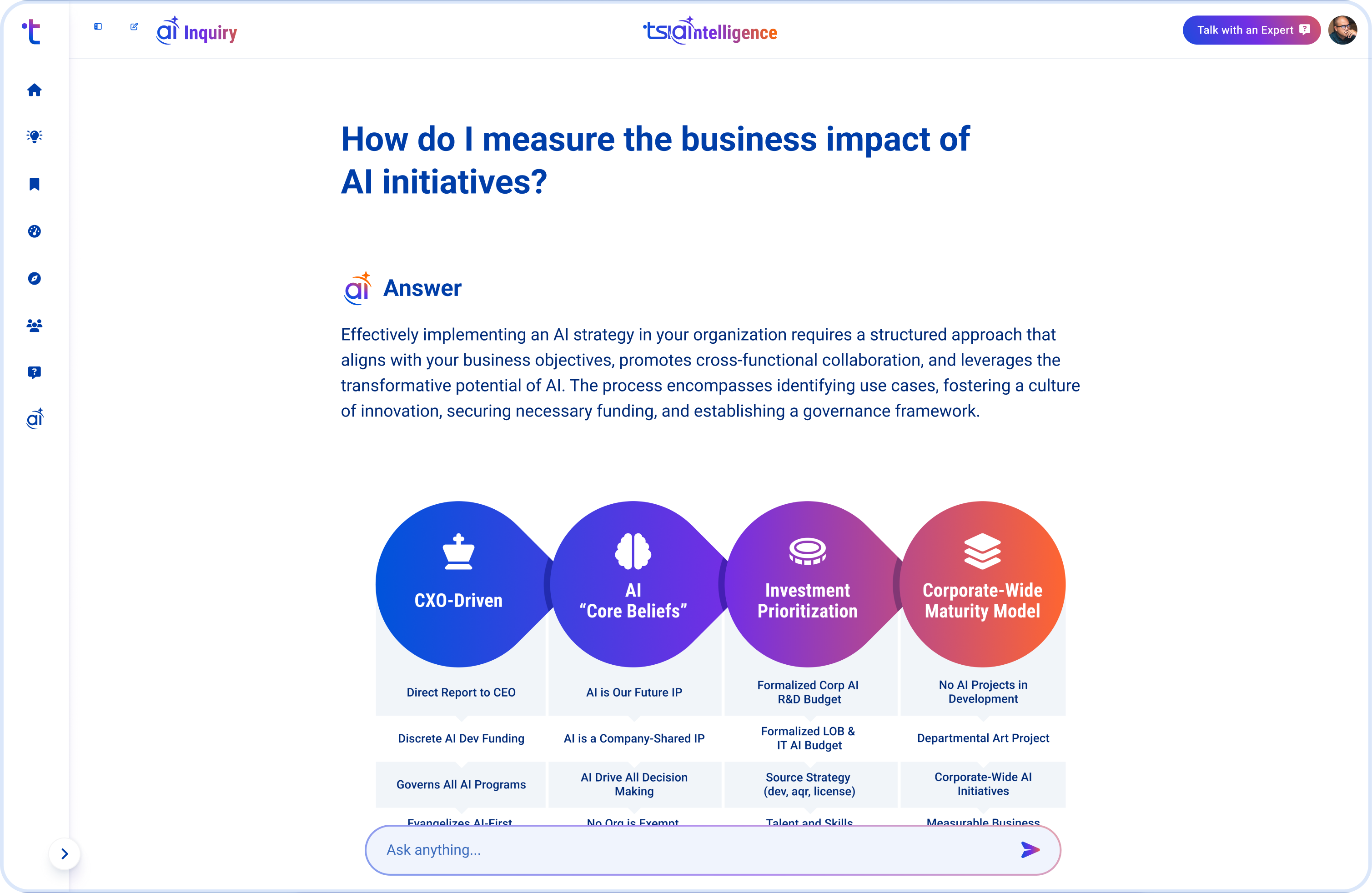
The current menu has Free, Individual, and Enterprise plans. Individual provides one person with research and AI access. Enterprise adds organization-wide access, expert inquiries, fuller benchmarking, and advisory services. Prices sit behind sign-in or a sales conversation; enterprise terms describe revenue-based tiers. A separate, disclosed price is unusually concrete: a 2026 STAR Awards entry costs $4,500 or two Premium Credits. Entering buys evaluation, not a guaranteed win.
Events and a partner program extend the model. Technology & Services World mixes research presentations with practitioner sessions and networking. The partner directory includes providers such as Certinia and Coveo. TSIA’s stated subscription approach emphasizes ongoing support rather than hourly billing. Its distinctive market position is the combination of operating comparisons and advice focused on technology services.
A buyer can also choose a broad analyst subscription, a consulting project, or an internal analytics effort. Those alternatives answer different questions. TSIA is most relevant when the uncertainty concerns running a technology services operation: how work is organized, measured, funded, and improved. A company looking mainly for product selection advice should be clear about that distinction before choosing an advisory budget.
The expertise is specialized too. Professional services researcher Bo DiMuccio previously worked at IDC and Deloitte; his TSIA biography describes research covering project economics and services strategy. That background helps explain the mix of numbers and organizational questions. A weak margin may demand a pricing change, a different delivery approach, or a better definition of what the service is meant to accomplish.
When the framework moves
TSIA’s familiar shorthand is LAER: Land, Adopt, Expand, Renew. Its 2017 explanation identified a weakness in traditional technology companies: they knew how to win business and renew maintenance, but had invested less systematically in adoption and smaller expansion opportunities. Subscription economics made those neglected activities harder to ignore. The first contract might begin small; continued use and spending mattered.
- LLandWin the customer
- AAdoptMake it useful
- EExpandGrow the relationship
- RRenewEarn the next term
Now TSIA is reconsidering the sequence. Its October 21, 2026 research proposes DARE: Design, Activate, Realize, Evolve. The argument is that AI customers need measurable outcomes, technical readiness, and integration planning earlier. Usage alone cannot establish value. This is a proposed framework, not evidence that every company has adopted it. Still, revising an established vocabulary is an interesting test of a research business’s willingness to change its advice.
Borrow the question before the answer
A practical application is modest: choose one operating question, establish a baseline, find comparable peers, and assign someone to test an improvement. That is an editorial recommendation, not a promised TSIA result. The approach loses usefulness when definitions differ, comparisons are unsuitable, or nobody can change the process. Research can identify a gap. Closing it requires the organization that owns the customer relationship to do the work.
Keep asking
Explore TSIA, membership options, the research blog, and Portal launch news.
Follow on LinkedIn, X, Facebook, or YouTube.
↗ Watch: Close the Promise Gap Thomas Lah · TSW 2026↗ Watch: The Future of the AI Customer Lifecycle J.B. Wood · TSW 2026