There is a moment in every startup pitch when the spreadsheets stop helping. The market is barely a market. The product may be a diagram, a prototype or a sentence on a napkin. The founder has only conviction, a peculiar amount of homework and a problem that will not leave them alone. Inspired Capital wants to meet them there. The New York venture firm describes its territory as the stretch from napkin to Series A, a compact phrase for the most ambiguous part of company building. It is early enough that an investor can still affect the shape of the business, and risky enough that certainty is mostly theater.
Founded in 2019 by Alexa von Tobel and Penny Pritzker, Inspired now manages nearly $900 million across three funds. Its public check range runs from $500,000 to $20 million. That is unusually elastic for an early-stage firm: small enough for a pre-seed experiment, large enough to lead a substantial Series A. Yet the more revealing number is the pace. Inspired says it makes fewer than 10 new investments a year, with the entire firm supporting each company.
A firm built from operator memory
Von Tobel built LearnVest after leaving Harvard Business School during the 2008 financial crisis. The financial-planning startup grew to nearly three million users and was acquired by Northwestern Mutual for almost $400 million. She later ran digital and innovation work inside the insurer. Pritzker arrived with a different kind of range: founder, business executive, investor and former U.S. Secretary of Commerce. General partner Lucy Deland spent a decade helping turn Paperless Post from a living-room idea into a platform that served 100 million hosts and guests. General partner Mark Batsiyan built LearnVest's enterprise business, helped launch Northwestern Mutual Future Ventures and ran Inspired's operations through 2023.
This biography is part of the product. Early-stage money is widely available when markets are generous; practiced judgment is not. Inspired's pitch is that its senior team remembers the founder's side of the table - hiring before a brand exists, revising a business model under pressure and making consequential decisions with incomplete data. It also has a dedicated platform function for recruiting, introductions, brand, communications and advice. The useful promise is not that operators possess magical answers. It is that they recognize the texture of the problem.
The scarce resource is not capital. It is attention before certainty.
Three funds, one widening aperture
Inspired's flagship funds have grown in deliberate steps: $200 million for Fund I, $281 million for Fund II and $330 million for Fund III. The three closes total $811 million; other managed capital brings reported assets close to $900 million. Fund III, announced in February 2024 during a difficult venture fundraising market, was expected to back about 30 companies from pre-seed through Series A. Fortune reported that the commitments came from existing limited-partner relationships, a useful vote of confidence in an industry where the real scorecard can take a decade to arrive.
Flagship fund progression / USD
The bars show fund commitments, not Inspired Capital's corporate revenue or valuation.
The business has two constituencies. Founders use its capital, network and operating support. Limited partners supply the money and seek venture returns. Inspired invests that pool in private-company equity, reserves capital for later rounds and ultimately aims to return more than it raised through acquisitions, public listings or secondary sales. Its exact management-fee and profit-sharing terms are private, so the important observable choices are portfolio construction: lead rounds, seek meaningful ownership, follow winners and avoid turning a larger fund into an excuse for a larger deal count.
That lead-investor role matters in practice. A lead commonly helps set the price, shapes the round, conducts the deepest diligence and may take a board seat. For a young company, the choice influences who joins the cap table and how the next financing is received. Inspired's wide check range lets it scale the commitment to the opportunity instead of forcing every company into one standard round. The tradeoff is selectivity. A founder is competing not only for dollars but for one of a small number of relationships the partnership can service at full strength. In this model, saying no often is the mechanism that makes a sincere yes possible.
Generalist, but not indiscriminate
A glance at the portfolio can feel like wandering through several trade shows at once. Dandy modernizes dental labs. Rho builds a financial operating system for businesses. Suno lets people generate music. Form Energy is developing long-duration energy storage. Teamshares buys small businesses and converts employees into owners. Axion brings proactive intelligence to manufacturing, while Solace connects patients with health advocates. Inspired also backed MosaicML, the model-training company Databricks agreed to acquire for roughly $1.3 billion in 2023.
A portfolio arranged by problem, not fashion
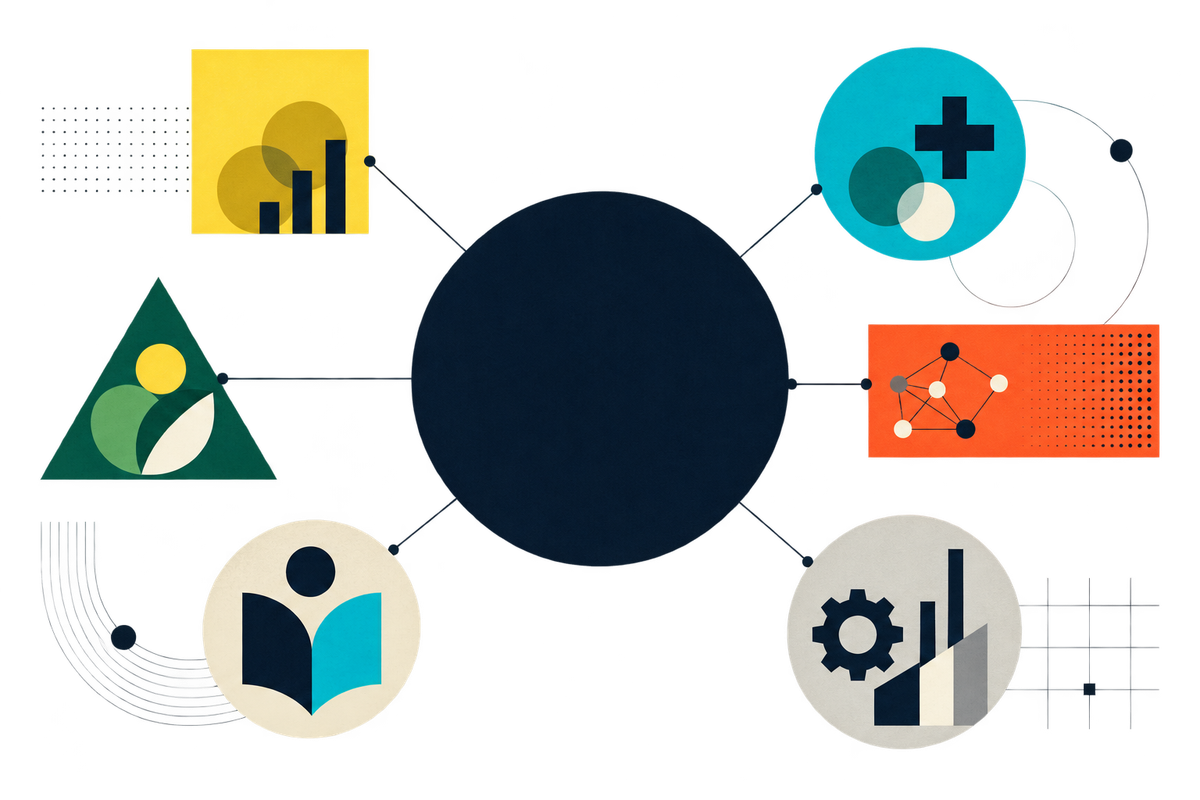
The connective tissue is not a software category. It is a type of problem: consequential, operationally messy and large enough to reward a long build. The firm groups its focus around financial technology, healthcare, artificial intelligence, workforce and education, industrial systems, and a "new frontier" that includes climate and scientific technology. That gives it permission to follow shifts in computing without pretending every worthy company looks like SaaS.
Generalism creates a real risk. A firm can become fluent in themes and shallow in industries, especially when healthcare reimbursement, defense procurement or manufacturing data requires specialist knowledge. Inspired's answer appears to be concentrated company selection plus an expanding bench of investors and venture partners. Jonathan Frankle, a MosaicML co-founder and neural-networks scientist at Databricks, joined as a venture partner. Technology venture partner Ming Fang brings decades of engineering experience. The model is less "we know every market" than "we can assemble the relevant room."
What gets a founder to yes
Von Tobel's public filter is refreshingly legible. She looks for founders obsessed with a problem, often because it has followed them through a career. She prefers markets where a big swing is rational and founders willing to build for 15 or 20 years. During the 2024 funding crunch, she described constraints as powerful: scarcity forces choices, and choices reveal the company. It is a useful inversion of the easy-money playbook, when speed of fundraising could masquerade as speed of learning.
Why this problem? Why you? Why now? And would you still want to solve it if the category stopped trending tomorrow?
For a founder, that translates into a practical pitch. Show the earned insight rather than merely the market slide. Explain what changed in technology, regulation or behavior. Make the path to a large outcome credible without sanding off the hard parts. And treat the investor as a prospective long-term partner, not a wire transfer. Inspired's flexibility means the conversation can begin before conventional traction, but its small annual cohort means the bar for conviction is high.
Where Inspired sits in venture
The closest alternatives are seed specialists such as First Round Capital, Primary Venture Partners, Lerer Hippeau, Homebrew and Forerunner Ventures, along with larger platforms including General Catalyst, Andreessen Horowitz, NEA and Bessemer. Inspired occupies an interesting middle: the personal feel and early entry of a boutique, paired with enough capital to lead sizable rounds and keep investing as companies grow. Its New York roots also matter in a market still shaped by Silicon Valley networks, particularly for fintech, consumer, healthcare and enterprise founders on the East Coast.
Differentiation in venture is notoriously easy to claim and hard to audit. Every fund offers help, patience and founder empathy. Inspired's more testable signals are structural: a senior team with company-building histories, fewer than 10 fresh bets annually, a check range spanning two distinct stages and a portfolio platform with visible recruiting and communications functions. The MosaicML outcome supplies one bright data point, but one acquisition cannot settle a venture strategy. Fund performance, ownership and returns remain private.
A generalist fund still needs a specialty. Inspired's is high-conviction company building.
The long game gets harder
Inspired's challenge is the same tension that follows every successful early-stage firm. Larger pools invite larger rounds, more follow-ons and a gradual drift away from the napkin. Hot sectors can compress diligence even for investors who dislike hype. Meanwhile, supporting companies in quantum, defense, healthcare, climate and consumer software demands very different networks. Concentration magnifies both the benefit of being right and the cost of being seduced by a persuasive founder.
Still, the firm's restraint is the point. Venture capital is an odd service business in which the provider chooses its customers, the customer can wait years for the service to pay off, and the best outcomes often begin as ideas that sound misplaced in the present. Inspired Capital has built its brand around recognizing those ideas early and staying close while they become legible. The napkin is not romantic because it is simple. It is valuable because, for a brief moment, nothing except the quality of the thinking can hide behind scale.