On leap day in 2012, InsideHook's first published recommendation concerned a zero-gravity airplane. Most publications would choose a safer first date. This one suggested that if you had a free afternoon and a certain appetite for absurdity, gravity itself might be negotiable. The format was modest: a daily email, one worthwhile thing to do or buy, selected for a man with taste, money and very little time. The subject matter could be outlandish; the service was practical. Someone else had done the looking.
That small act of curation became a New York media company covering style, travel, food and drink, culture, fitness, health, cars and gear. Today InsideHook publishes a website, product reviews and six free newsletters. Its own About page says the newsletters reach more than 1.9 million subscribers each week. The company still offers shortcuts through a crowded world. What changed in August 2026 is the identity of the guide: readers now meet a named writer at the door.
- InsideHook started as a daily recommendation service for busy, affluent men, then grew into a national lifestyle publisher.
- Its free journalism and newsletters are supported by advertising, branded content, events and commerce.
- In 2026 it relaunched six newsletters around distinct writers and subjects, folding older travel and drinks emails into IRL.
- The useful idea to borrow is narrow curation: earn a reader's trust with a specific promise, then let expertise widen it.
The time-saving proposition
InsideHook was founded by Andy Russell, Jon Keidan and Nick Michlewicz, according to the company's announcement of its Los Angeles expansion. Russell had worked around DailyCandy and Thrillist, two businesses that made the inbox into a discovery channel. The opening in 2012 was clear. There were plenty of things to do; finding the one worth leaving home for was work. InsideHook packaged that search as editorial judgment and delivered it to a reader who could afford to act.
The early copy was unapologetically male and aspirational. It offered little-known clothiers, underground dinners, open-cockpit flights and the occasional implausible adventure. Its first leap beyond New York took the same formula to Los Angeles in 2013, with actor Rob Lowe as partner, adviser and curator. To mark the launch, Lowe tried a water jetpack in Newport Beach. It was a publicity stunt with a thesis: this publication would not merely list experiences; it would try them.
A publisher can sell this arrangement twice, provided readers trust the first sale. InsideHook sells an audience to advertisers through branded stories, email placements, video, events and site integrations. It also publishes shopping advice and deals, where commerce links can generate revenue. Its editorial policy draws the necessary line in plain language: “No one can pay to be featured on InsideHook.” Paid stories and emails are labeled as partnerships. A recommendation business lives or dies by that distinction.
A person in the inbox
For years, the company expanded by adding places and categories. New York, Los Angeles and a national edition eventually sat alongside city and state dispatches. Later came specialist emails on travel, drinks, wellness, style and shopping. A 2023 site redesign grouped the publication under Culture, Leisure and Wellness. It was sensible taxonomy. It did not, by itself, answer why someone should open this email instead of the next one.
In August 2026, editor-in-chief James Jung announced a more radical edit. InsideHook retired its old newsletter lineup and launched six titles. The Daily became Hits. The Stitch became Protagonist. The Charge became Champ. The Journey and The Spill were combined into IRL. Coverage arrived as a new culture letter; The Goods kept its name. Each has a writer and a defined beat. The company did not abandon its interests. It changed how those interests are introduced.
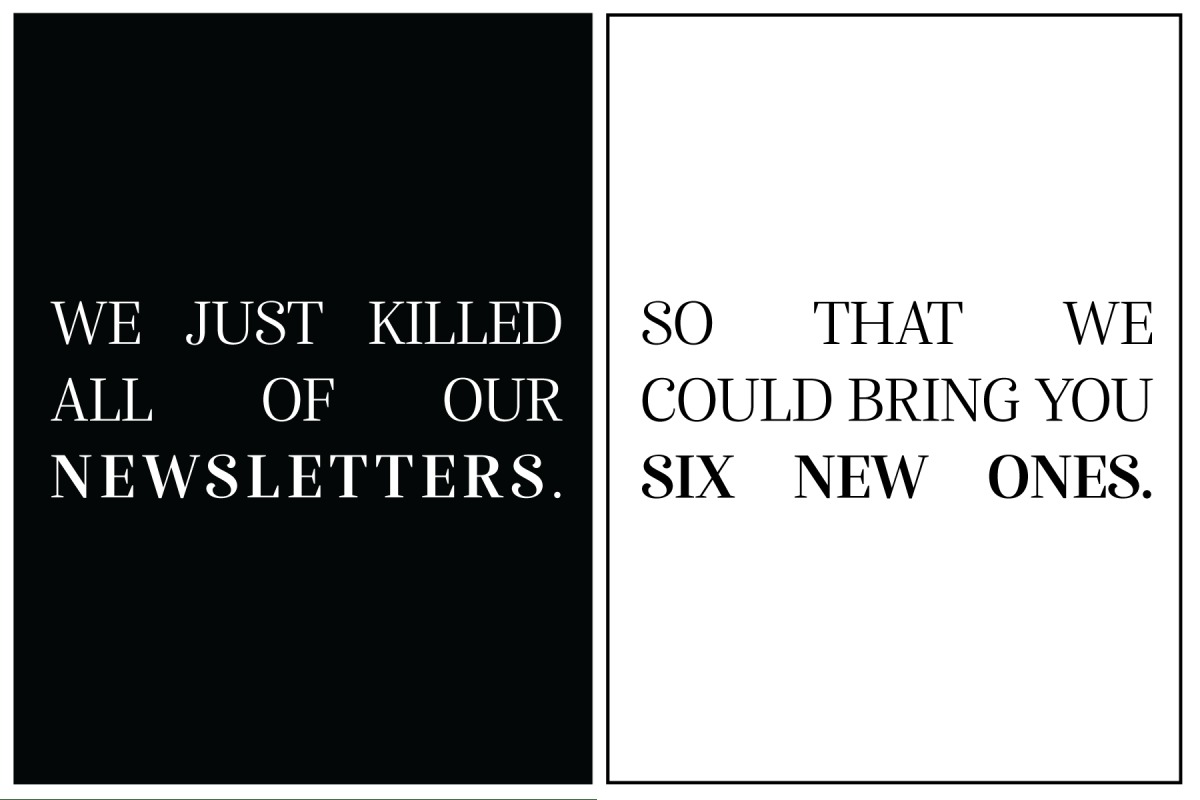
Jung's explanation was unusually candid about the competition. Readers have Substack writers, podcast hosts and social creators in their pockets. A publication's voice can become indistinct when every story speaks as a corporate “we.” His proposed remedy was a more personal transaction: recognizable people, subject expertise and reporting from the world beyond the screen. That is an editorial judgment, and also a product decision. An inbox rewards habits; a distinct voice gives a habit a human shape.
“We want distinct voices and points of view, expert insights and dispatches from out there in the real world.”James Jung / Editor-in-chief, InsideHook
The lineup also tells a reader what to do with InsideHook. Take Hits for the broad edit. The Goods narrows a purchase decision; its reviews and roundups are useful when a search results page offers more options than judgment. Coverage sorts culture. IRL points toward restaurants, travel and other reasons to put down the phone. Champ covers wellness without turning life into a spreadsheet. Protagonist looks at menswear through reporting and photography. Readers can choose one, or take all six. The service costs them nothing in subscription fees.
The limits of a good tip
There is a revealing interruption in the company's timeline. InsideHook researched a Texas newsletter in late 2019 and asked local subscribers whether they wanted it. They did. Then COVID-19 arrived. A service built to recommend restaurants, bars and destinations suddenly had very little useful advice in those categories. The Texas edition was postponed until 2021. The product was not faulty; its premise depended on the possibility of going out. The episode is a tidy reminder that even an excellent recommendation has to meet the reader's actual circumstances.
The new newsletter plan has its own conditions. A named writer can build loyalty only if the reporting earns it. Six voices require six coherent editorial promises, a dependable publishing rhythm and the restraint to label commercial work clearly. The company says its writers and editors test products when possible and use trusted contributors when they cannot. That standard demands time, access and editorial care. The reported $1.7 million Series A in 2013 belongs to the company's early chapter, when the task was to expand the daily email.
InsideHook has also tested whether its publishing machinery travels beyond lifestyle. In 2024 it partnered with basketball journalist Seth Davis to launch Hoops HQ, a separate paid publication for college basketball fans. Its reported launch price was $4.99 a month or $49.99 a year. The venture is a useful contrast: free broad-interest discovery on one side, specialist reporting behind a subscription on the other. The shared asset is an ability to assemble writers, reach readers and make an editorial point of view feel worth returning to.
The lesson in one email
Most media companies ask for attention before they have proved what they can do with it. InsideHook's original daily email reversed that order. It promised one thing, then supplied one thing. It knew the reader's problem: limited time and a surplus of possibilities. That promise could be copied by a local guide, a specialist reviewer or any publication willing to choose carefully in public. It works best where the editor can see what the reader cannot, and where a recommendation can be acted on soon.
What InsideHook changed in 2026 was the social texture of the promise. A recommendation from an unnamed institution can be useful. A recommendation from someone whose taste you know can become a relationship. There is a little irony here. A company that once offered to help men get out more now competes for space on a screen. Its answer is to make that screen a doorway. The airplane from leap day was a stunt, certainly, but also a decent first principle: offer people a reason to leave the familiar ground.