The email was absurdly long, roughly 2,000 words, and it went to a stranger who happened to be Mark Cuban. Reggie Renner had watched an episode of Shark Tank in which Cuban backed a cat-drawing business. Renner, a programmer in Indiana with a fledgling idea about web traffic, made a brisk calculation: if that idea had a chance, perhaps his did too. He wrote that night. Somewhere near the beginning, he mentioned that he was a fellow Hoosier.
Cuban answered within minutes. The due-diligence team later passed. Renner asked Cuban to look again.
The second look changed the plot. Cuban began with about $30,000 in February 2012 and had invested $1 million by October, according to Renner's account at the time. There is a tidy founder myth available here: bold email, famous billionaire, capital arrives. The more revealing detail is the bit between rejection and investment. Renner treated “no” less like a verdict than a result that deserved another test.
“I'm just a coder who loves building tools.”Reggie Renner
The gamers build a traffic machine
Renner did not enter media through a newsroom. A Carmel High School and Indiana University alumnus, he began as a programmer and spent years as a lead developer at Midwestern startups. He met Mike Langin through online gaming. Together they started a technology blog, discovered how difficult it was to attract readers and did what engineers often do when reality is uncooperative: they built something.
That something became ZergNet. Launched in 2012 and aimed first at small gaming publishers, it offered a bargain among websites. A publisher could place recommendations from approved partners on its pages; in return, its own stories would circulate through the network. Unlike recommendation services that filled boxes with whatever sponsored link paid most, ZergNet emphasized publisher control and reciprocal traffic. It watched what people chose, then helped more people find it.
The numbers arrived quickly. By late 2014, ZergNet said it worked with roughly 1,600 clients and its own lightly tended homepage drew 29 million people a month. Renner raised a $3.2 million Series A from Greycroft, Bertelsmann Digital Media Investments, Lerer Hippeau and Cuban. He had begun the process without a personal route into New York venture capital. His solution was the same one he used with Cuban: put the proposition in front of people, learn from the silence and keep pitching.
There was little startup pageantry. When a reporter asked for promotional images in 2015, Renner laughed that they were engineers with no marketing team and no materials. He described himself as boring outside work and family. His preferred founder ritual was a nightly walk of at least an hour with Langin, partly to relax and partly to talk strategy. Silicon Valley has whiteboards and off-sites. ZergNet had two gamers taking a very long constitutional.
When the widget became the publisher
Recommendation technology gave Renner and Langin a privileged view of desire in motion. They could test headlines and thumbnails, compare reactions and see which stories travelled. Looper, their early movies-and-television property, showed what might happen if they used those tools on publications they owned. Video on YouTube broadened the audience and helped fund additional launches. By 2019, the company that began as ZergNet was concentrating on its own media operations under the Static Media name.
This was a curious route into editorial work. Renner has said he rarely watches movies and does not cook, though his company publishes extensively about both. He did not solve that mismatch by cosplaying as a critic or chef. He hired people with subject expertise. His job was to make the machinery useful: distribution, experimentation, advertising and the data that told editors where curiosity was gathering.
Static Media settled on an ad-supported model, resisting subscription walls for a broad consumer audience. Programmatic advertising produced profits that could go back into the system. Some brands were built; others were bought. Tasting Table and /Film arrived in 2021. Glam and Wrestling Inc. followed in 2022. Renner described the appeal of neglected names with a trace of the restorer's instinct: familiar sites could be given editorial attention, better tools and another chance to grow.
The model is circular in the productive sense. More brands create more signals. The signals sharpen distribution and acquisition decisions. Advertising supplies cash for the next property. In 2023, when Static Media partnered with the private-equity firm Novacap, it reported more than 100 million monthly website sessions, 20 million YouTube subscribers, 15 million Facebook followers and 8 million Snapchat subscribers. Renner said the partnership would accelerate the same playbook through scaling and mergers.
Renner's favorite examples are wonderfully ordinary. He once pointed to a Food Republic article about water and hydration that attracted 1.2 million visits. The subject was hardly an obvious blockbuster. Its performance illustrated why intuition alone can be a poor audience department. When news breaks, Static can circulate variations of a headline or image and see within seconds why one angle connects. A word, a picture or a stray enthusiasm for eggs may shift the result. Editors are then left with a better question than “What is popular?” They can ask what, precisely, made this useful to a reader.
The method also carries an old web-media hazard. Optimizing presentation can slip into optimizing provocation, and recommendation boxes earned a grubby reputation by blurring stories with ads. ZergNet's early pitch tried to distinguish itself through whitelisted publishers, clear choices and organic exchange rather than a highest-bidder free-for-all. Renner argued that readers should understand what they were seeing and click only when the link had merit. Static's wager is that close measurement and editorial credibility can coexist. Every acquisition gives the company more opportunities to prove that claim, and more occasions on which a cheap click could undermine it.
A portfolio, and a line in the code
The shopping continued. Food Republic, Women.com, The Takeout, Hunker, Cuteness and Sciencing joined the collection. Static moved into cars with Jalopnik, further into travel with PlanetWare and into technology and entertainment with BGR and TVLine. Engadget arrived in 2026, followed by Mom.com, the company's first publication devoted solely to parenting. Static now says its 33 brands receive more than 220 million visits each month.
Scale makes the old question about recommendations more consequential. A click can be measured with exquisite precision; its value cannot. Renner has long spoken about keeping readers' trust while using data to understand their choices. In August 2026, Static made that boundary explicit with a portfolio-wide policy: articles, reviews and other editorial work must be written by identifiable people and reviewed by human editors. The company said the rule covers about 12,500 original articles each month.
“More is not necessarily better.”Reggie Renner, on generative AI and publishing
It is an intriguing position for a company born from code. The engineer is not renouncing technology. He is assigning it a job description. Machines can distribute, compare and surface patterns. Writers carry the bylines, judgment and accountability. The distinction also clarifies Renner's own role. He became a media executive by understanding that publishing contains two intertwined problems: making something worth reading and helping a reader encounter it. His career has lived mostly in the second problem, while his company depends on hiring people who can solve the first.
Indiana stays in the dateline
Renner never moved the company to the coasts. After the 2014 fundraise, he pointed to Indiana's lower operating costs and nearby universities as practical advantages. Static Media's headquarters remained in the Indianapolis area even as its sites reached readers far beyond it. Today the company describes itself as virtual-first, but its origin is stubbornly local: two technical founders, a Midwest startup résumé and a cold email that led with a shared home state.
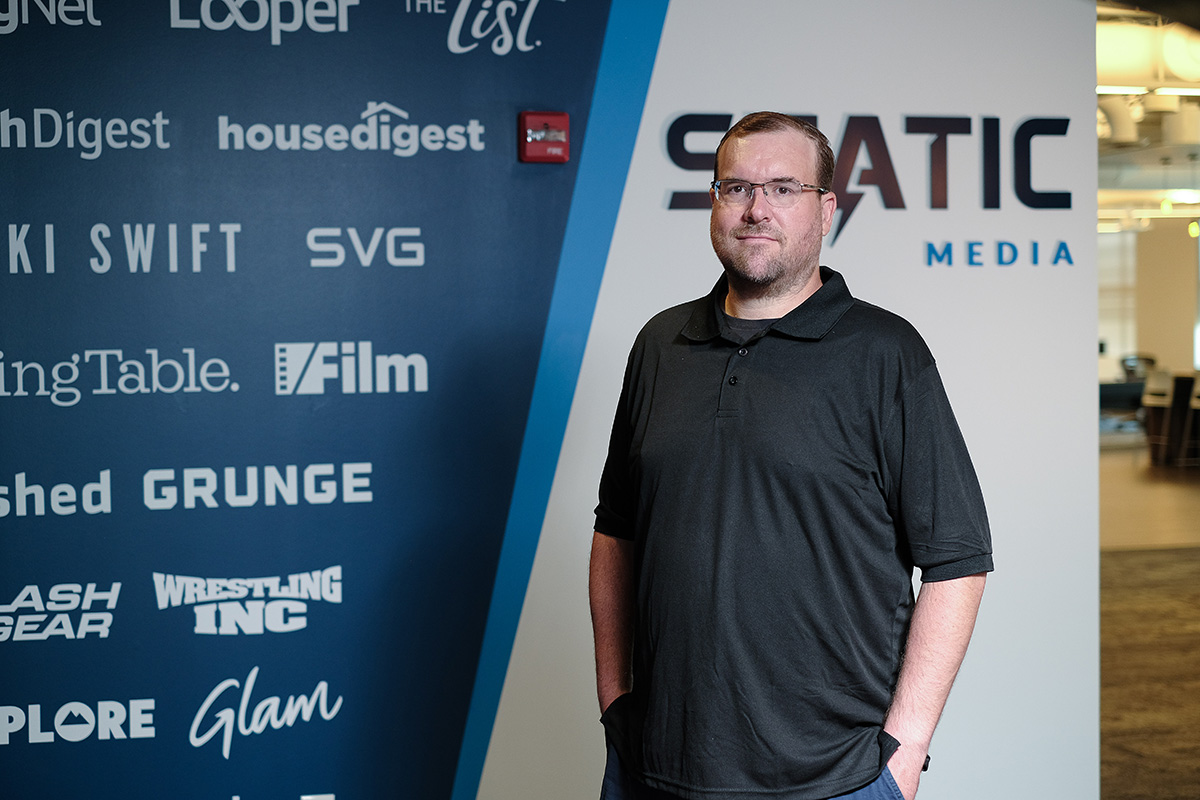
That location helps explain the low profile. Renner rarely cultivated a celebrity-founder persona. He has appeared in trade interviews, local business coverage and, in 2026, a digital-media class at NYU, but public attention has generally landed on the machinery and the brands. The reticence fits a chief executive who once joked that his company lacked even a proper press photograph. The product was the proof; the operator stayed just outside the frame.
His ambition, however, is not especially hidden. Renner wants to keep entering new subject areas, restoring established sites and meeting readers wherever they pause for something useful or diverting. He once pictured a commuter on a train after a long day, looking for a story that could be both entertaining and informative. It is a modest portrait of the customer, almost pointedly so. No talk of changing humanity. Just someone with a few minutes and a screen.
The most durable idea in Renner's story may be this respect for small signals. One reply to an overlong email. One thumbnail that draws attention. One neglected publication with a recognizable name. One reader deciding whether the next story is worth a click. Static Media has become large by noticing those choices, repeating what works and leaving room for a person to decide what should be written in the first place.