Ingar S. Bentsen has a useful instruction for anyone preparing to ask strangers for money: choose your words carefully. Get to the point. Tell a story that people can follow. He has even suggested explaining it as you would to friends over a beer. The advice leaves very little room for a slide entitled “Our Holistic Innovation Journey.” One imagines the beer getting warm.
At Nordea’s Gründerjakten competition, Bentsen helped finalists work on their presentations over four days. His advice went beyond delivery. Share the idea, he urged. Get reactions. Find people to work with. In that small collection of instructions sits an interpretation of entrepreneurship that runs through his career: an idea needs company.
That is the thread connecting the founder, investor, board member and podcast host. Bentsen has spent years building TheFactory in Oslo, bringing people with young businesses into contact with people who have money, experience or customers. The encounters take different forms. The underlying question remains pleasingly concrete: who could help this company do the next difficult thing?
A shipping ambition, an Oslo address
Bentsen’s route into this work included business studies at the International University of Monaco. He wanted a shipping career. His subsequent working life took him through electricity sales, mobile ventures and a company called Payments before TheFactory. It is a less tidy progression than a venture-capital biography might prefer, and more interesting for it.
By 2019, the business he was building occupied three floors in central Oslo. There was a table-football table, Polaroids of founders on the walls and a stage he had built himself. A founder assembling a platform for other founders turns out to have involved some actual assembly.
The stage is a useful detail because it gives physical form to his later work. There must be somewhere to stand, someone worth addressing and a reason for the audience to listen. Much of the business of an accelerator happens between those three things. The carpentry simply made the arrangement visible.
Before the name lost “fintech”
TheFactory dates its beginnings to 2015. FintechFactory launched in 2016 at Telenor Arena in Fornebu, followed by TheFactory’s formal establishment in 2017. Bentsen was among the initiators alongside Hans Christian Bjørne, Philip Røer and Steinar Sæther. These were separate steps in making an organization, rather than one ceremonial moment with a ribbon.
The original focus was financial technology. An accelerator could offer founders training, introductions and access to capital in a field where established institutions already controlled much of the business. Working out how a small company might reach those institutions was part of the proposition.
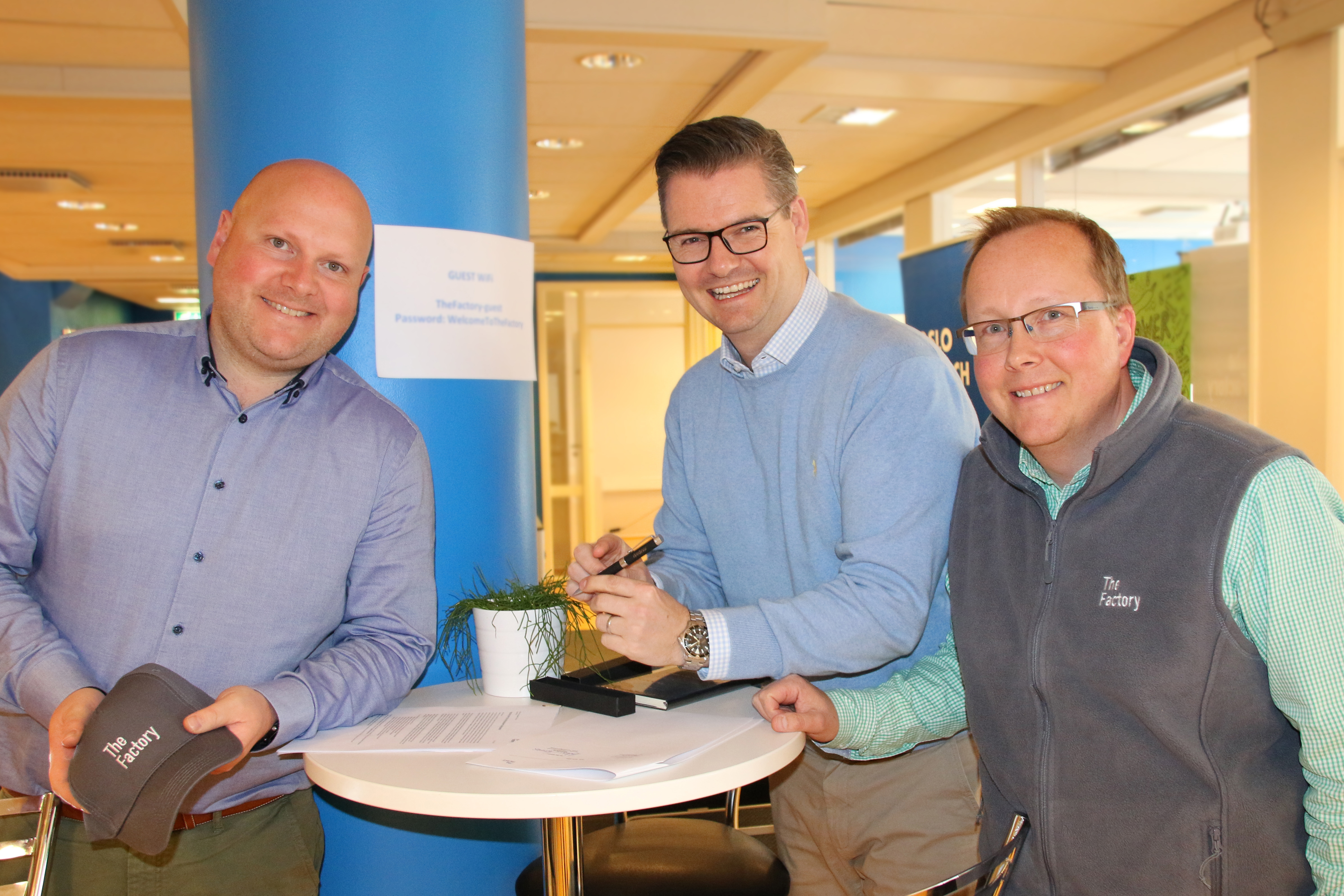
The partnership with Kredinor in July 2019 illustrates the arrangement. The financial-services business wanted access to ideas and emerging concepts; TheFactory brought a community of founders. Each side had something the other could use. For a young business, an introduction to an established company can make a proposed market feel considerably less abstract.
There is a useful tension here. The businesses described as challengers may also need the institutions they hope to challenge. A potential rival can become a customer, partner or route to market. Bentsen’s work has repeatedly occupied this awkward, productive middle ground.
Money with someone attached
In a 2018 LØRN conversation about financial technology and acceleration, Bentsen argued for capital accompanied by useful expertise. “Smart money is better than lots of money,” he said, translated from Norwegian. He also emphasized cooperation between established companies and startups, using the term “powercoupling.”
“Smart money is better than lots of money.”
Ingar S. Bentsen · LØRN, 2018 · translated from Norwegian
The phrase supplies a practical test. Money arrives as a number. The person supplying it may also bring judgment, an introduction, or knowledge of what a customer will actually buy. Those additions are harder to put in a spreadsheet. They can still matter when the next decision comes due.
Bentsen’s role has included raising capital for TheFactory’s investment companies, the Angels vehicles, as well as chairing TheFactory Asset Management. This puts him on both sides of the familiar fundraising conversation: helping founders prepare to seek backing, while securing capital for the structures that can provide it.
He also received Norway’s Ecosystem Hero of the Year recognition in 2019. The title is unusually theatrical for a business concerned with introductions and follow-up. Yet it points to a real distinction in his work: the product includes the relationships around a company, alongside the company itself.
Four kinds of conversation around a young business. Editorial illustration.
The less glamorous chairs
The stage gets attention. The boardroom gets an agenda. Bentsen has worked in both. In September 2020, he joined Shifter’s podcast for a conversation about building a functioning board, drawing on experience across roughly ten boards at the time.
The discussion’s subjects were practical: recruitment, compensation, engaging members and deciding what a company should use its board for. They describe a different phase of entrepreneurial life from the first pitch. Someone now has to help the business make decisions repeatedly, including when there is no audience to applaud them.
That appearance is revealing in its choice of subject. An accelerator founder can spend a great deal of public time talking about beginnings. Here Bentsen was discussing the machinery that must keep working afterward. A board seat carries expectations beyond lending a name to a website.
A year later, he appeared on Rapporten to discuss startups, investment, Firi and large banks. The subjects kept returning to the same relationship: young companies and the people or institutions able to shape their chances. The vocabulary changed with the audience. The interest in how those connections function stayed recognizable.
Learning to leave a favourite category
By August 2023, Bentsen was discussing a change of emphasis. Fintech had become too narrow a basis for a proposed new fund. The flow of suitable companies was insufficient. For an organization that had begun with the sector in its name, that was a consequential admission.
He described a market where established banks had adapted and some anticipated challengers had grown more slowly than expected. Licensing requirements could also put founders through lengthy waits. The decision was about where future investment attention should go; interesting financial-technology businesses could still receive consideration through another vehicle.
It is an instructive moment in his story. Building an organization around an opportunity creates a second task: noticing when the opportunity has changed. A familiar category offers expertise and relationships. It can also become a habit. Bentsen was publicly making the case for looking beyond it.
Today, TheFactory describes a portfolio spanning several fields, including property technology, sports, sustainability and defence and security. Its homepage reports more than 600 startups accelerated, more than 90 investments and six exits. Those are organization-wide activity figures, rather than a measure of Bentsen’s personal investment returns.
From the stage to the microphone
StartupBeat began as a magazine in 2019 and expanded into a podcast in spring 2023. Bentsen became one of its hosts. Interviewing offered another setting for his work with founders and investors: a conversation could travel beyond the people able to attend an event in Oslo.
A December 2025 episode featured investor Trond Riiber Knudsen, recorded at TheFactory On Air the previous month. Its advertised subjects included recognizing founders and the experience of early investing. The format joined the live gathering to the later listen. The audience could arrive at different times.
Another December episode brought in Allon Groth of the Norwegian Venture Capital Association. Its concerns included capital availability, policy and cooperation among founders, investors and government. Bentsen’s microphone was reaching beyond the individual pitch to the conditions in which a company tries to grow.
The shift makes sense alongside the rest of his work. A founder may need help explaining a product today and understanding the investment landscape tomorrow. A podcast cannot supply every answer. It can let a useful question reach someone who was never in the original room.
The next room has different requirements
In 2026, Bentsen’s public work includes TheFactory’s defence and security initiative. He is listed on an Arendalsuka discussion about whether Norway can build dual-use companies quickly enough, alongside participants from government, innovation and defence technology. It brings the accelerator’s connecting role into another set of relationships.
The DefSec Accelerator runs for 12 weeks and is designed for early businesses developing defence, security and dual-use technologies. Its stated work includes introductions to industry and public actors, market preparation, pilot opportunities and investor contact. The ambition is to help companies move from an invention toward operational use.
That is a demanding setting for a familiar method. Useful introductions depend on understanding what each participant needs. A meeting earns its place when it helps the next decision happen. The success of this chapter will have to emerge through the companies and relationships being built.
For now, Bentsen’s career offers a consistent image: someone making places where people can explain what they are trying to do, then finding others with a reason to care. Sometimes the place is a program, a board meeting or a podcast. Once, in an Oslo office, it was a stage he had made himself. There is something agreeable about an accelerator founder who has, quite literally, supplied the floorboards.
Keep the conversation going
- TheFactory ↗Accelerator programs and investment activities
- Ingar S. Bentsen on LinkedIn ↗Public professional profile
- StartupBeat ↗Conversations hosted by Bentsen and colleagues
- Bentsen on building a functioning board ↗Shifter podcast · 2 September 2020
- Startups, investments, Firi and big banks ↗Rapporten · 28 September 2021
- Bøller med bankene ↗Finansavisen profile · September 2019
- TheFactory broadens its fintech focus ↗Shifter interview · August 2023