Imagine writing five versions of a letter that all request the same thing. One arrives, one gets ignored, and one persuades the reader to act. Inceptive's recent experiment did something like this with mRNA. Each candidate told a cell to make the same cancer-fighting receptor. Yet the sequences around and within that instruction changed how the message worked. In a small mouse study, the best version drove near-complete depletion of B cells across blood, spleen and bone marrow. The protein did not change. The instructions did.
- Inceptive designs sequence-based medicines with AI models trained alongside laboratory experiments.
- Drugmakers are the customers. Alnylam committed $30 million upfront to a collaboration announced in June 2026.
- Its latest CAR-T result is a 24-hour mouse experiment, not evidence of patient benefit.
- The useful idea to copy: make the missing training data, then let real biology grade the model.
The company sits at an awkward and interesting intersection. It sells neither a chatbot for scientists nor a finished medicine from a pharmacy shelf. It builds models that propose molecular designs, tests selected candidates in its own lab, and works with pharmaceutical partners that can carry promising programs further. The named customer is Alnylam, a pioneer of RNA interference drugs. Inceptive also describes other commercial partners without publicly naming each one. Its address is in Palo Alto; its work reaches Berlin and Zurich, and the intended market is global.
A scientist leaves a dream job
Jakob Uszkoreit had already helped write one of the defining papers of modern AI, the 2017 work that introduced the Transformer. He has described a peculiar sequence of events in late 2020: the birth of his daughter, the striking performance of AlphaFold2 at protein-structure prediction, and the first efficacy results for mRNA COVID vaccines. Together they shifted his attention from language and images to living systems. In 2021 he founded Inceptive with Rhiju Das, a Stanford biochemist. This was less a tidy career pivot than an admission that a more consequential puzzle was waiting outside the computer.
The puzzle was data. A model can learn patterns in language because people have left enormous quantities of text. Therapeutic RNA is different. Public datasets largely describe natural RNA, while drugmakers use synthetic molecules with chemical and structural choices that evolution did not provide as a training set. Inceptive's answer was to build a wet lab that could make and measure the examples its models needed. The machine chooses useful experiments; the experiments teach the next machine. That loop is the company's core product as much as any one sequence.
The first good answer was only a tie
Inceptive's first published CAR-T test in June 2026 had a carefully limited claim. Without much CAR-T-specific data, its models generated mRNA designs that matched established sequences in cell assays within a month. Combined with a partner's lipid nanoparticle, the sequences also worked in animals. A tie against an optimized comparator is a respectable beginning. It is not the promise that brings a new therapy into a clinic. The company kept measuring, gathered proprietary CAR-T data, and tuned its models again.
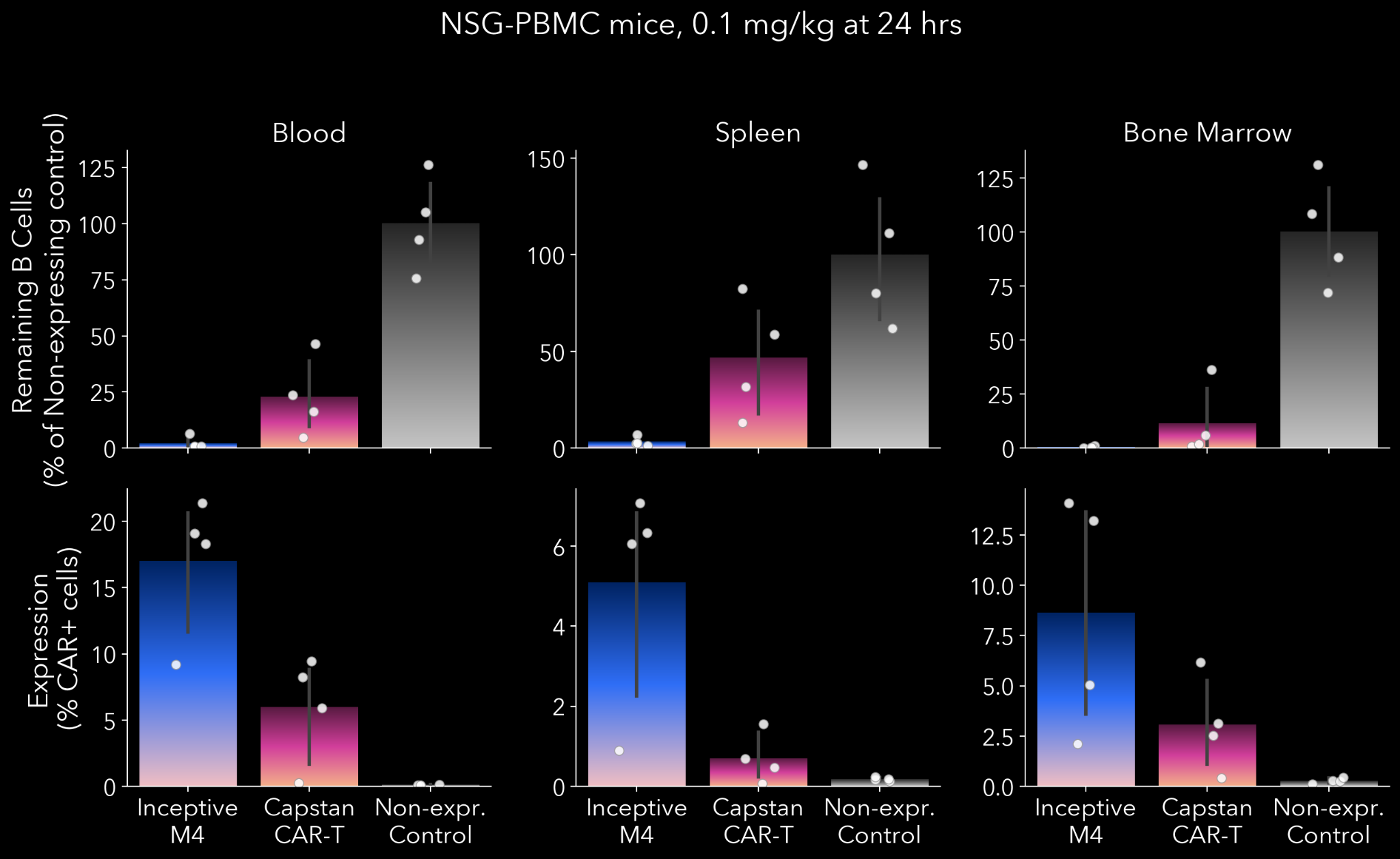
September's follow-up is more pointed. The team chose five AI-generated sequences for an anti-CD19 CAR, all encoding the identical receptor protein. It formulated them in a CD8-targeted lipid nanoparticle from collaborator Amplitude Therapeutics and tested them in humanized mice against an optimized Capstan Therapeutics sequence. Three of the five Inceptive designs performed substantially better than the comparator on B-cell killing. Its best candidate, M4, produced roughly three times the CAR expression at 24 hours and nearly cleared B cells in the measured tissues. Four mice were in each group. The figure is arresting; the sample size is equally important.
Why should spelling matter if the protein is the same? An mRNA molecule is more than a coding line. Its untranslated regions, codon choices and folding influence how much protein a cell makes, for how long, and how the cell responds to the message. Delivery matters too: a fine sequence in the wrong lipid package may never reach the right cells. Inceptive worked with Mana.bio on earlier formulations, then used Amplitude's targeted particle for the later study. The drug is message and courier together.
“Most drug design still works through a process of trial and error, testing thousands of molecules and hoping something sticks.”Jakob Uszkoreit, announcing the Alnylam collaboration
The $2 billion number needs a small print edition
In June, Alnylam agreed to pair more than 20 years of proprietary RNAi data with Inceptive's models. The companies aim to design better siRNA molecules and prioritize candidates for laboratory work. The agreement has been described as worth up to $2 billion. The immediate consideration is $30 million, including cash and an equity purchase. The rest depends on preclinical, regulatory and commercial sales milestones. Those are difficult milestones. The number captures the ambition of the arrangement; the upfront payment better describes what changed hands at signing.
That deal also clarifies Inceptive's place in the market. Alnylam has approved medicines, deep RNAi expertise and the ability to develop and commercialize drugs. Inceptive offers model development, experimental data generation and molecular design. Instead of trying to replace a drugmaker, it inserts a design engine into one. For a pharmaceutical team, the practical value would be fewer low-quality candidates to make, faster learning on unfamiliar targets, and sequences worth advancing. The public evidence supports a partnership and early preclinical results; it does not yet establish faster approvals or lower full-development costs.
Inceptive raised a reported $20 million seed round in 2021 and $100 million Series A in 2023, with backers including Andreessen Horowitz, NVIDIA, S32 and Obvious Ventures. The actual cost of building its lab and models is undisclosed. The financing is a measure of resources available, not money spent. Likewise, the animal results are a measure of biological effect in that setup, not a price tag for a future treatment.
Start with the missing dataset. Design an experiment that produces it. Ask the model to propose a small, testable set of candidates. Measure the outcome that matters outside the computer. Repeat. This works best where experiments can be run at scale and the readout tracks the desired function; it becomes harder when delivery, safety, long-term effects or human biology diverge from the assay.
What counts as a win?
The seduction of AI biology is that a curve on a screen can look like a cure. Inceptive has at least pushed its argument into an organism, and its September result deserves attention for that reason. Yet a 24-hour observation in a small mouse study cannot tell us whether the effect lasts, whether the formulation is safe at clinical scale, or whether it helps people with cancer or autoimmune disease. More experiments will be needed to make those claims.
There is something refreshing in the company's narrower, testable question. Can a model suggest a handful of molecular instructions that outperform a heavily worked-over sequence, while a lab checks the answer? In one disclosed experiment, yes. Whether that becomes a repeatable method across targets and modalities is the business, the scientific wager, and the long wait that follows. Biology, unlike a headline, insists on reading the whole message.