A precision oncology company that asks a stubbornly practical question: before you start chemo, what if you actually tested the drugs against the cancer first?
Caption - A working biotech lab in Palo Alto, where a dog's blood draw becomes a personalized treatment ranking. The patients have four legs. The science does not care.
Walk into a veterinary specialty hospital in Denver, Boston, or Atlanta on a Tuesday morning and you will likely meet a dog with lymphoma and a worried family. The vet has options - several chemotherapy protocols, each with a fan club of oncologists who swear by it. None of them know which protocol will work best for this particular dog. Until recently, the answer was to start, watch, adjust, and hope.
ImpriMed is the small Palo Alto company trying to retire the hope. The vet ships live cancer cells overnight. ImpriMed's lab runs them against a panel of anticancer drugs - actually exposing the dog's own cells, in a dish, to the actual medicine. A machine-learning model trained on years of these tests turns the results into a ranked prediction. By the time the family comes back for the follow-up, the oncologist has a personalized chart of likely responders.
It is the kind of idea that sounds obvious in retrospect, which is exactly why it took two Stanford engineering PhDs five years and three funding rounds to make it real.
A diagnostic report. The vet draws blood or aspirates a lymph node from a dog with suspected lymphoma. ImpriMed runs flow cytometry, PCR for clonality (PARR), and a live-cell drug sensitivity panel. The result is a Personalized Prediction Profile: which drugs the model believes are most likely to fight this individual cancer.
Caption - The deliverable is a PDF the vet can read in 90 seconds. The work behind it takes days and a great deal of cell biology.
Dogs get cancer at human-like rates. Their tumors look and behave like ours. There is less regulatory friction in veterinary medicine, faster outcome data, and an enormous unmet need. Pet cancer alone is a billion-dollar market - and an unusually honest sandbox for the human application coming next.
Caption - Comparative oncology, written plainly.
The same approach - live-cell drug sensitivity plus a machine-learning model trained on outcomes - is being adapted for human blood cancers under a product called xCellSense, and packaged for pharma CRO partners testing drug candidates against patient-derived cells. The veterinary business is the proof. The human business is the bet.
The vet collects fresh cancer cells from the patient and ships them overnight to Palo Alto.
Live cells are exposed to a panel of chemotherapy drugs in the ImpriMed lab. Flow cytometry classifies the cancer subtype.
An AI trained on prior cases turns raw sensitivity data into a clinical prediction.
The oncologist receives a personalized ranking of drug options - and an evidence base for the conversation with the family.
We will save pet cancer patients first - and we will save pet parents next.- The ImpriMed thesis, paraphrased
The 2023 Series A was led by SBVA (SoftBank Ventures Asia), with participation from HRZ Han River Partners, SK Telecom, KDB Silicon Valley, Ignite Innovation Fund, Samyang Chemical Group, Murex Partners, and Byucksan.
The Series A took ImpriMed from a focused veterinary diagnostics company to a precision medicine platform with a credible path into human blood cancers and pharma partnerships. It also doubled the team.
Korean strategic capital - SK Telecom, KDB Silicon Valley, Samyang - is rare in U.S. veterinary biotech. ImpriMed's bi-continental setup, with operations in Seoul as well as Palo Alto, made the round possible and gave the company an Asian launch corridor.
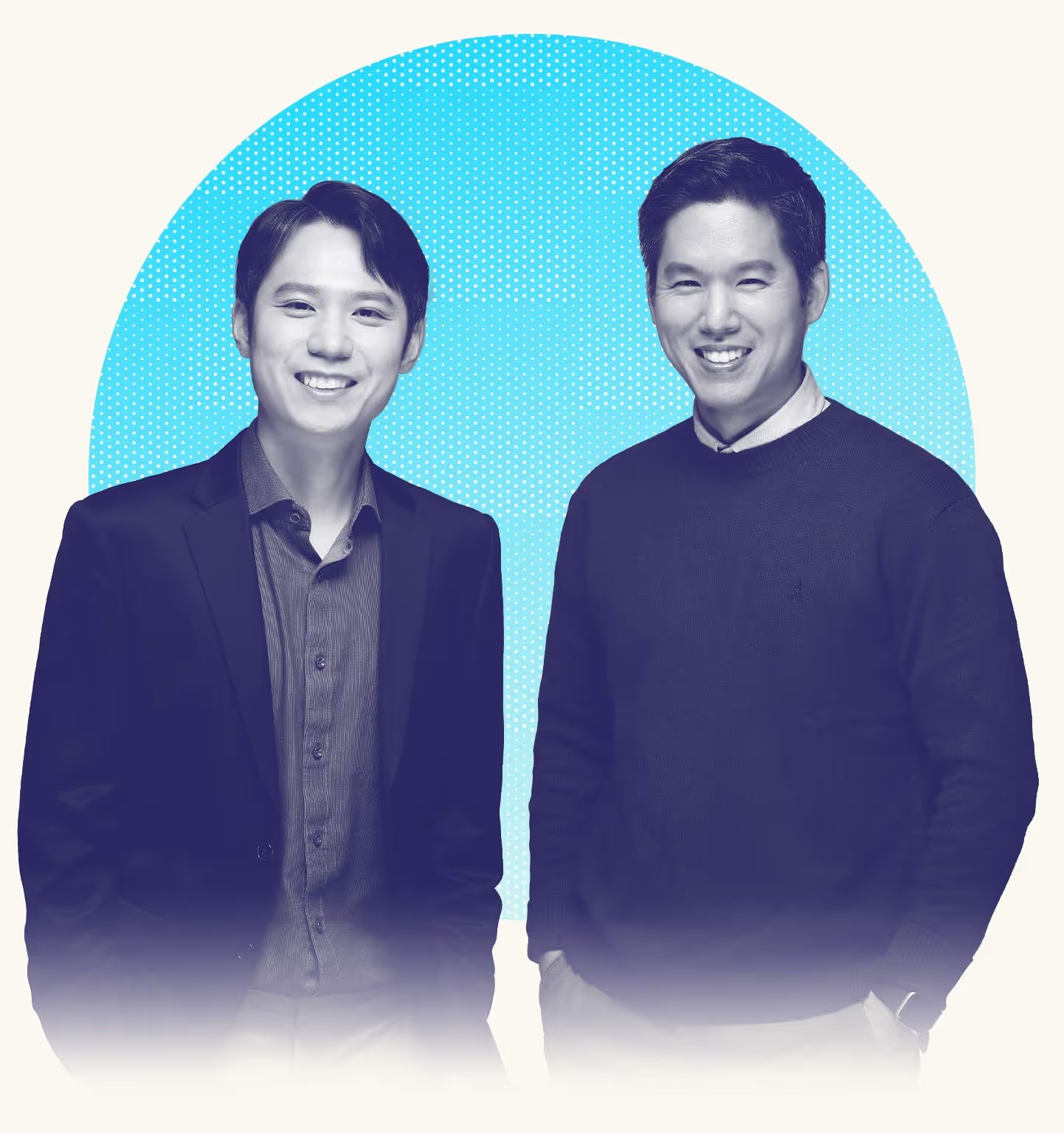
Sungwon Lim and Jamin Koo met as Stanford undergraduates. They did engineering PhDs there together. They watched friends' pets get cancer and saw oncologists working without the tools their hospital colleagues took for granted. ImpriMed is what happens when engineers refuse to accept that clinical instinct is the best instrument available.
Co-Founder & CEO
Stanford PhD in engineering. Runs operations, strategy, and the relationship with the veterinary oncology community. Interviewed by Authority Magazine as part of its "Meet the Inventors" series.
Co-Founder & CTO
Stanford PhD in engineering sciences. Owns the lab science, the data pipeline, and the machine-learning models that turn ex vivo drug response into a clinical prediction.
The flagship - AI-driven drug response ranking for canine lymphoma and leukemia, built from the patient's own live cancer cells.
Flow cytometry that classifies cancer subtypes to guide treatment decisions.
A PCR-based assay that confirms lymphoma diagnosis when histology is ambiguous.
Catches drug-sensitivity mutations in breeds at risk of severe adverse reactions.
Remote pathology workflow for fast diagnostic interpretation.
The in-development product extending live-cell drug response prediction to human blood cancer patients.
ImpriMed's team published a study in Veterinary and Comparative Oncology demonstrating that ex vivo drug sensitivity data plus immunophenotyping, combined with machine learning, predicts in vivo chemotherapy response in canine lymphoma.
Caption - Rare in pet medicine. Important for credibility with academic oncologists.
The platform is in use across 90+ specialty hospitals and 40 U.S. states, with a network of more than 250 veterinary oncologists ordering tests for their patients.
Caption - The proof is not the lab. It's the call from the oncologist who orders the test again.
Hybrid by design: bench scientists, software engineers, and field-experienced veterinary professionals sharing a wet lab and a code repo. Scientific advisors from Colorado State University and Stanford School of Medicine sit on the edges of the table.
Walk back into that same specialty hospital and the room is almost the same. The dog is the same. The worried family is the same. The vet still has options - several chemotherapy protocols with their fan clubs of oncologists. What is different is the printout in the vet's hand.
It is not a guarantee. ImpriMed has been careful, in its press and its papers, to call the report a decision-support tool, not a verdict. Cancer keeps a percentage of its mystery no matter how good the model gets. But the conversation is different now. The family hears specific drug names with specific reasons. The vet starts where the model says the response is most likely. The follow-up visit, if it comes, has a faster path to a better answer.
That small change - replacing instinct with evidence at one moment in one Tuesday morning - is the whole product. Multiply it by 250 oncologists, 40 states, and the next platform aimed at human patients, and you can see what the Series A was actually buying.