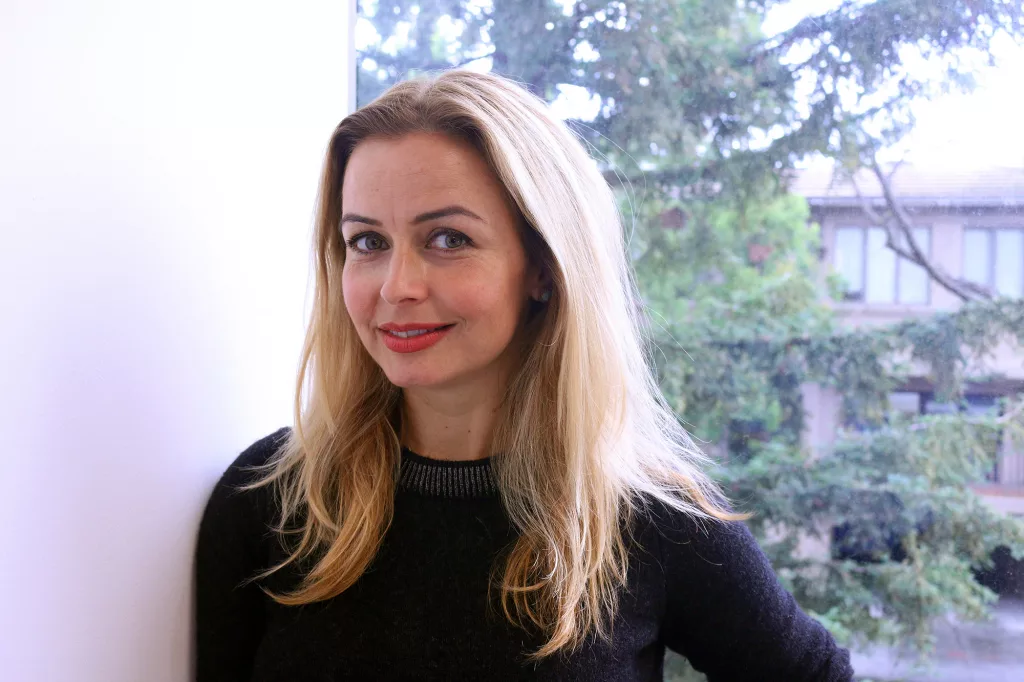
Most cancer drugs are tested on mice that were engineered to get sick. Christina Lopes looked at the family dog - which gets cancer on its own, lives in the same house, breathes the same air - and saw a better teacher.
That single reframing is the engine of The One Health Company, the Palo Alto startup Lopes co-founded in 2016 and runs as CEO. Its flagship, FidoCure, takes a biopsy from a dog with cancer, sequences the tumor's DNA, and hands the veterinarian a precise read on which mutations are driving the disease - along with a matched, targeted therapy. It is, the company says, the first human-grade precision cancer platform built for dogs. As of its latest counts it reaches more than 1,350 clinics and has treated over 5,000 dogs.
The pitch is deceptively simple and quietly radical: cancer care for dogs, in Lopes's words, "has not changed much in the last 30 years." Surgery, then a blunt round of chemo, then hope. FidoCure starts from a different premise - "every cancer is unique" - and treats each tumor as the specific genetic problem it actually is. The dog gets a tailored shot at remission. And every case adds to one of the largest clinico-genomic datasets in comparative oncology, a library of real-world tumors that researchers can mine for clues about the human kind.
One Health, two species, one disease
The name is a thesis. "One Health" is the principle that the health of people, animals, and their shared environment are inseparable. Dogs and humans get strikingly similar cancers - same genes, same mutation hotspots, same stubborn tumors. A dog's cancer arises spontaneously, in a body that ages roughly seven times faster than ours, which means the disease, and any treatment, plays out on a timeline scientists can actually observe.
FidoCure turns that biology into a service. A vet sends a tumor sample to a CLIA-certified lab. Next-generation sequencing reads the genome. An AI layer flags the actionable mutations and proposes targeted therapies - often FDA-approved human drugs repurposed for canine biology. The vet gets an action plan; the dog gets a precision treatment that used to be reserved for people; the database gets one more annotated, real-world tumor.
It is a rare business model where the product helps the patient in front of you and the science behind everyone else at the same time. Treat enough dogs, the logic goes, and you start to see which targeted therapies work against which mutations - evidence that is expensive and slow to gather in human trials but accumulates, dog by dog, in the FidoCure network.
From Cerberus to canines
Before any of this, Lopes was a managing director at Cerberus Capital, the private equity firm with roughly $30 billion under management. Her beat was emerging-markets finance - moving capital, technology, and people into developing economies. She sat on the advisory board of International Planned Parenthood in the Western Hemisphere and advised the UN Commission on the Status of Women. She helped roll out a pilot pre-cervical-cancer vaccine program in Bolivia. The throughline, long before dogs entered the picture, was closing gaps in who gets care.
The turn toward cancer was personal. Lopes cared for her father through a terminal cancer diagnosis, and she has lost several family dogs to the disease. When she co-founded One Health with Ben Lewis - a veterinarian, and her husband - the grief had a direction. The result was a company that refuses to treat "people medicine" and "pet medicine" as separate countries.
The financier
Managing director at a $30B fund, fluent in moving capital into hard places. She knows how to underwrite a long bet.
The advocate
Years advising on women's health from Planned Parenthood to the UN. Care access, not just capital, was always the point.
The founder
A scientist's instinct - she did doctoral coursework in ethics at Princeton - turned loose on a 30-year-stale market.
The partner
Co-built the company with her husband Ben Lewis, a vet whose clinical-trial experience grounds the science in real clinics.
A pitch, a sling, a win
There is a founding scene that says almost everything about how Lopes operates. Early on, she entered One Health in Wharton's Venture Initiation Program. She arrived with her newborn daughter. The baby - normally an excellent sleeper - woke up two minutes before she was due on stage. Lopes tucked the infant into a sling, walked out, delivered the pitch over a fussing newborn, and won the competition.
She did not ask anyone to make an exception for the circumstances. She just folded the circumstances into the work and kept moving. It is the same posture she brings to a stale market and a hard disease: don't wait for ideal conditions that aren't coming.
Brazil, Ireland, and a father without a glass ceiling
Lopes was born in Brazil and grew up across three countries - Brazil, the United States, and Ireland - watching how wildly the basics of education, healthcare, and financial stability could vary just by crossing a border. She came of age around economic crisis and, earlier, the long shadow of military dictatorship. The disparities were not abstractions; they were the texture of her childhood.
She has credited her father's feminism for a useful blind spot: she grew up without the sense that there was a ceiling she wasn't supposed to push past. That confidence, paired with a front-row view of inequality, shaped a career that keeps circling back to the same question - who is being left out of good care, and what would it take to let them in.
The credentials stack accordingly: a B.A. from the University of Massachusetts, a master's in international and political affairs from Columbia, and doctoral coursework in ethics at Princeton. It is an unusual resume for a biotech founder, and that is rather the point. She approaches canine oncology as a systems problem - capital, ethics, access, science - not just a lab one.
How the bet got funded
Investors took the comparative-oncology thesis seriously and early. The chart below tracks One Health's disclosed financing - a seed round led by Andreessen Horowitz's bio fund, then a $10M Series A led by Polaris Partners and Borealis Ventures, with Lerer Hippeau, Y Combinator, and Tau Ventures along for the ride.
The money bought reach. FidoCure went from a regional pilot to availability in all 50 US states, then into clinics abroad. By 2024, Lopes was on stage at the Animal Health Summit presenting what the company bills as the world's only portfolio of canine cancer drugs - a phrase that would have sounded like science fiction when she was still underwriting deals at Cerberus.
Davos, Inc., and a Top 100 list
The World Economic Forum named Lopes a Young Global Leader at Davos, citing work that spanned dealmaking and women's health. Inc. Magazine put her on its Top 100 Female Founders list. The honors are nice; the more telling metric is that thousands of dogs have gotten a precise shot at remission they wouldn't have had, and that a research dataset now exists that didn't before.
The career, in order
- PRE-2016Managing Director at Cerberus Capital (~$30B AUM); emerging-markets finance.
- PRE-2016Advisory board, International Planned Parenthood; advisor to the UN Commission on the Status of Women.
- 2016Co-founds The One Health Company in Philadelphia with Ben Lewis.
- 2019$5M seed led by Andreessen Horowitz's bio fund, with Lerer Hippeau and Y Combinator.
- 2020$10M Series A led by Polaris Partners and Borealis Ventures; FidoCure in all 50 states.
- 2024Presents the company's canine cancer drug portfolio at the Animal Health Summit.
Why dogs, really
It would be easy to file FidoCure under "pet tech" and move on. That misses the ambition. Lopes is not only trying to give dogs better cancer care, though she is doing that. She is building a bridge between veterinary and human medicine, on the theory that the family dog - aging fast, getting human-like cancers, living a human-adjacent life - is the most honest model of the disease we have access to. Treat the dog well, learn from the tumor, and the knowledge flows in both directions.
That is the quiet audacity of the whole enterprise: a company where doing right by a sick golden retriever in Ohio and advancing oncology for people in general are, structurally, the same act. Lopes spent a career deciding where capital should go to do the most good. She seems to have concluded the answer was, of all things, the dog asleep at her feet.