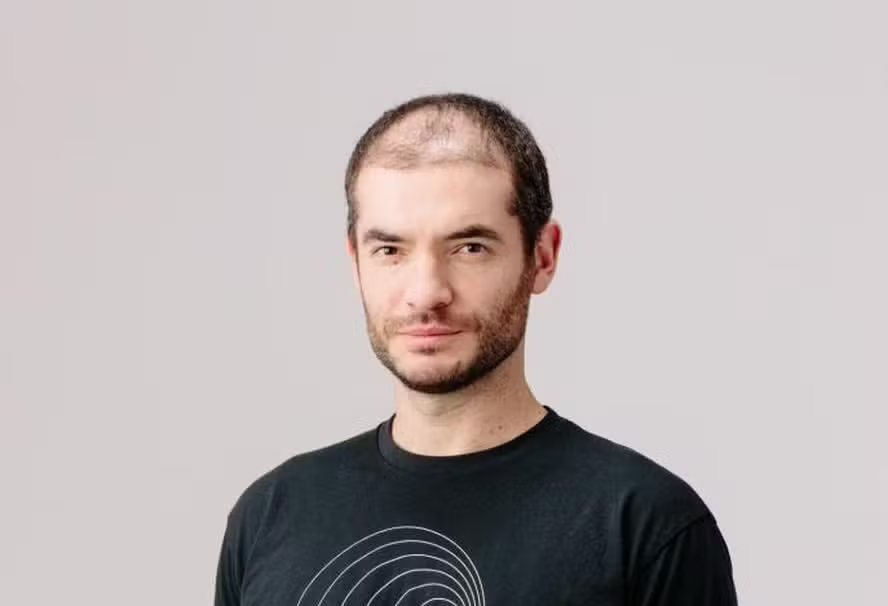
He sits in a room with fifty people, no titles on the doors, no PowerPoints on the walls. The building is deliberately nondescript. The company is worth thirty-two billion dollars and has no product. This is exactly the plan.
Ilya Sutskever was born in Gorky - Soviet Russia, 1986 - into a family that moved to Jerusalem when he was five, then to Toronto when he was sixteen. He lasted one month in Canadian high school before the University of Toronto admitted him as a third-year undergraduate. The pattern was set early: arrive, skip ahead, go deeper.
The deep learning revolution has a specific birthday: September 30, 2012. That was the day AlexNet's results were announced at the ImageNet Large Scale Visual Recognition Challenge, slashing the top-5 error rate from 26% to 15% and leaving every other team in the dust. The three authors were Geoffrey Hinton, Alex Krizhevsky, and Ilya Sutskever. They built it in Hinton's lab at the University of Toronto. Google bought their company, DNNResearch, six months later. Every AI product you use today traces a lineage back to that afternoon.
VERIFIED RECORD
What makes AlexNet remarkable is not just the result - it's what it proved. Sutskever and his collaborators showed that with enough data, enough compute, and the right architecture, neural networks could learn to see. The field had been circling this idea for decades. The 2012 paper made it undeniable. 100,000 citations and counting. One of the most impactful papers in computer science history.
One doesn't bet against deep learning.
- Ilya Sutskever
At Google Brain, he helped develop sequence-to-sequence learning - the architecture that became the backbone of Google Translate. Then came OpenAI. In December 2015, he co-signed the founding documents alongside Sam Altman, Greg Brockman, Elon Musk, Wojciech Zaremba, and John Schulman. He became Chief Scientist. For the next nine years, every major OpenAI breakthrough had his fingerprints on it: GPT-2, GPT-3, GPT-4, DALL-E, CLIP, Codex, ChatGPT. The list is not a highlight reel. It is the history of commercial AI.
Then came November 2023. Sutskever was one of four OpenAI board members who voted to fire Sam Altman. Within 72 hours, nearly the entire company had threatened to quit, Altman had negotiated his return, and Sutskever had signed a letter calling for that return - and issued a public statement of regret. "I deeply regret my participation in the board's actions." Six months later, he left.
30
The Carmack Reading List
Game developer John Carmack once asked Sutskever what he should read to understand AI. Sutskever handed him a list of approximately 30 papers and said mastering them would give him "90% of what matters" in the field. The list circulated online and became one of the most widely shared AI curricula on the internet - an accidental syllabus for an entire generation of researchers.
On June 19, 2024, Sutskever announced Safe Superintelligence Inc. with co-founders Daniel Gross and Daniel Levy. The mission statement is unusual for a company: "The world's first straight-shot SSI lab." No products. No customers. No roadmap. Just one goal: build artificial intelligence that is both superintelligent and provably safe, without compromising one for the other.
The money arrived fast. September 2024: one billion dollars from Sequoia Capital, Andreessen Horowitz, DST Global, and SV Angel. April 2025: another two billion, valuation at thirty-two billion dollars. Google Cloud announced a partnership to provide TPU access for SSI's research. Meta made an acquisition approach. Sutskever declined. His co-founder Daniel Gross left for Meta in July 2025. Sutskever became CEO.
FELLOW, ROYAL SOCIETY
The intellectual pivot is the most interesting part of the story. For years, Sutskever was among the most vocal advocates of the "scaling hypothesis" - the conviction that simply making models bigger, with more data and more compute, would produce qualitatively new capabilities. He was right. ChatGPT proved it. But in late 2024, he announced something that rattled the field: "Pre-training as we know it will unquestionably end." And then: "We're moving from the age of scaling to the age of research."
He was not predicting failure. He was predicting that the era of brute force was giving way to something subtler and harder - and that this is where his career has been pointed all along. When Dwarkesh Patel asked him in 2025 how many years until superintelligence, he answered: "I think like 5 to 20." He said it the way someone says a number they have thought about for a long time and stopped being surprised by.
Outside the office, he is aggressively private. "I lead a very simple life. I go to work; then I go home. I don't do much else." His 2022 tweet - "It may be that today's large neural networks are slightly conscious" - generated more column inches than most papers he's published. He posted it without academic context, without hedging, and has never fully walked it back. When you have spent decades thinking about what intelligence is, the line between machine learning and awareness starts to look more like a gradient than a wall.
His PhD advisor Geoffrey Hinton won the Nobel Prize in Physics in 2024 for the same foundational work they pursued together at Toronto. Hinton has described Sutskever as one of the most talented students he ever had. The student has since been elected a Fellow of the Royal Society, won the NeurIPS Test of Time Award three consecutive years, appeared on Time Magazine's list of the 100 most influential people in AI twice, and received an honorary doctorate from his alma mater. In 2026 he became the first AI researcher to receive the National Academy of Sciences Award for Industrial Application of Science.
The math of SSI is deliberately absurd. Fifty employees. Thirty-two billion dollar valuation. Zero products. It is the most expensive research lab in history organized around the explicit refusal to ship anything. Sutskever has said he believes the company's structure is itself a safety measure - by removing commercial pressure, he removes the incentive to cut corners on alignment. Whether that bet pays off is a question that will take years to answer. He is already working on the answer.