An aerospace engineer looking for a component has two problems. One is choosing the part. The other is finding the information that makes choosing possible: the current catalog, the correct specification, the detail that changed since last time. In 1959, the business that became IHS began working on that second problem. Its material was microfilm. Its opportunity was the considerable inconvenience of being an engineer surrounded by information you could not easily use.
- IHS organized technical information, then added forecasts, software and industry expertise.
- Subscriptions produced 81% of its $2.18 billion revenue in fiscal 2015.
- The original company merged into IHS Markit; its businesses now follow several successor paths.
That sounds like a modest beginning for a company that would eventually own CARFAX and advise the energy industry. But the connection is surprisingly direct. A car buyer, a petroleum executive and an aircraft engineer all face decisions whose consequences outlast the meeting. IHS sold them ways to examine the evidence before committing.
The catalog that kept changing
Richard O’Brien, a product editor at Rogers Publishing, heard readers complain about obtaining current vendor information. The answer was to compile and index catalogs on microfilm. The first product had the wonderfully unromantic name Vendor Specs Microfilm File. Early users included Martin-Marietta and Convair Astronautics.
Consider what the index accomplished. The manufacturers already had catalogs. Engineers already knew their profession. IHS made the material easier to find and keep current. Its usefulness came from maintaining the connection between a question and a dependable answer.
The delivery technology kept changing. IHS began producing CD-ROMs in 1985 and put products online in 1995. By its fortieth anniversary, a company announcement said the original database had expanded from 25,000 pages to nearly three million. Maintaining the collection became a different undertaking from simply storing it.
An archive is never quite finished if the documents describe work still being done. Someone has to track revisions, reconcile names and preserve context. That maintenance is easy to overlook until the wrong version reaches the person making the decision.
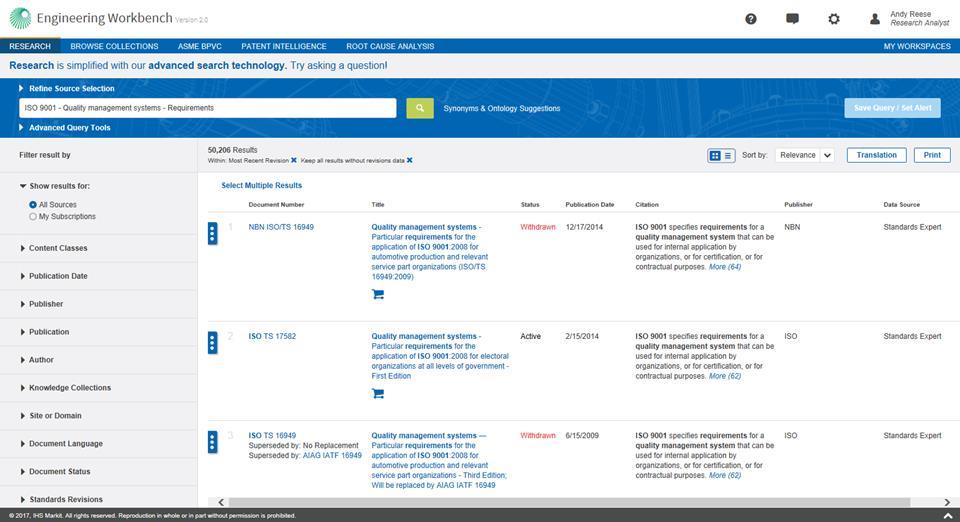
Engineering Workbench later gave that undertaking a software interface: searches, document filters and technical collections. A user could narrow results by publisher, date or language. For a technical team, this is practical help with the daily work of locating the document a design depends on.
Buying the missing pieces
IHS broadened the questions it could answer by acquiring businesses with their own information and expertise. In 2004, it bought Cambridge Energy Research Associates for approximately $29.1 million, net of acquired cash. CERA brought energy research and strategic advice. Global Insight followed in 2008, adding economic and industry forecasting.
The acquisitions placed different kinds of knowledge alongside one another. Technical records could help someone understand an asset. Economic forecasts could help assess demand. Industry analysts could interpret what changing conditions meant. Selling those capabilities together was central to IHS’s strategy.
The automotive business makes the logic tangible. In 2013, IHS acquired R. L. Polk & Co. for approximately $1.4 billion. Polk brought vehicle-registration information and CARFAX. Forecasts describe what may be built or sold; registrations record market activity; vehicle histories help buyers examine individual cars. Each answers a different question about the same industry.
One historical partnership shows how specific the work could get. IHS distributed ERAI information about counterfeit and high-risk electronic parts. A component database could identify a part; a supplier-risk record could raise another question about buying it. Bringing those records together helped procurement teams investigate risk. The information supported their checks, rather than replacing physical verification or the judgment of the people responsible for the purchase.
Its customers accordingly ranged from manufacturers and suppliers to governments and consumers. Against a general information publisher or a narrowly focused research service, IHS offered combinations of sector data, specialist interpretation and software. That breadth mattered when a decision crossed disciplines. For a simple question, it could be more machinery than the reader needed.
The subscription had a clock
By fiscal 2015, subscriptions accounted for 81% of IHS revenue. Agreements were typically annual and non-cancellable. This gave an information business a recurring rhythm: customers kept working, information kept changing, access kept being renewed. Consulting and other services supplied additional revenue.
“80% of our revenue is annual subscription-base, cash up front.”
Jerre Stead / 2016 merger interview
There was an important catch. A customer’s need for information could survive a downturn while its ability to pay weakened. In 2015, the Resources segment’s non-subscription revenue fell 27% organically. The company attributed the decline to economic challenges in energy. Project spending was an early casualty.
Organic revenue change. The annualized subscription base also shrank about 5% during 2015, pointing to further pressure in 2016.
The subscription effect moved more slowly. Resources subscription revenue still grew 2% organically that year, but the annualized value of its subscription contracts fell about $35 million, or roughly 5%. IHS warned that this would produce negative Resources subscription growth in 2016. Reported revenue and the contract base were telling different parts of the story.
That is a useful distinction for anyone copying the model. A subscription changes how revenue arrives. It does not remove exposure to a customer’s industry. Watch renewals and contract values alongside the income statement.
The name changed. The questions stayed.
In July 2016, IHS merged with Markit, combining industrial information with financial-market data and services. At completion, IHS Markit reported more than 50,000 key business and government customers. The commercial idea was to bring complementary products to each other’s customers.
S&P Global acquired IHS Markit in February 2022. More changes followed. The engineering business was sold to KKR-managed funds for $975 million in cash in May 2023 and became Accuris. In July 2026, S&P Global completed the separation of its automotive division as independent Mobility Global.
A buyer following an old IHS product therefore needs to follow the product’s lineage. Engineering standards, economic intelligence and automotive data no longer share one corporate destination. The name on an old report is a starting point.
The practical idea to borrow is smaller than the acquisition strategy: find a costly, repeated decision, organize the evidence it requires, and maintain it where people work. That approach earns its keep when accuracy, context and updates matter. When a free document answers a one-off question, the case for an ongoing subscription is much thinner. IHS’s original insight still holds: getting the information into usable order can itself be valuable work.