A car can wear the same badge as the one beside it and still be a different commercial proposition. Change the battery, equipment package, finance deposit or market, and the comparison shifts. The brochure supplies the adjectives. Somebody has to establish which details actually match. That is the territory occupied by JATO Dynamics, a British information business whose raw material is the automobile in all its inconvenient variations.
Founded by Jake Shafran in 1984, JATO supplies the specifications, prices and market intelligence used by companies making, selling and financing vehicles. Its work sits behind decisions that consumers encounter as a monthly offer, a configurator or a dealer’s explanation of a trim level. The company describes a workforce of more than 800 experts. It is a sizeable operation devoted to making a deceptively simple question answerable: what, exactly, are we comparing?
01The badge is only the beginning
For an automaker, “a rival SUV” is too loose a category to support a pricing decision. JATO’s manufacturer offering connects vehicle detail with product planning and competitive positioning. Teams can investigate equipment, versions and pricing across countries, then judge where a proposed model belongs. Its published coverage includes more than 200 brands and 1,800 vehicle models. Those figures describe the breadth of the research, not a guarantee that every dataset contains every possible vehicle.
The distinctions become useful when the information travels. A product planner may need a competitor comparison; a retailer needs a listing; a leasing business needs a correctly configured quotation. Reusing structured specifications across those tasks reduces the need to translate the car afresh at each handoff. That is the commercial appeal of JATO’s position between the manufacturer’s product information and the systems that put it to work.

02The price has more than one number
Now add the finance offer. A monthly payment is easy to advertise and surprisingly difficult to compare. Deposits, interest rates, contract lengths and final payments can move independently. JATO’s Monthly Payments brings advertised consumer and business offers together across seven European markets, including Britain, Germany and France. It supplies weekly updates, allowing commercial teams to compare the terms surrounding the headline number. The product addresses the difference between a vehicle’s list price and the affordability proposition presented to its buyer.
A historical example makes the distinction tangible. In its October 2024 analysis of Tesla in France, JATO described a September lease-with-purchase-option promotion starting at €299 a month, with a €4,000 manufacturer discount. It also reported 4,592 Model Y registrations that September. Crucially, the analysis awaited a fuller retail-versus-business breakdown before establishing the promotion’s impact. A sales spike and an attractive offer can coincide without proving exactly how many customers the offer persuaded.
payment
deposit
length
payment
The number in the advert is the start of the comparison.
This is also where interpretation earns its keep. Volumes with Nowcasting supplies market-volume intelligence linked to specifications; Price Tracker follows price and equipment changes. Together, such products let a team examine what changed in the offer and what happened in the market. The useful discipline is to keep observations separate from explanations. Registration records describe activity. They do not, by themselves, interview the buyer.
03A configurator cannot improvise
MotorK offers a concrete example of how the data becomes a customer experience. The automotive software company wanted a configurator that could handle optional packages and accurate vehicle information across its operating markets. It selected Carspecs, and the teams worked through data structure and acquisition timing. MotorK also implemented WLTP Link. The published case study says the resulting configurator benefits more than 500 dealerships across Europe. That is a documented deployment footprint, rather than a claimed sales uplift.
The lesson is practical: agree on the data before polishing the interface. The attractive screen depends on which vehicle versions are available, which options belong together and when the underlying information changes. A reader building a comparison service can copy that sequence. First define the product accurately; then decide how the user chooses it. Otherwise, a smooth purchase journey can carry an incorrect configuration all the way to the quotation.
Emissions add another layer. WLTP Link retrieves manufacturer information for individually configured vehicles, including optional equipment. JATO explains that additions affecting weight, rolling resistance or aerodynamics can alter the relevant values. For a leasing operation, that makes emissions information part of the quotation process. In March 2025, Ayvens renewed its JATO relationship after 20 years of collaboration, naming Carspecs and WLTP Link among the solutions it uses. The relationship centres on information that must remain useful long after the initial integration.
04The browser catches up with the database
In December 2024, JATO launched Vehicle Viewer, a cloud service accessible through a JATO account. Existing V5 and JATO Net users were invited to sign in. The launch brought vehicle specifications and selected finance information into a searchable, vehicle-by-vehicle interface, with access dependent on the relevant licence. It was an explicit effort to modernise delivery: established research presented through a service customers could reach directly in the browser.
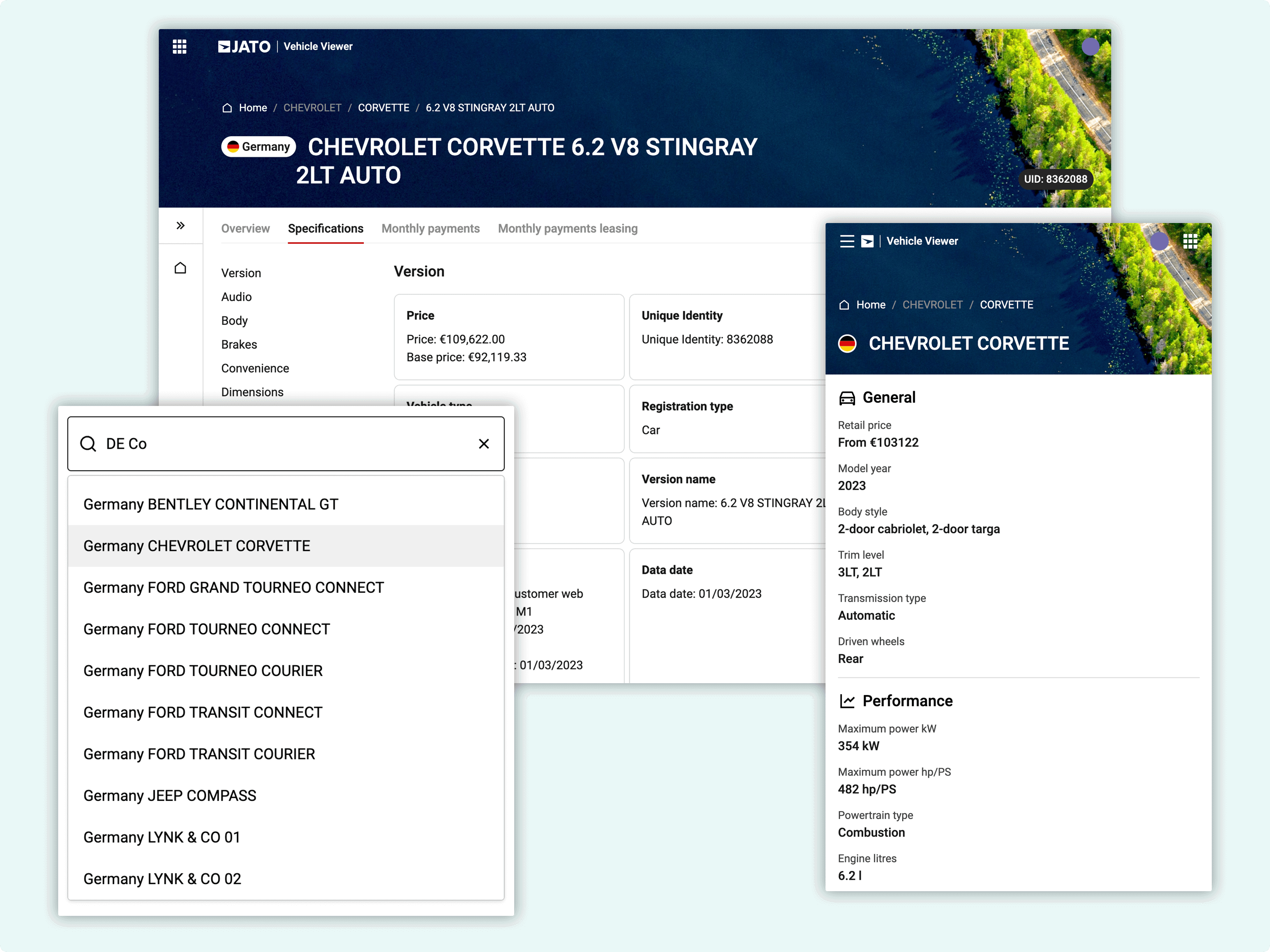
By July 2026, the interface had another job. Model-level incentive campaign summaries used AI to explain manufacturers’ campaigns and changes from the preceding offer. The feature was being rolled out where JATO collects incentives, for customers licensed to that dataset. Here, AI has a bounded assignment: make an existing body of commercial information easier to read. The value still rests on the campaign details being timely, correctly associated with the vehicle and understood in context.
Developers have a separate route. The JATO developer portal documents its JaaS APIs and the credentials required for contracted products or approved trials. A business can therefore put information into its own application instead of directing every user to a JATO screen. The delivery choice follows the job: an analyst may prefer a browser, while a marketplace needs data inside the machinery of its own service.
05The second owner needs the first specification
The used-car market gives vehicle identity another purpose. In February 2026, JATO expanded VINView Pro beyond the UK into seven further European markets. Available through Sales Link or API, it supplies factory-build information tied to a vehicle identifier, including equipment and options. The intended uses include appraisal and listing. Knowing a model’s standard equipment is different from knowing what was installed on the individual car arriving at the dealer.
In March, JATO and autobiz announced a partnership spanning a 22-country European framework. JATO contributes structured specifications and identification; autobiz contributes used-vehicle valuations and residual-value forecasting. Their announcement names Europcar Mobility Group as a joint customer. The commercial logic is straightforward: connect the description of the asset to its market value, then carry that connection into forecasts. For fleet operators, consistency matters when the same process must work across borders.
06A specialist in a crowded data business
JATO has competition for this work. Autovista combines specifications, valuations and repair information, standardising vehicle attributes and linking them to identifiers. Standardisation alone is therefore no exclusive claim. JATO’s distinctive proposition is the combination of detailed product information with finance offers, registration intelligence and delivery into retail and leasing workflows. Buyers should compare the fields, countries and decisions they need supported, rather than assume that two automotive databases are interchangeable.
The business model follows those uses. JATO sells licensed subscriptions and data access, governed by customer contracts, while JATO Advisory supplies bespoke research and interpretation. A sensible buying brief specifies markets, products, users and integration requirements before asking for a quotation. Implementation effort belongs in that calculation too: someone must map the fields, handle updates and check the resulting outputs. A database becomes useful when the organisation can reliably act on what it contains.
The people doing that work remain part of the proposition. JATO’s recruitment site lists research, engineering and advisory roles across locations including Uxbridge, New Delhi and Mexico City. Its recruitment language emphasises collaboration and professional development. That mix helps explain why this business combines software with subject expertise. A structured field and an analyst’s judgment perform different jobs, and customers may need both.
Geographic expansion tests the same idea at a larger scale. An August 2026 announcement described expansion to 58 markets, adding Colombia and Singapore with Kazakhstan and Uzbekistan to follow. Dean Miles, head of automotive, framed the expansion around competitive comparisons and pricing decisions. The promise is comparability across another border. Each addition is useful only to the extent that the relevant products and information reach the customer’s actual task.
“Customers in these new markets can benchmark competitors”
Dean Miles · Head of Automotive · August 2026
For users, the discipline is refreshingly unglamorous. Check the exact vehicle. Compare the entire offer. Match the dataset to the market and the date. Treat a forecast as a forecast. JATO’s place in the car business rests on making those habits easier to practise at scale. The options list, usually the small print beneath the photograph, turns out to contain quite a lot of the business.