A customer clicks. For the team buying advertising, that can feel like a small victory. For the customer, it is the moment the work begins. Can I find the right product? Does this page load? Where did the information go? Somewhere between those two perspectives sits iCrossing, a company whose history makes a useful argument about where marketing actually happens.
- A search specialist that added the people who build the destination.
- Enterprise work spanning media, websites, customer data and operating workflows.
- A practical buying question: can your agency fix what stops the next step?
The interesting part is the boundary it kept crossing. An agency hired to bring visitors to a website can report the visitors and declare the assignment complete. But if those visitors leave, the client has bought an introduction that went nowhere. Following that disappointment takes an agency into design, engineering, content and eventually the way its client organizes work.
01 A search agency buys the other half
Jeffrey Herzog founded iCrossing in 1998. Its starting point was search marketing, a discipline unusually close to expressed intention. Someone typing a query has already volunteered a clue. The commercial problem is deciding what to do with it.
By 2007, Herzog was describing “a gaping hole in digital marketing”. That July, iCrossing bought Proxicom, a website development business whose clients included Toyota and Chevron. The acquisition followed a $62 million financing round involving Goldman Sachs, Oak Investment Partners, RRE Ventures and StarVest Partners. Proxicom’s purchase price was undisclosed.
The reasoning was satisfyingly concrete. Build search knowledge into the website at the beginning, rather than paying later to compensate for a destination people cannot discover. A beautiful site and an effective acquisition campaign could each pass inspection while the combined experience disappointed. Bringing the two together changed what the agency could take responsibility for.
“A gaping hole in digital marketing”Jeff Herzog, explaining the Proxicom acquisition, 2007
02 The publisher enters the search box
Hearst announced its agreement to acquire iCrossing in June 2010. The announcement named Bank of America, Toyota, Travelocity and Coca-Cola among iCrossing’s clients. Hearst was buying capabilities that included paid search, analytics, web development, mobile and social marketing.
Contemporary reporting put the deal at approximately $325 million. Treat that as a reported acquisition figure: the companies did not disclose financial terms. It measures what a buyer reportedly paid for a business, not what a client pays for a campaign.

The combination gave a publisher a different kind of customer knowledge. Publishers know what audiences choose to read; search specialists study what people are trying to find. Neither perspective automatically produces a sale. Together, they invite a more useful question about what information should appear at which moment.
The expansion continued. After taking a minority stake in Mediablaze in 2016, iCrossing acquired the London digital experience and content agency in 2021. Content became another part of the destination it could help build.
03 Sometimes the bottleneck is a ticket
Today, iCrossing sits between a digital agency and a technology consultancy. Its work includes paid media, search, experience design, platform engineering, customer data and AI. Enterprise clients can buy help diagnosing a problem, implementing the systems behind a response, and running marketing afterward. Proprietary technology supports that services business.
The distinction becomes clearer in the unglamorous work. An automotive client relied on engineers for routine campaign updates. iCrossing says a self-service administration portal reduced engineering tasks by 40%. The limiting factor was who could make a change.
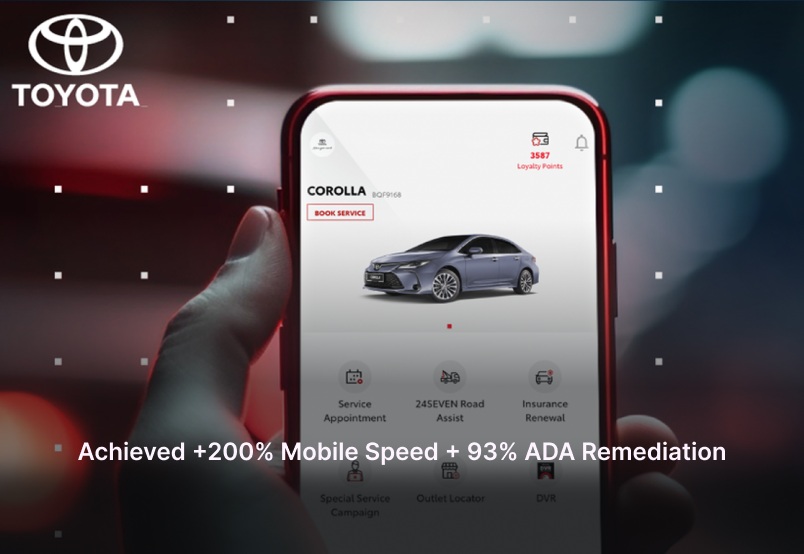
For Toyota, the agency describes progressive web app engineering that improved mobile performance and addressed accessibility problems. For Icons.com, its CRM and data work connected previously fragmented channels. These are different briefs with a shared feature: buying more attention would have left the underlying obstacle intact.
Each handoff is a place to inspect. This is an editorial illustration, not a measured conversion funnel.
04 The agency that reduces agency fees
There is an amusing complication in selling expertise: sometimes the useful advice is to change how much outside help a client needs. iCrossing reports a 60% agency-fee reduction after redesigning a manufacturer’s delivery model. A separate healthcare engagement used a hybrid model and reported 32% lower costs without new hires.
Manufacturer engagement
Healthcare engagement
Separate client cases. Agency-reported outcomes; different scopes and baselines.
Those figures are examples, not a price list or a forecast. They suggest a useful procurement habit: ask which costs a proposed change removes, where the work moves, and who maintains quality afterward. A cheaper supplier can leave an expensive process untouched.
05 Discovery gets stranger. The question survives.
AI search has complicated the original bargain. An industrial manufacturer could become more visible while receiving fewer visits. iCrossing describes combining search, AI visibility and traffic reporting to explain that divergence. The dashboard needed a wider view of discovery.
Its iX Accelerator platform supports connected data, workflows and optimization. The company also announced three 2026 Financial Services Forum awards with American Express for work spanning AI search and generative AI. These developments extend a familiar concern: what happens between being noticed and being useful?
A useful market comparison puts iCrossing alongside integrated digital agencies and transformation consultancies, with specialist search firms and internal teams as other options. Its particular proposition is continuity across the assignment: the team studying demand can also work on the destination and its supporting systems. Buyers should test that proposition in the proposed staffing plan. Shared branding across disciplines matters less than whether the people doing the work share decisions, evidence and responsibility.
For a buyer, iCrossing makes most sense when the problem crosses departmental boundaries. A narrow assignment may need only a specialist. An integrated engagement needs access to systems, usable data and people empowered to change the journey. Without those conditions, adding disciplines can add meetings.
The part anyone can copy costs no acquisition budget: follow one customer task from discovery to completion. Mark every wait, repetition and unclear next step. Then assign responsibility for the whole trip. The click was always a beginning.
iCrossing / Client work / Insights & news / Technology