A roof can be late before anyone orders the tiles. The builder has a milestone date. The roofing contractor has a requested delivery date. Somewhere between the two sits a supplier trying to decide what to manufacture. Each company may have a perfectly respectable system. The trouble begins when those systems disagree.
This is the territory occupied by Hyphen Solutions: the space between businesses building the same house. Its software connects schedules, purchase orders, documents and payments across residential construction. The interesting question is how information gets from the person who changes a plan to the person whose truck is already being loaded.
- The customer: homebuilders and the suppliers, manufacturers and trades working with them.
- The machinery: BuildPro for builders, SupplyPro for trading partners, plus accounting, design and payment products.
- The bet: fewer expensive surprises when everyone can see the work coming.
A network with work to do
Hyphen says its software touches one in three new American homes. Its current website describes more than 126,700 users and 18,000 suppliers. Stone Point Capital, an investor, says the company serves 20 of North America’s top 25 homebuilders. These are reported reach figures, rather than evidence that every customer buys every product.
The distinction matters. Hyphen sells a collection of connected tools. A builder might need construction scheduling; a supplier might need orders delivered into an existing business system. The commercial opportunity lies in making those two purchases useful to each other. A schedule becomes more valuable when the company delivering the materials can act on it.
a Hyphen solution
Company-reported adoption. Illustration shows proportion, not individual homes.
The purchase order leaves the office
BuildPro manages the builder’s side: scheduling, purchasing, documents, inspections and related construction tasks. SupplyPro gives suppliers and trades access to the work they need to fulfill. SupplyPro Connect moves purchase-order information into supplier systems, reducing the ritual of reading an order in one place and typing it into another.
In Hyphen’s HomeTeam Pest Defense case study, Deborah Silver describes the earlier arrangement: “There was too much phone calling and emailing.” Orders had arrived through fax and email. With the integration, purchase orders populated HomeTeam’s system automatically. It is a pleasingly ordinary improvement: fewer opportunities to introduce a mistake while moving information.
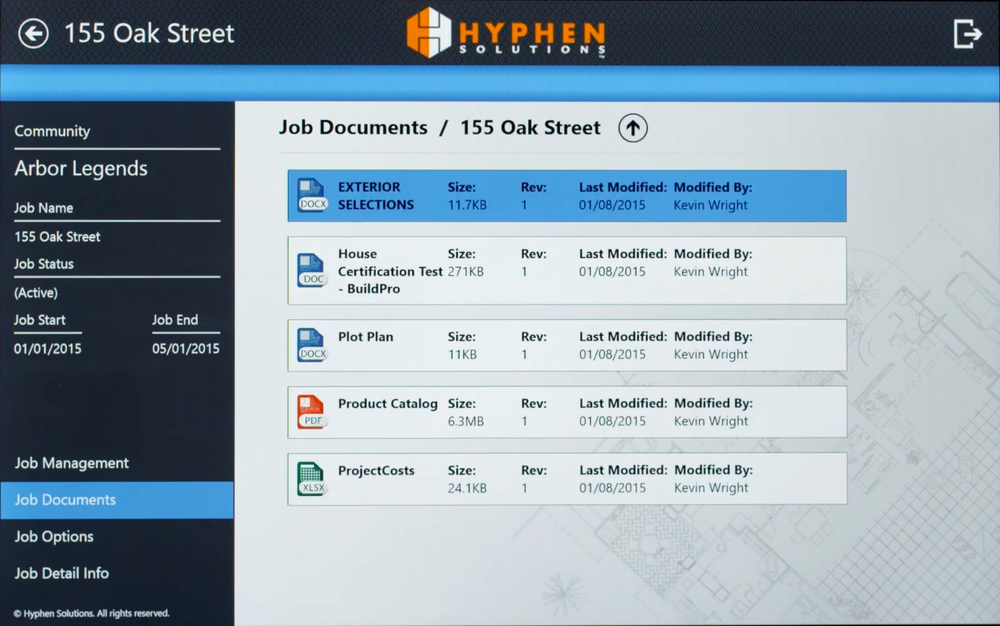
The wider suite follows adjacent jobs. BRIX supplies builder accounting and enterprise resource planning. BuilderGM addresses smaller and mid-sized builders and connects with QuickBooks. Hyphen Wallet handles payment workflows. Warranty tools keep requests moving after closing. Customers can choose around their existing operations; the important buying exercise is deciding which connections they actually need.
The roof-date experiment
Eagle Roofing offers a concrete example. According to Hyphen’s April 2025 customer story, late information encouraged last-minute orders and excess production. Eagle adopted a custom reporting subscription, sending reports to analysts every two weeks and onward to customer-service teams. Those teams could identify awarded projects with missing orders.
A 14-day disagreement between roof-delivery dates triggered follow-up. The company reported less excess stock and better cash management. The lesson is procedural: compare the dates, spot the mismatch, call someone. Reporting gave employees a reason to intervene before an uncertain order became an awkward delivery.
- 01Compare the dates
- 02Find the mismatch
- 03Give someone the next move
An editorial distillation of Eagle Roofing’s reported workflow.
The bill travels too
There is a cost to connecting the parties. Hyphen’s public supplier agreement lists setup, monthly license and maintenance, and purchase-order transaction fees. The amounts sit in the customer’s order form. Wallet fees depend on payment choices and configuration. Buyers should calculate the whole workflow, including transaction volume and implementation effort, before comparing subscriptions.
That practical emphasis also explains the ownership story. GreyLion first invested in 2016. In October 2020, Stone Point invested alongside it; financial terms were undisclosed. The announcement identified integrated payments, additional products and acquisitions as priorities. Money moving through construction was becoming a larger part of the software proposition.
“If you elongate your construction cycle, you’re going to waste money.”
Felix Vasquez, CEO · October 2025
The builder’s CIO saw the gap
Hyphen dates its founding to 1999 and identifies David B. Deniger as its founding general partner. Its history also includes a 2010 management-led purchase of almost 70 percent of its partnership interests. The company has had several ownership chapters, while continuing to concentrate on residential construction and the businesses that serve it.
CEO Felix Vasquez previously served as D.R. Horton’s chief information officer. His doctoral dissertation examined interorganizational information systems in residential construction. It is an unusually specific academic interest for someone running a company devoted to getting separate businesses to coordinate. His biography dates his work guiding Hyphen’s supply-chain vision to March 2002.
Hyphen’s 2022 acquisition of Chameleon Power extended its reach into visualization and virtual showrooms. Now a buyer’s material selections sit within the broader product portfolio alongside the less photogenic business of orders and accounting. The range reflects how many different decisions eventually arrive at the same construction site.

Give the exception an owner
The market has alternatives. ECI’s MarkSystems also handles production-builder scheduling, purchasing, accounting and warranty. Hyphen’s distinctive proposition is its builder-supplier network and the connected products around it. For a buyer, the useful comparison starts with existing accounting software, the kinds of homes being built, and whether trading partners will participate. An extensive product catalog only helps if the necessary information actually passes between the selected tools. Compatibility deserves close attention: Constellation HomeBuilder Systems appears on Hyphen’s partner list even as its products occupy neighboring territory.
In September 2026, Hyphen described Dash, an AI assistant embedded in four of its products. Its stated job is to answer questions using schedules, orders and operational activity. That direction makes sense for a company already holding the records. It also leaves a familiar dependency: useful answers require useful information.
The transferable idea is simple enough to try without buying anything. Pick one recurring handoff. Agree which record governs it. Decide who investigates a discrepancy. A shared screen cannot rescue stale dates or a team that ignores them. Hyphen’s opportunity lives in making that small discipline repeatable across the businesses assembling a home.