A salary is a peculiar thing to make public by accident. You may be quite happy with yours. You may even think it deserves a small parade. Still, receiving a payment should not automatically invite strangers to inspect the rest of your financial life. Howard Wu has spent years working on the mathematics, software and organizational plumbing behind that unremarkable preference.
Wu co-founded Aleo, a blockchain built around zero-knowledge cryptography, and leads Provable, the company building its infrastructure and confidential financial products. His work asks a deceptively small question: how much must a system learn about you before it can believe you? A correct payment needs verification. A public autobiography of the payer’s finances seems an extravagant extra.
That question has carried him from Berkeley research to a live network, developer tools and, more recently, a wallet called Shield. The route includes co-authored papers, a change of job title and years of engineering. Privacy sounds clean in a sentence. In software, it arrives with dependencies.
The problem on the Berkeley desk
At the University of California, Berkeley, Wu studied computer science and applied mathematics, then completed a master’s research project in electrical engineering and computer sciences. His 2018 report concerned DIZK, a distributed zero-knowledge proof system. Alessandro Chiesa was his research advisor; Dawn Song was the second reader. The project was firmly situated in the difficult business of making cryptographic ideas run on actual computers.
Zero-knowledge proofs allow one party to establish that a statement is true without revealing the private information behind it. Producing such proofs, however, can demand considerable computing resources. The machinery that protects information must still find somewhere to do its work.
DIZK addressed a specific bottleneck: proof generation constrained by the memory of a single machine. Wu and his co-authors Wenting Zheng, Chiesa, Raluca Ada Popa and Ion Stoica distributed that work across a cluster. Their USENIX Security paper reported computations of up to billions of logical gates, with improvements over the prior systems they evaluated.
There is something revealing about this early work. The obstacle was concrete: memory, machines, the size of a computation. It helps explain why Wu’s subsequent career is as much about engineering usable systems as describing the virtues of privacy. An elegant guarantee has limited social life if nobody can afford to produce it.
Spread proof generation across a cluster of machines.
Extend private computation to programmable applications.
A paper acquires a payroll
The next research thread was Zexe, co-authored by Sean Bowe, Chiesa, Matthew Green, Ian Miers, Pratyush Mishra and Wu. It appeared at the 2020 IEEE Symposium on Security and Privacy. Its subject, decentralized private computation, points toward a broader ambition than a confidential transfer: applications whose execution can be checked without exposing their private contents.
Wu has described receiving interest in Zexe from Vitalik Buterin and decentralized trading projects. He has also recounted spending much of 2019 and early 2020 exploring how to deploy the construction on Ethereum. His account turns on an architectural frustration: building privacy into a system whose defaults expose activity was proving difficult.
Those experiments helped push him toward a separate blockchain. In December 2019, Wu, Michael Beller, Collin Chin and Raymond Chu founded Aleo Systems. The company’s name, Wu later explained, expands to Autonomous Ledger Executions Off-chain. Cryptographers do occasionally allow themselves a pronounceable word.
By 2020, the project was introducing developer software, including the Leo programming language. The ambition was to let developers write private applications without assembling the underlying cryptographic machinery themselves. A language is a practical admission about adoption: most people who might build something useful have other things to do than become specialists in proofs.
Wu’s early writing placed this work in the context of the wider web. Services collect information to personalize experiences; users surrender it to obtain the experience. He wanted a different arrangement, with computation and verification doing more of the work that collecting and storing personal data had traditionally done.
“Because, private data should be just that - private.”
Howard Wu, 2020
By 2021, he was developing that argument in an essay about a privacy layer for the web. The problem extended to incentives: a service and its users can want different things from the same data. Repeated consent banners offer a familiar illustration. The internet has made requesting permission remarkably efficient; making the request intelligible remains a less consistent achievement.
Wu’s proposed direction gave the user’s device a larger role in computing over private information, while another party checked the result. That aspiration connects the academic work to the company. It changes the practical question from how much information a service can gather to how little it needs to receive.
The title changes. The work continues.
In November 2022, Aleo appointed Alex Pruden chief executive. Pruden had been chief operating officer; Wu moved from CEO to chief technology officer. For a founder, this is a meaningful edit to the business card. It is also a reminder that building a network creates different jobs as the work grows.
The development company and the network’s foundation would become distinct parts of the project. In a January 2024 conversation with Pruden, Wu discussed the evolution of the technology and its design decisions. Pruden described the foundation’s responsibility toward a decentralized network, while Wu continued his technical involvement alongside his company role.
These distinctions matter to understanding what Wu does now. He is the co-founder of Aleo and CEO of Provable, the development company within its ecosystem. A live network has participants and responsibilities that extend beyond the person who helped start it. Founding is an event; operating the surrounding software is a continuing assignment.
Aleo mainnet launched on September 18, 2024. Its announcement described years of work by contributors, testnet participants, developers, provers and validators. Leo was part of the stack, alongside the proof systems and consensus software. The research had acquired an address where applications could actually run.
A launch supplies a date for the timeline. It also changes the questions. Once software is live, the discussion moves toward developer experience, reliability and what people will choose to build. Research can establish a possibility. A network has to make room for repeated use.
Privacy gets a front door
Wu’s public work in 2025 increasingly returned to payments. Payroll and business transfers made the argument tangible. Colleagues generally need to know that the company pays them; they have fewer reasons to inspect one another’s bonuses. Companies likewise have reasons to keep supplier relationships and financial arrangements out of a public viewing gallery.
In February 2025, Provable and the Aleo Network Foundation announced an integration with Google Cloud. The collaboration included a validator role and work bringing blockchain data into BigQuery. Infrastructure partnerships occupy a different register from a cryptography paper, but they address a related concern: give developers something workable beneath the application.
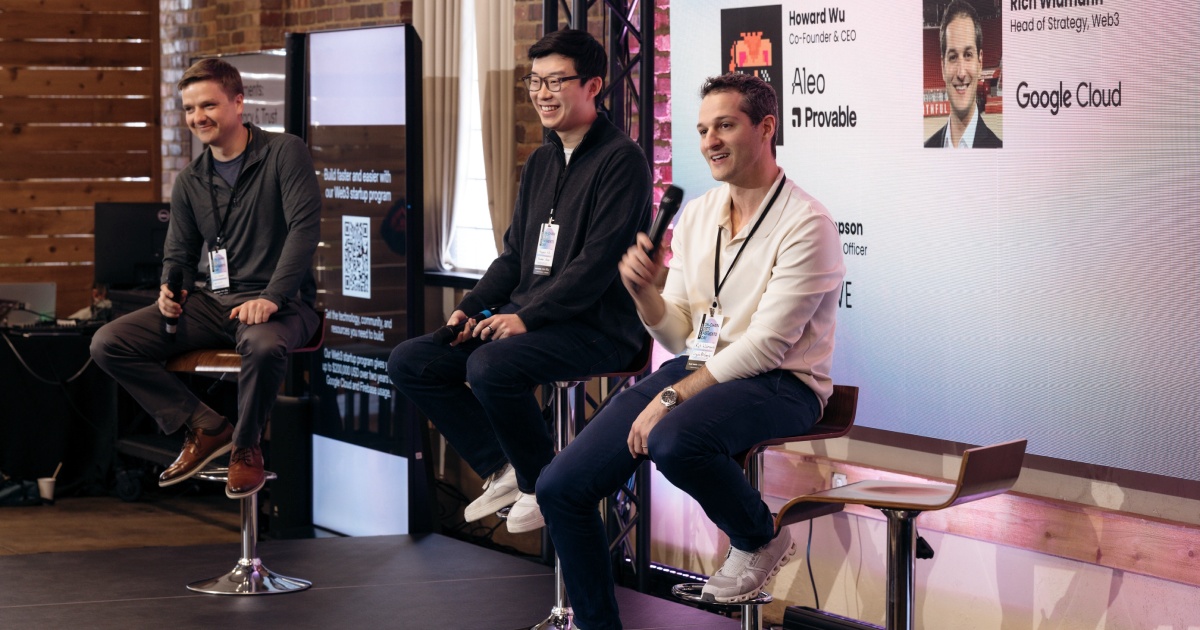
At On-Chain B2B Payments Day, Wu appeared on a panel with Google Cloud and Bitwave. The discussion addressed the exposure of commercial information on public blockchains and the need to share records selectively. There is a useful ordinariness to the setting: microphones, stools, a screen full of company names. The subject was what a finance team might actually need.
Then the product work moved closer to the person holding the phone. In November 2025, Provable announced an agreement to acquire Leo Wallet from Demox Labs. Along with the wallet came responsibilities for the infrastructure and integrations people already depended on. Taking over an existing product means inheriting expectations as well as code.
On February 17, 2026, Provable launched Shield Wallet. Its design puts confidentiality at the starting point, protecting balances and transaction details through the Aleo stack. The wallet is self-custodial: users hold the keys to their assets. The proposition is easier to grasp than the underlying mathematics. Open an application; move money; keep control of what becomes visible.
In April, Provable asked Leo Wallet users to move to Shield and said new feature development would concentrate there. It also said it was covering network fees for private transfers. That is the sort of product decision that determines whether a capability feels accessible. A user’s patience can expire well before a technical explanation reaches its second acronym.
Who gets to see the books?
In August 2026, Provable opened early access to Shield Swap, a confidential trading venue aimed at institutions, businesses and governments. The design distinguishes market information from participant information: prices, trade sizes and pool reserves remain verifiable, while identities, portfolios and links between transactions are protected.
“Serious trading firms do not publish their books or broadcast their positions,” Wu said. The announcement described encrypted compliance records and selective disclosure through view keys. It anticipated a public launch in the fourth quarter of 2026. Early access marked a product stage, with the wider release still an announced plan.
Prices · trade sizes · fees · pool reserves
Identities · balances · portfolios · transaction links
Public verification of market activity; selective disclosure of protected records.
The distinction carries Wu’s original question into a specific commercial setting. An auditor, a counterparty and a curious stranger have different reasons for asking to see financial information. Software can be designed around those differences. The promise depends on getting both the cryptography and the experience right.
Across Wu’s research, languages, network work and products, the recurring ambition has become increasingly recognizable. Let a system establish what it needs to establish. Give people a usable way to decide what else gets disclosed. After years of equations and engineering, the desired result is almost pleasantly uneventful: the payment arrives, the business continues, and your financial life keeps its own company.