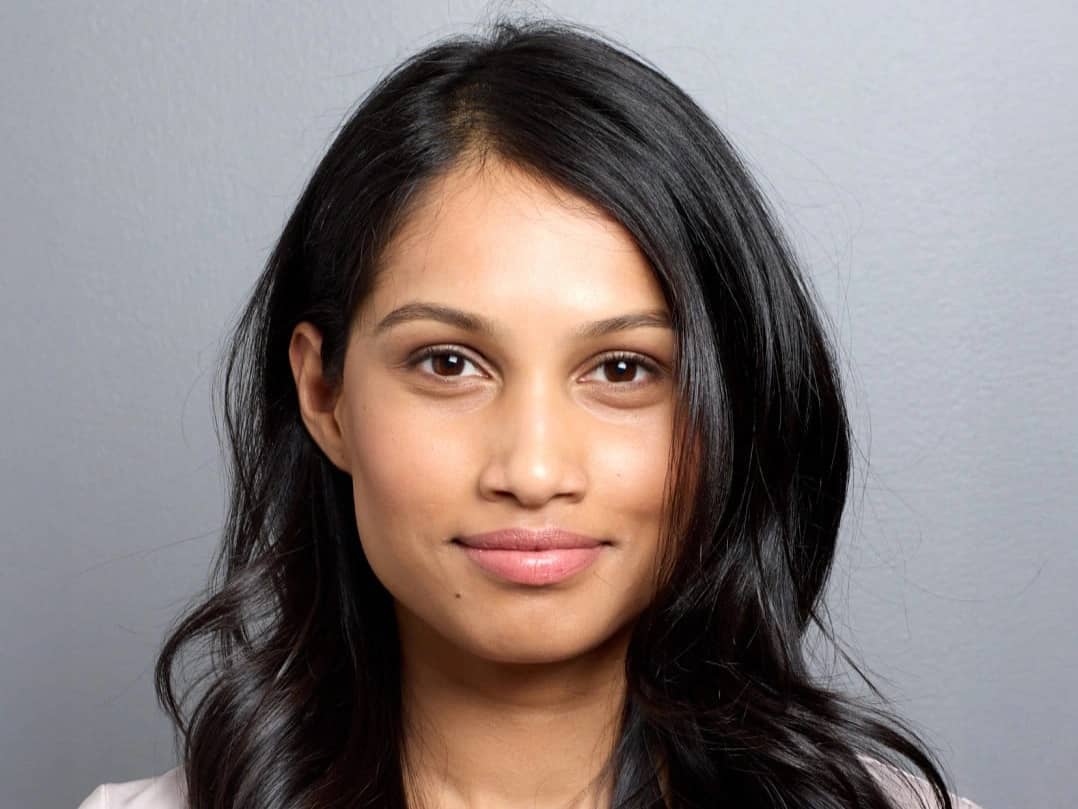
The Prover
Before Uma Roy was pitching investors on zero-knowledge proofs, she was a teenager walking into MIT labs - not as a student, but as a high schooler who had already talked her way into doing research with graduate students. She published a paper from it. Then she enrolled.
That pattern - arriving somewhere before she was supposed to be there - is the throughline of her career. She built an AI research record at Google Brain without a PhD. She became a founding engineer at Gantry while the startup was still finding itself. And in 2022, she co-founded Succinct with John Guibas to solve a problem that most people in cryptography quietly assumed required a specific kind of priesthood: making zero-knowledge proofs usable by ordinary software engineers.
They were right that it was hard. They were wrong about who could fix it.
No one thought ZK could be easy. The past 3 years since starting Succinct have been a wild journey with so much blood, sweat and tears - but I wouldn't trade it for anything.
Uma Roy, X / Twitter @pumatheumaWhat SP1 Actually Is
Zero-knowledge proofs let one party prove to another that a computation happened correctly - without revealing any of the underlying data. Useful for blockchain scaling. Useful for privacy. Useful for verifying AI outputs. The catch: building ZK circuits for real programs used to require teams of expert cryptographers and months of circuit-writing.
How SP1 Changes the Equation
SP1 is a RISC-V zero-knowledge virtual machine. Instead of writing cryptographic circuits from scratch, developers write standard Rust code compiled to RISC-V. SP1 takes that program and generates a zero-knowledge proof of its correct execution - automatically. The cryptography is already handled. You just write software. It's the difference between soldering your own CPU and writing an app.
SP1 is 100% open-source. It's built on STARKs using the Baby Bear field. And as of early 2025, it's the fastest zkVM in the world for key workloads - 28-30x faster than comparable alternatives. Ethereum blocks that once took minutes to prove now take under 12 seconds with SP1 Hypercube, the latest iteration of the system.
The Math Kid Who Wanted Results
Uma Roy grew up drawn to mathematics with encouragement from her father. By high school she was doing MIT-level research. Her MIT master's thesis was a measured, careful piece of work: using machine learning to estimate covariance matrices for real-world problems. Elegant. Useful. Publishable.
And, it turned out, not enough for her.
She joined Google Brain as an AI Resident, publishing work on NLP and cross-lingual learning - the kind of research that gets cited and then sits in a PDF archive. She left for Gantry, an ML infrastructure startup, because she wanted to be closer to something being built. She joined as a founding engineer. She learned what company-building felt like from the inside - sustainable engineering culture, honest communication, products that evolved from data rather than intuition.
When she co-founded Succinct, she brought that operating instinct with her. The company runs as a product-driven organization. Shipping speed is legendary: Roy has described her team as having "true wizards across the stack" who ship faster than she expected even as CEO.
From Research to Revenue
In March 2024, Succinct closed a $55M raise led by Paradigm - the firm known for backing foundational crypto infrastructure. Robot Ventures, Bankless Ventures, Geometry, and ZK Validator also participated. The signal was clear: this wasn't a bet on a technical demo. It was a bet on a platform.
The Succinct Network - launched in December 2024 - turned SP1 from a software project into an economic system. Anyone can now run a prover node, competing to generate ZK proofs in exchange for fees. The auction mechanism has pushed proving costs down 10x as competition heats up. By May 2026, provers had earned $130,000 in fees, representing $1.7 million annualized.
The Succinct Network will take SP1 from a great piece of open-source software to a movement, where anyone can join to help prove the world's software. Prove with us.
Uma Roy, X / Twitter @pumatheuma, December 2024SP1 is already securing billions in total value locked across major L2 networks. Mantle - an optimistic L2 with $2.2 billion TVL - is transitioning to a ZK rollup using SP1. Solana has integrated an SP1 verifier. The adoption curve is steep.
Angel Before the Prover
Alongside building Succinct, Roy has been placing bets on adjacent territory. She's an angel investor in Cursor (the AI coding tool that has become default infrastructure for developers), Cognition (AI software engineering), Eigenlayer (restaking), and Conduit (rollup infrastructure). The portfolio isn't random - it maps the stack that Succinct's proving layer sits underneath. She's investing in the applications while building the substrate.
On Intents, Bridges, and What Users Actually Want
Roy thinks about user experience with unusual specificity for someone building cryptographic infrastructure. At Variant Fund, she laid out her framework for intent-based architecture: rather than users declaring what to do ("swap X for Y"), intents state what outcome is desired ("give me as much ETH as possible for this USDC"). The system figures out the how.
Her security argument is equally direct: "Bridges get hacked all the time." The move to ZK-based verification isn't just a performance upgrade - it's the replacement of trust assumptions with cryptographic proofs. No bridge operator to bribe. No relayer to compromise. Just math.
The Road Ahead
Roy declared 2025 the biggest year in Succinct's history - and then immediately said it wasn't enough. "Jobs not finished." The 2026 roadmap, she's said publicly, has even more ambitious plans. The PROVE token launched as part of the Succinct Network's incentive design. SP1's proving capability now extends to Ethereum consensus, Bitcoin state, and cross-chain swaps - workloads that span the entire web3 stack.
She has spoken at ETHDenver, Pragma San Francisco, Pragma Denver, TOKEN2049 Singapore, and traveled from Hong Kong to Seoul bringing the ZK message to developers globally. The talk at TOKEN2049 was titled "Truth in a Post Truth World" - a hint at what she sees as zero-knowledge technology's largest possible application: cryptographic proof as a foundation for trustworthy information, not just trustworthy software.
Uma Roy started doing research at MIT before she was enrolled. She's been arriving early ever since.