In 1988, a six-year-old boy in Greece was given an Amstrad computer. It had a green screen, a BASIC manual in English and, as far as his parents expected, the useful ability to play games. Kostas Chalkias found another use. He read the book, copied instructions and began to make a game of his own, with a ball knocking down blocks. At seven, he could explain what the program was doing. The machine had stopped being a toy and become a system he could question.
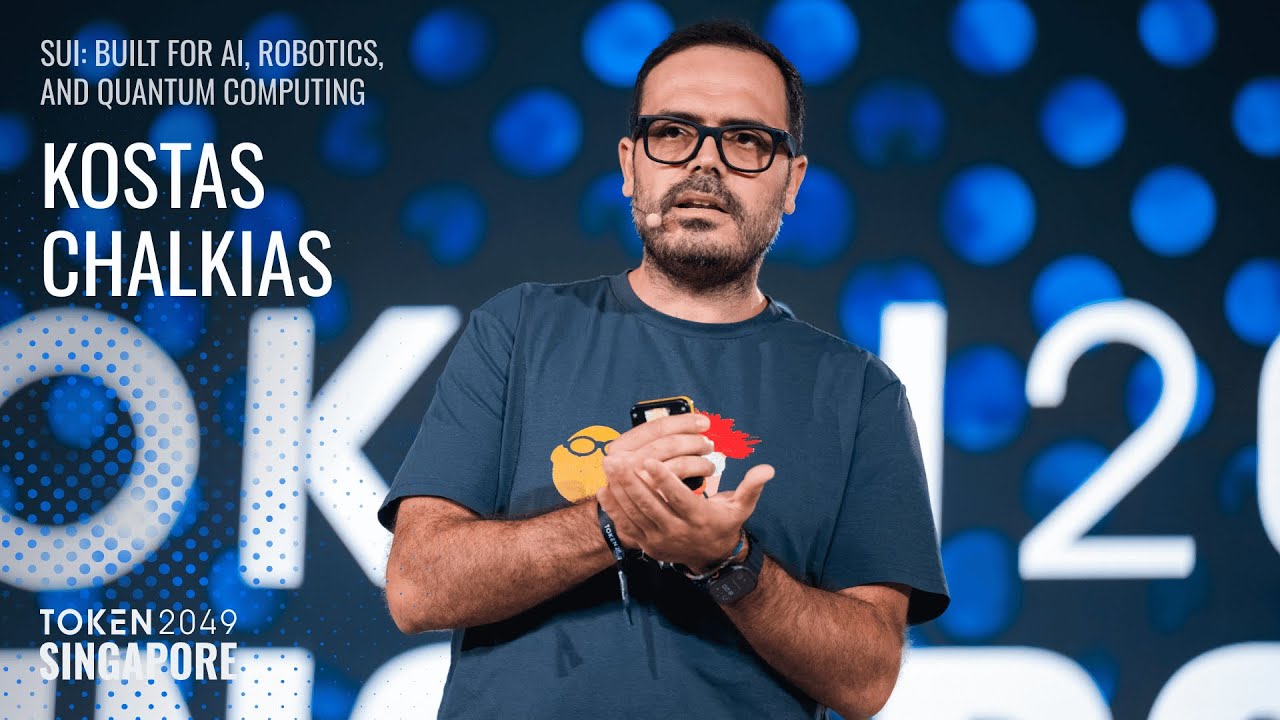
Nearly four decades later, Chalkias asks much larger systems similarly stubborn questions. At Mysten Labs, the company he co-founded in 2021, he is chief cryptographer. His work reaches into Sui, a blockchain designed to make digital transactions fast and programmable, and into tools for identity, storage and security. A cryptographer's job can look remote from daily life until a password fails, a transaction is disputed or an AI assistant remembers something it should not. Then the abstract becomes uncomfortably personal.
A village, a radio signal, a green screen
Chalkias is from Ierissos in Halkidiki, a corner of northern Greece near Mount Athos. In a 2026 interview, he recalled that his father ran what he described as the first pirate radio station in Halkidiki. Electronics, then, were part of the family atmosphere before the Amstrad arrived. His parents bought the computer when he was six. He remembers the accompanying programming book as the first English book he read. The story has a pleasingly domestic start: a father interested in radio, a child interested in games, and a manual that opened a trapdoor.
He was fond of chess and backgammon, and of thinking in probabilities. At sixteen, he worked on a fishing boat, following an occupation his grandfather knew and found himself considering the odds behind the catch. He has told the story with the mild amusement of someone who knows that most teenagers on a fishing boat would have focused on the fish. The habit was consistent: observe a process, look for the rule, try to improve it. Cryptography would eventually give that curiosity a rigorous profession.
He studied applied informatics at the University of Macedonia. A professor saw his strength in mathematics and computer science and encouraged him toward cryptography. Chalkias went on to doctoral work involving identity-based and timed-release encryption. The names sound forbidding, but the questions are plain enough: who can unlock information, under what conditions, and how can anyone else verify the answer? From the start, the mathematics had to survive use by actual people.
A career built in public
Research papers and competitions became part of how Chalkias made himself visible. He says they mattered to his eventual move to Facebook. Before that, he worked with Mike Hearn, an early Bitcoin developer who later became a lead engineer at R3. Their work included post-quantum signatures, a way of preparing digital ledgers for a future in which quantum computers might threaten today's cryptographic methods. A 2018 paper on blockchained post-quantum signatures lists Chalkias as its first author and Hearn among his collaborators.
At a conference where Chalkias presented research, another future colleague was watching: Sam Blackshear, sent by Meta to scout talent. Chalkias later learned that Blackshear had written an enthusiastic internal account of the encounter. That conference talk helped set an interview process in motion. It also began a professional connection that would outlast the project on which the two first worked together. Chalkias has since urged younger programmers to enter competitions and apply for demanding jobs early. He has said he wished he had tried for Facebook at twenty-five instead of thirty-five.
At Facebook, later Meta, he led cryptography for Libra, the company's proposed digital-currency project. He also described work connected to WhatsApp and Novi. Libra was retired after regulatory and other obstacles. That ending could have closed a chapter neatly, but careers rarely honor neat endings. Evan Cheng, Adeniyi Abiodun, Sam Blackshear, George Danezis and Chalkias founded Mysten Labs in 2021, carrying forward a shared interest in building a different digital infrastructure. Blackshear created the Move programming language used by Sui; Chalkias brought the cryptographic perspective.
The lock should not become the obstacle
It is tempting to think of cryptography as a collection of locks. Chalkias's work shows the other half of the problem: people have to use the locks correctly. A wallet can be secure in theory and daunting in practice. Sui's zkLogin, to which he has contributed, uses familiar online credentials together with zero-knowledge proofs. The idea is to let a person access a blockchain account without turning every first visit into a seminar on secret keys. The proof does careful work behind an ordinary-looking sign-in.
That concern for use also helps explain Sui's design. In a 2022 discussion, Chalkias described its object-centered approach: digital assets can be treated as distinct objects, and some transactions can move without waiting for the same full consensus process required elsewhere. He spoke about the Narwhal and Tusk consensus work and about cases that can take a faster route. Readers need not memorize the architecture to understand the point. His professional interest lies where a clever protocol meets the impatient reality of someone trying to get something done.
The research still matters. Chalkias has worked on zero-knowledge proofs, multiparty computation and proof-of-reserves questions. His Sui biography credits him with more than fifty papers and eight patents. Those numbers speak to sustained output, though the more revealing detail may be his readiness to examine how a system can break. In his own account, a cryptographer may try to crack a design, like a white-hat hacker, or devise one that resists attack. Often the same person has to do both.
One episode captures his appetite for checking the checkers. Chalkias has described work on proof of reserves and solvency, methods meant to let a financial service demonstrate what it holds and owes. The subject became painfully concrete during the market failures of 2022. A mathematical proof can be elegant on paper; the difficult work is deciding what facts the proof must actually cover. An omitted liability does not become harmless because the equation around it is beautiful.
When the software remembers you
By 2026, Chalkias was talking increasingly about AI. In an August appearance on The Starting Block, he argued that more capable AI makes continuous, automated auditing of blockchain code important. A single review captures a moment; a changing system requires continued attention. The conversation moved from keys and wallets to Walrus Memory, an approach to storing information that an AI assistant might carry between models or services. The appeal is obvious to anyone who has had to explain the same preferences to a new tool. The risk is equally familiar: a machine's memory can become a record someone else controls.
Chalkias has argued that AI's bottleneck is not only computing power. Memory matters too. In a June interview, he framed the problem around models that should be able to learn about their users while preserving privacy and allowing information to move. This is still an ambition, not a settled answer. It does, however, fit the pattern of his career. From timed-release encryption to digital signatures and easier logins, he keeps returning to authority: who may do what, what can be proved, and who gets to keep the proof.
His public life has a second geographical thread. Mysten Labs is headquartered in the United States, while Chalkias has spoken about building a stronger cryptography community in Greece. The 2026 Outliers conversation brought him back to the places and choices that shaped him. He described a childhood among books, games and improvised electronics, a professor's steer toward cryptography, and the competitions that widened his opportunities. The account is unusually good at showing how global technical careers can begin in small, specific rooms.
There is a nice symmetry in the fact that Chalkias's father sent signals over local airwaves while his son now works on ways to verify messages moving through vast digital networks. The comparison should not be pushed too far. One was a pirate radio station; the other involves formal proofs and distributed software. But both belong to a family history in which technology is something to open, test and make one's own. On that first Amstrad, a ball bounced across a screen because a child learned to give it rules. Today Chalkias works on rules for systems whose mistakes can travel much farther. The green screen is gone. The urge to see exactly what happens next remains. Perhaps the most consistent feature of his story is his insistence that a system should be examined before people are asked to trust it. That is a useful instinct whether the system is a small game, a currency network or an assistant carrying pieces of someone’s life between services.