The first machines Adeniyi Abiodun had to make trustworthy were a long way from a blockchain. They sat at oil and gas sites, far from the people who needed to know what was happening there. His job after university was to put hardware together for remote monitoring and write the software that made it useful, down to parts of the operating system. For a young engineer who had briefly considered astrophysics, this was a satisfyingly earthly problem: a distant machine, a reading, a decision.
He would spend the next two decades changing the machinery while keeping the question. At banks, a system had to tell traders and risk managers what their positions meant. At a Bitcoin mining venture, equipment had to produce a result other people could verify. At Meta, a research team wanted payments to cross the internet as casually as messages. Today, as co-founder and chief product officer of Mysten Labs, he works on Sui, a blockchain built for applications that need to move and manage digital assets. The surroundings have become more abstract. The demand for something people can actually use has not.
The long way from London
Abiodun was born to Nigerian parents and grew up in Nigeria until he was seven. The family moved to Britain while his father pursued a doctorate at the University of Aberdeen, then settled in London. He has described a childhood with three siblings, a brother and two sisters. At Queen Mary University of London, he initially chose astrophysics, drawn to the universe but eventually more interested in work whose results he could touch. Electronic engineering with computer science gave him that.
The oil-field job came first. Then he crossed into finance, writing trading and risk systems at JPMorgan and HSBC. These were substantial systems with immediate stakes: positions, exposure, decisions. He enjoyed parts of the work, but the repetition began to trouble him. The question was no longer whether he could make a system function. It was whether the system was opening up anything new.
- LondonOil-well monitoring
- BankingRisk and trading systems
- 2011–12Bitcoin mining
- MetaLibra and Diem
- 2021 onwardMysten Labs and Sui
A colleague’s interest in Bitcoin sent him to Satoshi Nakamoto’s paper in 2011. Abiodun began mining that year and built a mining business in 2012. His friends wanted to mine too, so he started running hardware for them. He later moved the business to California. He has joked about selling most of his early Bitcoin: if he had kept it, perhaps he would not be doing this work at all. It is the rare crypto regret that comes with a career attached.
The attraction was larger than the price of a coin. He saw an infrastructure that separate organizations could run without handing control to one of them. His own mining work was a way into that system, though eventually he wanted to see what else it could do. Oracle and VMware gave him chances to work on blockchain products for enterprises. They also showed him how difficult it can be to persuade institutions to share infrastructure when each wants to own the controls.
The project inside the locked building
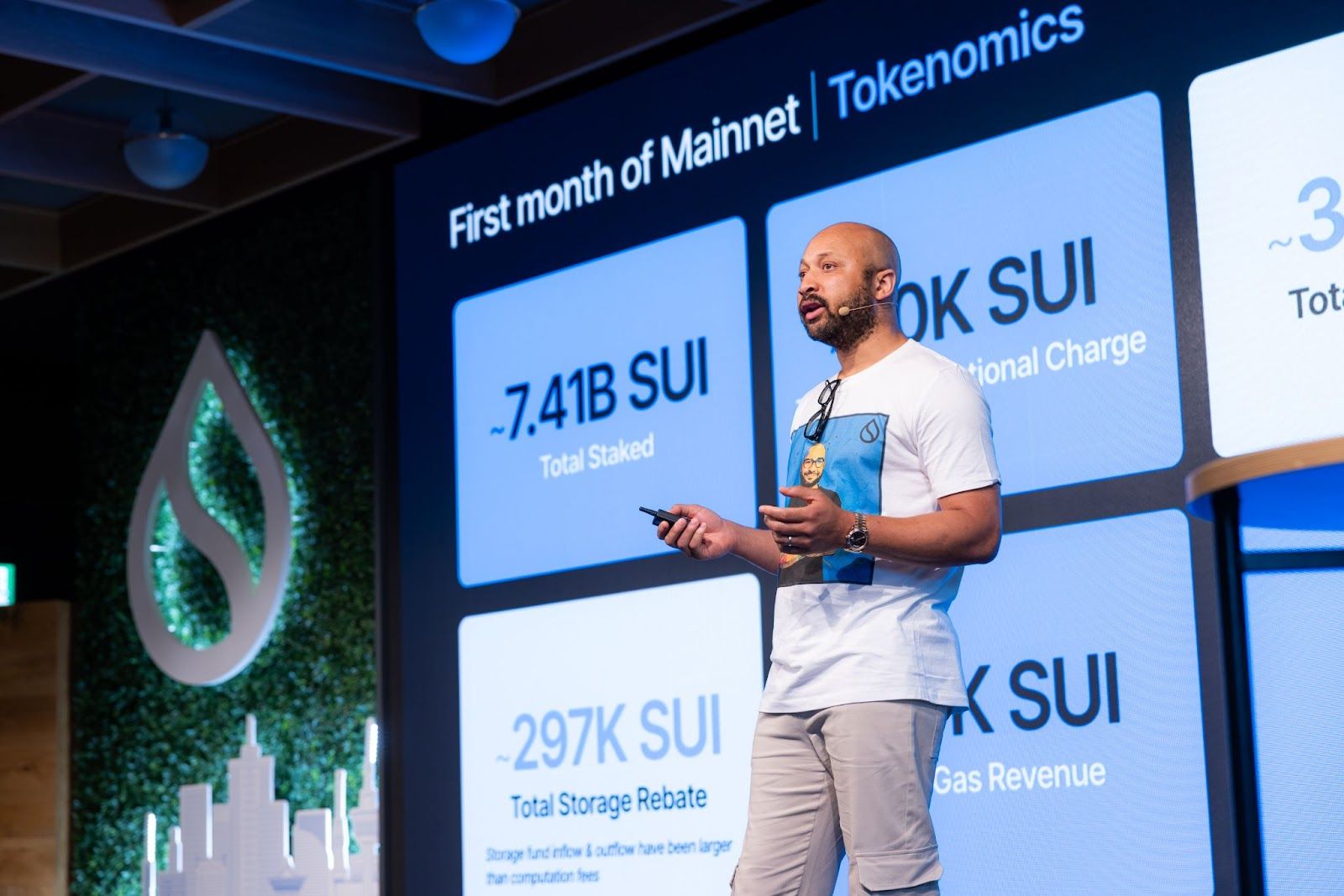
Meta’s Libra project offered a different scale. Abiodun joined because the team wanted to make sending money as easy as sending an email. The group brought together researchers, engineers and product leaders to design a global payment network and the programming language Move. Abiodun came in to work on decentralized identity, then shifted toward product work within the blockchain effort. He has described his strength as translating difficult science into something a consumer can use every day.
In one interview, he recalled that the Libra team worked in a separate building, protected by its own key-card access. The detail is almost comic in retrospect: a team designing open financial rails behind a locked door. It also captures the pressure surrounding a project that would have sat near Facebook’s vast user base. Abiodun has been frank that the team did not get its network launched and that public unease about Facebook’s power was understandable.
“I care about consumers.”Adeniyi Abiodun, on turning technical research into products
That unrealized effort became the founding story of Mysten Labs. Abiodun, Evan Cheng, Sam Blackshear, George Danezis and Kostas Chalkias had worked together on Libra and Diem. In 2021 they formed a company of their own. Each brought a different part of the puzzle: Cheng’s compiler and engineering background, Blackshear’s Move language, Danezis’s distributed-systems research, Chalkias’s cryptography, and Abiodun’s product focus. He has said that building with friends was one of the pleasures of the move.
Sui, the network they built, organizes digital assets as objects. Some transactions can be handled independently, allowing work to happen in parallel. A user need not know these details to buy an item in a game or move a payment. That ignorance is, in a sense, the product goal. Abiodun’s job spans economics, design, marketing, engineering and product teams, and he has emphasized the developers who must turn underlying capabilities into things people choose to use.
What a product chief measures
It is tempting to describe any new blockchain with a speed figure. Abiodun tends to return to a different set of measures: whether a developer can reach an audience, whether an application feels safe, whether the cost and the sign-up process let ordinary people take part. In a 2025 discussion of Sui’s progress, he argued that announcements matter less than builders shipping products and users actually showing up. That is a useful antidote to the industry’s habit of counting promises as progress.
The range of products he discusses is broad: games that treat digital items as things a player can own, payments that work across borders, and tools that let developers avoid asking newcomers to understand a wallet before they understand the service. It is also a familiar tension for him. More capability can make infrastructure more complicated. Product work is the repeated act of deciding which complication the user should ever have to see.
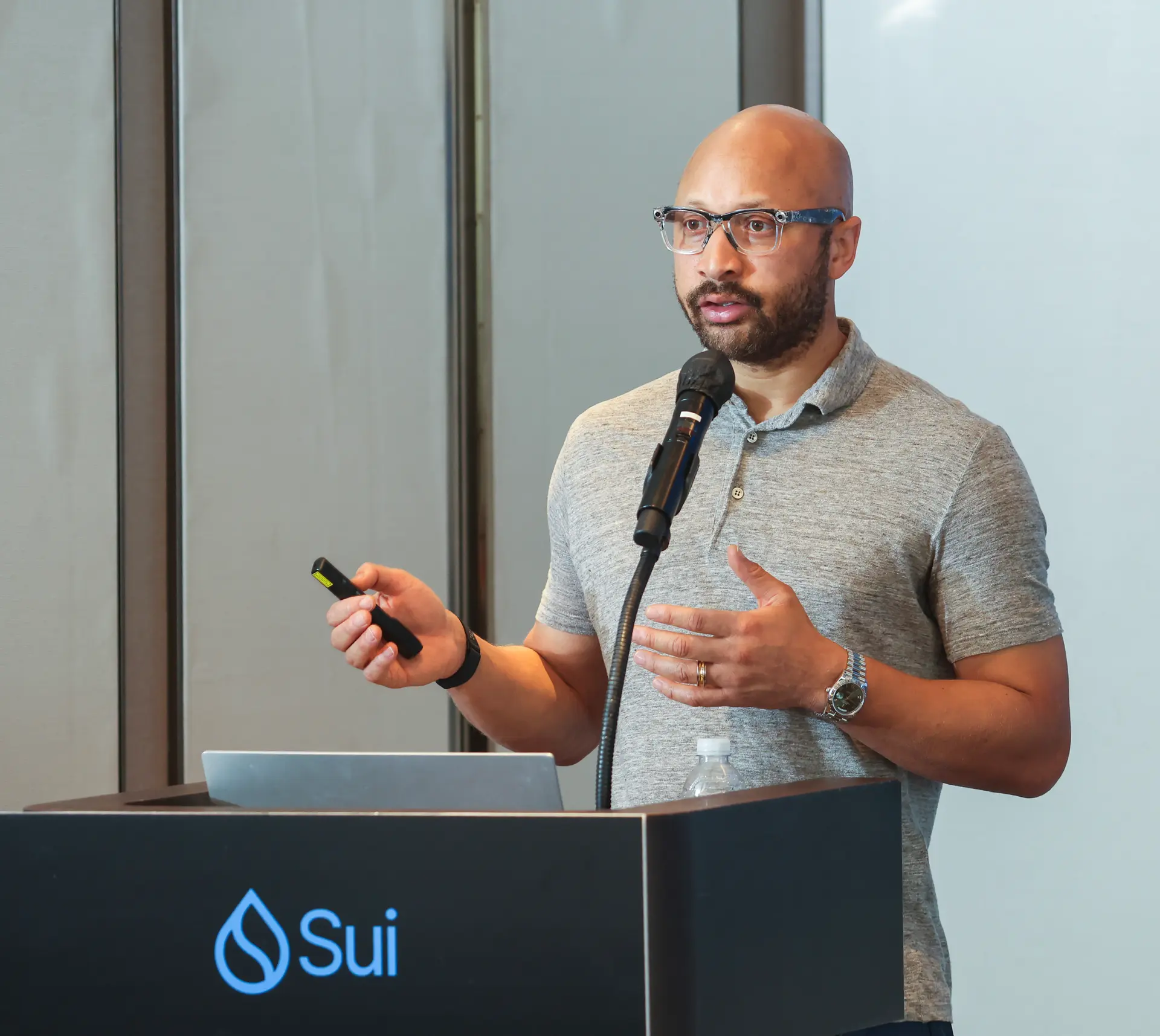
His ambitions have also become more specific. In 2026 he spoke about stablecoin transfers with little or no network fee, privacy for payment amounts and the possibility that software agents will transact on people’s behalf. The last idea invites a practical question: if an agent spends money, who authorized it, and how can anyone prove what it was allowed to do? Abiodun’s answer points toward systems where intent, permission and settlement can be checked. It is still a developing product area, with considerable work between a stage talk and the everyday experience he wants.
In September 2026, Sui announced that Daya was using the network for gasless stablecoin transfers for African businesses. Abiodun welcomed the integration as a way to make cross-border payments feel faster and less expensive. The geography matters to his story. He was born in Nigeria, grew up largely in Britain and built his later career in California. A payment crossing a border is familiar as a life event long before it becomes a technical diagram.
The same year, he joined a public conversation with Grayscale product executive Rayhaneh Sharif-Askary about financial products tied to Sui. It was another sign of how far the conversation had moved from a proposed payment network inside Meta. Now the questions include how institutions gain access, how ordinary businesses settle transactions, and how a person delegates limited authority to a piece of software. Those are very different audiences. They share a dislike of surprises. A payment should arrive, a permission should mean what it says, and the account behind an application should be understandable to the person using it. Abiodun’s long-running concern with product experience has a wider cast than it did in the Libra years.
A second route back to Nigeria
There is another bridge. In 2025, Abiodun and his wife Gloria announced a $1.3 million endowment to help aspiring software engineers in Nigeria pay for training. The plan involved a donation to the Inurere Foundation, administration by Meedl and a partnership with Semicolon’s Techpreneurship program. Training in Move, the language at the center of Sui, was part of the announcement. Abiodun pointed to high borrowing costs as one obstacle facing students who want technical skills.
The fund joins two versions of access that often get discussed separately. One is access to a payment or an application. The other is access to the education needed to build it. The first can be improved with a network and a good interface. The second requires money, institutions and time. Abiodun and Gloria’s announcement put a number on their commitment, while the longer test will be what opportunities the training creates for its students.
His own route was hardly straight: Nigeria to Scotland to London, astrophysics to electronics, oil fields to risk desks, a mining operation to a closely watched crypto project. There is no need to smooth those turns into destiny. Each gave him a closer view of what happens when technical systems meet real constraints: distance, risk, ownership, cost, trust.
At Mysten Labs he now works among colleagues whose specialties can sound remote from everyday life: compilers, cryptography, consensus. His question remains reassuringly plain. If all of that machinery works, what can a person do with it? The answer has changed from an oil-well reading to a payment or a digital object. The test has stayed close to the ground.